Pump It Up

Spurs painted pretty pictures with their passing all afternoon. Creative and beguiling, the movement and understanding had me purring with pleasure. No goals, though, and as the sun went behind the clouds an edge born of frustration crept into proceedings. Then a fine strike to settle matters, a deserved win for Tottenham. After exhibition pass and move from both sides, it came from a defender at a set piece. Of course it did.

Lovely stuff, it’s the way to play. Dembele was prominent in the centre, boosted by Sandro’s power behind him. Dempsey frequently came in from the left to find space across the line and worked hard to get back to do his share of defending. Walker joined the attack when he could. Swansea see possession and passing as a virtue too but we turned possession into opportunities on a regular basis. Defoe missed the best one, taking an extra touch when set up by Dembele. Walker’s thunderbolt from 30 yards mesmerised the keeper so completely, he was unable to move his arms but the ball struck him on the chest so hard, I could feel the impact on the Shelf. The buzz of amazement that went round the ground spared Gallas’s blushes as he lobbed a weak header goalwards immediately afterwards when well placed.

Otherwise, the final pass let us down as Swansea blocked shots and crosses from all angles. It was one of those games when we had many shots but the keeper made few saves because his defenders did all the work. Our chances were stillborn. For once I wanted Lennon to hold onto the ball for a shot as he weaved through the defenders – his passes were being blocked. In a passing game, his runs with the ball at his feet stood out and he made more almosts but not quites than any other man on the field.

That’s the trouble with Spurs, there’s almost so much of everything. The second half began with more of the same but the impetus gradually subsided. We’re good at passing, better at passing at a decent tempo but now Swansea sucked the life from our attacks. Adebayor had been told to buck his ideas up but Dempsey faded. In particular we slowed down in the final third, although credit to our opponents for having such an organised defence. We had to pump up the pace and effort at this point. Siggy had the right idea when he came on. Our Andre saw that an injection of pace and bounce was required. Neat through ball for JD too. Impact sub status beckons.

Being pushed so far back meant Swansea seldom threatened our goal. Michu was cut off from his midfield and could not outwit our high defensive line. Lloris was ever alert as sweeper but I can’t recall him making a save.

A pleasure to watch, it nevertheless had the air of high tea on the lawn, with the crusts cut off the cucumber sandwiches to boot. It’s a sign of how the message has reached the modern football fan when Swansea supporters fans applaud the way their team keep the ball in their own half. The players’ voices were as audible as those of a Sunday league game in the park. I can however report that Superjan’s excellent English extends to fluent swearing.

In a game of precision and caution, the manner of the goal was out of character. A set piece, a defensive error and the failed headed clearance fell to Vertonghen, but then pure class – a first-time half-volley into the bottom corner with his wrong foot.

These days I expect JD to put the chances away but he missed, to raise anxiety levels as the board announced 5 minutes of injury time. It was as if the ‘concede in the last ten minutes’ stat had flashed up on both jumbotrons and for good measure announced over the PA. In the one moment of genuine danger, Lloris punched clear bravely from the edge of the box. The resulting mayhem over whether we should have stopped playing as Michu lay prone on the turf obscured the fact that this was a match-winning intervention from a player who had virtually nothing else to do all game.

Those of you watching on TV had a better view of the incident itself than I did, with action going on at both ends of the pitch. I’m not one to condone violence, oh no. But the way manager and players rushed to defend Townsend, who rightly was playing to the whistle, is further evidence of team-spirit and togetherness.

To end, I’m indebted to the Guardian for Villas-Boas’s reflections on the late goals problem:

The players were losing concentration late in matches so he tried “stimulating concentration in the last part of training”. How did he do it? “By increasing the complexity of the tasks the players have been doing at the end of training,” he said. “The more complex the exercise, the more concentration they need at the end.” They went from Connect Four to Jenga to Sudoku. Only joking. But they closed out a 1-0 win over Swansea.

It’s the details that count.
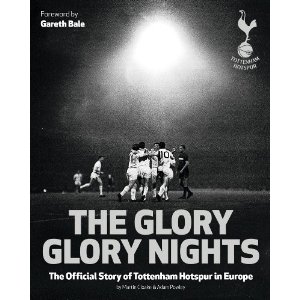
The Glory Glory Nights by Martin Cloake and Adam Powley

Order this book. As a Spurs fan, you must, or else drop so many hints to your loved ones that you wake up on Christmas morn to find ten coffee-table book sized parcels under the tree. Between now and then, listen to the radio, read the blogs, watch TV and make a note of how many callers and pundits say either that the Champions League is vital for financial survival or that finishing fourth defines success.

Then read the Glory Glory Nights. Take a quiet moment, all to yourself. Turn the pages slowly. Take in every detail of the photographs that cover every page. Read the text that describes the exploits of bygone times, of heroes whose time has passed but who will never be forgotten by those of us who ever seen the all-white strip with the proud cockerel.

Now close your eyes. Under lights, your world is spread before you. Nothing exists beyond the shimmering bright rim, not for 90 minutes at least.  Close your eyes and feel the chill in your lungs, the breath billowing steam from 50,000 pairs of lungs rising high into the dark north London sky. Feel the Lane shaking beneath your feet. This is what Europe means to Tottenham Hotspur. Glory. It’s what football means. Read and marvel at the glory of those european nights and anticipate nights to come.

This loving history takes its title from a book written in the mid 1980s and commissioned by Irving Scholar, which co-author Spurs blog 87Martin Cloake wryly describes as the best thing he ever did for the club. It keeps two key elements of the style too, the liberal use of photos and incorporating quotes and headlines from the following morning’s backpages, which gives a sense of time and place. As Martin says,  until comparatively recently fans relied on the papers for an account of the match because there was no other way of finding out what happened. Even the radio was confined to the bigger ties.
However, this is no mere revamp. It stands up in its own right as a tender tribute to a glorious past and brings out the enticing beauty and wonder of this entralling, all-consuming passion. The unobtrusive but insightful text sets the match reports, one for every single game, in context. Then, it allows the reader to explore the story for themselves as it unfolds. The images are stunning, chosen with care by Doug Cheeseman with an eye for the drama and passion the glory glory nights inspire. While the book rightly gives due regard to our modern successes, the black and white images are irresistibly evocative. Fans with rattles and cut-out cups gathering at the gates, players celebrating together and plenty of goals frozen in time. Mixed in is the surreal too; the Double team on an open-top bus with a man dressed as a clown clutching a stuffed monkey toy, Peters leading out the team past a row of giant Romanian urns in the tunnel or a man dressed as an ‘Aspurnaut’ parading round the pitch in the early 70s.

As a kid I had no doubt as to the meaning and significance of Spurs in Europe. My glory years began in the early seventies. We may have put 9 past Icelandic part-timers Keflavik but I knew I was part of a great tradition, the first British side to win a European trophy. Erratic and underachieving in the league (nothing changes…), play in all-white under the lights and we were transformed, a team that could beat any side in the competition. Frequently the glory glory lifted us to new heights, and to see Spurs win the UEFA Cup on our own ground not once but twice will live with me forever.

The book does my memories justice. There are extensive interviews with managers and players. In an age when we tend to think of players as primarily motivated by personal glory and vast wads of cash, it’s refreshing to see that they too bought into the myth. Europe was special to them and still is. The book avoids falling into the trap of becoming just a nostalgia-fest by giving due prominence to our remarkable Champions League run. Gareth Bale and Michael Dawson both fully recognise the magic of the Glory Glory Nights and were inspired by them. Make no mistake: those games away and home versus Inter or the astounding away victory at Milan rank up there with the best of the best.

European ties were magical affairs in far-off, mysterious places. It’s not that long ago, for example, when Spurs would kick-off not having seen their opponents play before. They had to think on their feet, changing tactics at half-time in order to cope with the unknown.  And Spurs were pioneers; the Cup-Winners Cup in 1963, the first to win two trophies, the first fans to fly abroad to watch their team. It tells the story of why Spurs and Europe have a special relationship, the tale of what it means to be a Spurs fan. Simply wonderful.

The Glory Glory Nights: The Official History of Tottenham Hotspur in Europe by Martin Cloake and Adam Powley published by Vision Sports. Click here for a special site to see inside the book

Look out for an interview with Martin Cloake, coming soon.

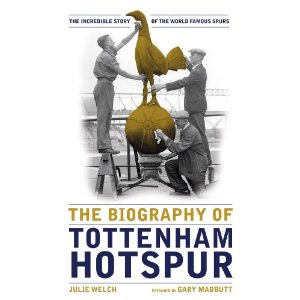
Review: The Biography of Tottenham Hotspur by Julie Welch

Why do we do it? The heartache and pain, the time, energy and money, the fury and frustration, all expended in support of a cause over which we have absolutely no control or influence whatsoever. Because we support Tottenham Hotspur. Read Julie Welch’s lovely, insightful and touching book and you will be inspired all over again.

More than just a history, The Biography of Tottenham Hotspur reaches into the heart and soul of the club. What marks out this club from most others is that it stands for something. Danny Blanchflower’s  famous statement that it’s not just about winning, it’s about glory and doing it in style, isn’t mere aspiration but articulates explicitly a culture and identity that dates back to the origins of the club in the 1880s on Tottenham Marshes.

For Tottenham Hotspur, it has to be good football, creativity and innovation. The Spurs Way is the right way. The pass and move approach lauded at Barcelona brought Spurs a league title in 1951 when Arthur Rowe called it ‘push and run’.Back in the early 1920s another great manager Peter McWilliam defined his tactics in exactly the same way. The mixture of flamboyance and exasperation, the sublime and the erratic that is familiar to readers of this blog would be instantly recognisable to Spurs fans of past generations.

As befits a biography, the book describes the club’s history while allowing the character to unfold and open up. Like Spurs, the Spurs blog 86writing is easy on the eye and draws you in. This is no dull history textbook. Rather, Julie is a storyteller, engaging and curious. She communicates her passion without allowing her voice to intrude or detract from the telling of the tale. It’s a measure of her skill and dexterity that she makes the journey from Tottenham Hale through the industrial landscape that covers the old marshes to our first pitch sound enthralling. And she’s not averse to the occasional gratuitous dig at our rivals: after all, she is a lifelong fan.

She freshens familiar tales such as the success of the Double side, the Nicholson era or the sordid conspiracies that brought the Gunners from Woolwich to north London, and by placing them in the broader context of the club’s culture and origins, enables the reader to look anew at more recent events that we’ve lived through. It kind of sneaks up on you, involving you in the story then in a couple of killer sentences nails its wider significance like a fine historian should. Be warned – set aside some time when you first open the covers because you’ll want to keep the pages turning, just to see what happens next.

Not all of which makes for pleasant reading. The late eighties onwards was a sobering read. Gross, Graham and Francis, and the inglorious reigns of Spurs idols Ossie Ardiles and Glenn Hoddle, goodness me how dispiriting they were, but as the current side teeters on the brink of new glory or yet another near-miss, it brings a vital sense of proportion. Being a fan isn’t about instant gratification. Read it and I defy you to rant on about the all-consuming Champions League.

Nothing really changes. Around the turn of the century the club was run by two dynasties of Jewish businessmen. ‘Up and coming club taken over by wealthy businessman in order to enhance his prestige. Club moves ground’ – 1890s or early 21st Century? ‘Club buys Scots, leads to great team’ – 1890s or 1950s? ‘Finances restricted by ground improvements, team slumps only to be rescued by a saviour who changes fortunes totally’ – that’s just page 58.

This is an enduring love affair. For better or worse. In any long-term relationship, there’s some give and take, although I suspect we supporters have put more into the relationship than the club has given back over the years. Through the anger and disappointment,  having been let down so many times, it’s worth it because when she touches me, nothing else matters. It’s a passion that makes us swoon and shake with unbridled joy, an experience like no other. Share that with thousands of others at the Lane and these are the unforgettable moments that make life worth living.

By the time you reach the end of the Biography, you feel closer than ever before to the club.  You will know more about the club and about yourself. About why you do those crazy things to watch a football team. About what it means to be a Spurs fan – about flowing football, pleasing the fans, about good football. About what it means to be you.

Look out for an interview with the author Julie Welch, coming soon.

The Biography of Tottenham Hotspur by Julie Welch is published by Vision Sports

Not Another Typical Spurs Defeat

The case for the prosecution: another negative set of substitutions in the final quarter by Villas-Boas presented the initiative to Everton at the very point when their efforts to equalise were floundering. Anyway, Spurs always snatch defeat from the jaws of victory. Part of the DNA.

The case for the defence: the substitutions gave us fresh legs in midfield. One change was unavoidable – the excellent Dembele, arguably our best player on the day, had a leg injury and had to come off. Sigurdsson’s arrival gave extra protection against Everton’s dynamic left-side duo of Pienaar and Baines. Anyway, the time Everton looked least like scoring was in the final 15 minutes.

The jury’s out, although put it to the popular vote on twitter and the boards and the prosecution not only proved their case beyond reasonable doubt, they could have called for the black cap. For me, this was not quite the usual Spurs capitulation that sadly is all too familiar, because in the final quarter we were defending well. I genuinely did not think Everton would score. Not like me at all. I can spot danger in the twitch of the opposing goalkeeper’s nose, never mind when they actually get hold of the ball in our half. That will teach me.

For much of the game, this was a contest between systems. Two well-drilled teams fought for supremacy. Both like to counter-attack so there were periods where nothing of significance took place as they waited for the other to take the initiative before decided how to counter punch. Everton had the best chances but as time passed, we held our shape better and gradually got on top, albeit without posing a concerted threat to their goal.

Everton’s attacks were met with clusters of defenders. The imbalance on our left caused by Bale’s absence created a few problems, but late in the first half, cue first Dempsey then Defoe dashing deep to defend. Come the second, we were able to release Demps from his defensive duties. He popped up in central areas on several occasions, most notably when his good shot caught a deflection and sailed over Howard’s head.

Suddenly our approach looked even better. Needlessly we gave the ball away – Tom Hud I’m looking at you – but otherwise we looked assured. We kept our shape, worked hard, blocked passionately. In the last ten minutes Siggy hit the bar and Vertonghen could not quite deliver a final ball with the same quality to match the move that set him up, a superb passage of play where the ball flowed from our box to theirs. Siggy sprinted from right midfield to the left edge of their box, then hurtled back again before Howard could clear.

The defence calls David Moyes to the stand: “We had tried everything,” said Moyes. “We put Baines out wide, Pienaar through the middle and those final 10 minutes were probably the poorest part of our play.”

To me, that augers well for the future. Well-organised under pressure is a sentence that I have seldom typed in the 4 years of this blog, at least in respect of Spurs. As for the substitutions, I’m not keen on too much tinkering when we are ahead but Dembele had a knock and Siggy played well. Falque is an attacking player so we tried to maintain the initiative rather than sit back. However, the prosecution points out that Hud is a master at sitting back and I would have removed Adebayor, who had a poor game, rather than Defoe and Lennon.

Never mind the systems and tactics. In the end we were undone by human error. Lloris called for an innocuous ball into the box so loudly that even my crackly stream picked it up. The only person who didn’t hear was the one who mattered most. For the second time in three weeks, Caulker chose to disobey.

He’s been well-taught. I suspect he’s paid attention to defender’s rule number one – when in doubt, kick it out. The fact he takes responsibility will serve him well in the future but it was this individual error rather than a catastrophic collapse that turned the game.  It gave Everton possession, we failed to track Pienaar’s run and were left to ponder ruefully on about how much Villas-Boas could have brought out of Redknapp’s reject. Another ball, played in front of our centre-half so he could not challenge without risk of a penalty, a fortunate touch on and a well-taken winner.

Everton had the best of the opening quarter but the only stream I could find made everything look slow and uncoordinated. Or perhaps it was fine and that was just when Tom Hud came on. Anyway, the radio was excitedly extolling Everton’s virtues. For those of you who saw that bit, fill in your own paragraph:


Found something good after about 20 minutes, although as it buffered I thought I must be watching a replay from past glories  – Spurs in white shirts and navy blue shorts. The radio commentators were right. Everton finished the half on top but we held out under intense pressure, partly thanks to sterling blocking by Sandro and Caulker but also partly because Osman’s aim was skeewhiff on the day. Lloris’ “tackle” at the edge of the box was masterly.

You’ve seen the stats: Spurs have conceded 10 goals this season in the final 15 minutes of matches, and if matches finished at 80 minutes, we’d be top of the table. There’s a problem there. Could be tiredness – in my last piece I felt that overall, the Europa League has been a help not a hinderance because it’s assisted team-building but it could be a factor, as Essexian has pointed out. Without minimising the problem, this wasn’t a typical defeat. Keep our shape like that and we will succeed more often than we fail. Sequences are significant, not individual results. Between now and New Year’s Day we play Swansea, Stoke and Reading at home, Villa and Sunderland away. Let’s see what this frustrating defeat means in that context. I read another (unconfirmed) stat on twitter that said we had the same number of points at this stage last year. If that’s true, who knows – we could be ahead of ourselves come 2013.