Paul Gascoigne and the Ultimate Taboo

Gazza on my mind this week. No real reason. A home tie to take us to Wembley, can’t complain about the semi-final draw and Liverpool’s ability to find a banana skin more often than Charlie Chaplin have all contributed to a sense of ease and relaxation. So the mind wanders back to past glories, and in modern times there are few more glorious than Paul Gascoigne. And as is the way with these things, I’ve not been looking but Gazza has found me, with a great story from Daveyboy in the comments section of my last article, Morris Keston gives him a mention on twitter and then there he is in the book I’m reading.
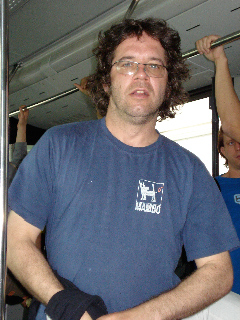
A Man Who Looks Like Danny Baker. From the Site http://menwholooklikedannybaker.com. You Couldn't Make It Up

I’ve been a big fan of Danny Baker for many years. Not quite in the league of Kennedy’s assassination or Princess Di’s death but I vividly recall the first time I heard his radio show. On a bleary eyed Saturday morning, making breakfast for the kids, wife at work and no chance of football, the mindless banality of Capital Radio would provide scant diversion from the drudgery of breakfast and the washing up, but it was the best I could come up with. Turning the dial, Robert Cray’s upbeat blues ‘Smoking Gun’ ripped from the radio and I hung around to see who on earth was playing this stuff. From then I’ve followed the fabulous Baker boy around the airwaves. Many times I’ve had to pull over because I’ve been laughing so much but his sense of the absurd and relaxed freeflowing presentation masks an effortless mastery of the medium of radio. Now he’s back at 606, a show he originated and was then dismissed from because he not entirely seriously suggested that aggrieved fans may wish to beat a path to the door of a certain referee. In reality this was the excuse because it was clear his face didn’t fit – on 606 he wanted to talk about things other than Fergie’s latest press conference or whether that was a penalty after 37 replays. Like things you had confiscated at the turnstiles or unusual places to play football.

His knockabout style and apparent lack of a coherent career plan (at BBC London he works on a handshake rather than a contract) hides his status as an insightful and shrewd observer of popular culture, especially football and pop music. His 2 hours on BBC London on the day after Michael Jackson’s death, where without a script he reminiscenced around his time in LA before, during and after his NME interview with Jackson back in the 80s, the last major independent interview with him, was touching, funny and honest, and said more about Jackson than the sum of all the tosh that overwhelmed the media for weeks after.

His latest book  Baker and Kelly – Classic Football Debates, written with Paxton Road stalwart Danny Kelly, was certain to find its way into my Christmas stocking. Someone would put two and two together as they wandered round the bookshop ten minutes before closing on December 24th, when Waterstones is jam packed with desperate punters scooping up any offering that possessed a connection with loved ones for whom they could not think of anything that they would really want. It’s a bit like the aunt who every year gives you the latest Westlife album, because one Saturday round at hers, squirming with embarrassment at Celebrity Idol Factor on Ice, your morale squashed as flat as a Kraft cheese slice run over by a steamroller, you thought it would keep everyone happy by saying that parts of the chorus were ‘quite nice’. Quite nice. How inoffensive and non-committal is that. It implies that your nervous system was closed down totally save for a pulse sufficient to lift one eyelash a fraction of a millimetre. But to your aunt, it indicates undying appreciation of their irish might, to be rewarded each and every Christmas with their latest offering.

The only question with the Baker and Kelly book was not if I would receive one but how many. In the event, it was only a single copy (but four THFC 2010 calendars….). It’s a largely disappointing effort, an erratic mix of funny anecdotes, rehashed phone-in material that does not translate well to the page and fillers, all of which stinks of money for old rope. Even the print is spread wide apart so as to reach the end of the 300 pages without undue effort. But there are several gems, one of which is an eye-witness account of Gazza’s infamous spree in London. Stuck in traffic, Gazza cannot sit still so he jumps out the cab and commandeers a London bus, complete with passengers, which he then drives round the Marble Arch roundabout. Leaping out, he spots some workmen and while he cadges a fag, digs a hole in the road with a pneumatic drill. Baker and friend Chris Evans look on as he reaches their destination, a media awards ceremony to which he had not been invited, via a Bentley that he flagged down at the lights – the elderly couple in the back were only too glad to help. This was front page news at the time, with Gazza and his drinking pals both celebrated and simultaneously castigated by the tabloids in the ways that only they know.

Baker maintains that they were not drunk but the redtops were determined to imply otherwise. The bottles in the photo (not from the book) are water but that’s
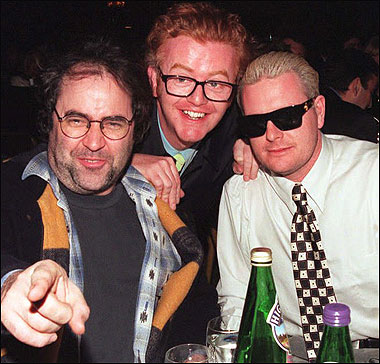
Baker, Evans and a Mystery Man in Disguise

not the story that the tabs want. But the most touching element of this story is the public’s reaction to Gazza – everybody loved him. People from different backgrounds felt good just to see him. They cheered him wherever he went, went along with his fun (and it was all fun to him) and he made them feel better. Everyone felt they knew him, sharing jokes, shouting hallo, wishing him well. For his part, he could talk to anyone and stopped to give them all the time of day. No PR, no manufactured celebrity status, just Gazza.

Gascoigne was loved by the people, genuinely and unashamedly so, in a manner that may never be repeated. Pre-Sky, this was a time when players were not so tainted by their riches as they are now, separated and aloof from their fans. If Rooney wins us the World Cup, he would  not be able to set foot outside the front door without a phalanx of bodyguards and PR people, and the sad thing is, he may not wish to.

Baker’s affectionate tribute to his friend opens our eyes to one side of his personality but obscures another, the demons that have driven him to the bottom of the deepest abyss. He touches upon the reasons driving Gascoigne on, his restlessness, the need to fight off a boredom that would engulf him when, finally, there were no more highs to sustain him: “The brighter his star shone the more its inevitable collapse into a black hole haunted him.”

It’s a powerful image of impending doom touching even the most exciting crazy moments but it does not look the real problem in the face: Paul Gascoigne suffers from a serious mental health problem. This is not criticism of the man, how can it be, it’s an illness, nor does it belittle any of his achievements on the pitch. If anything it makes them even more miraculous, given that they were performed under such duress. Gascoigne according to his autobiography was a restless, distracted and hyperactive child whose obsessive behaviour was under control but manifested itself later in life as the pressure eroded his coping mechanisms. He saw a therapist of some sort once as a child but never returned. Baker remarks on how Gazza was constantly talking and narrating his day, reminding himself of what was happening to him as a  means of calming himself down.
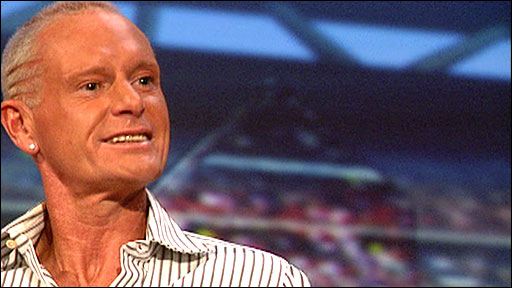
Gascoigne MOTD2, 2009, in Optimistic Mood

Later, when football no longer sustained him, the drinking, depression and self-abuse took hold. The week long drinking binges by messrs Baker, Evans and Gascoigne are a myth, says Danny, and the London escapade ended with Gazza on Baker’s sofa, chatting with the family as they watched TV. However, he was supposed to be in his log cabin in the remote Scottish hills, which was the bolt hole and place of safety that his manager at the time, Walter Smith, had sorted out. Now we see a pallid and broken man, going through the motions and blank behind the eyes, struggling to rehabilitate himself.

Danny Baker has written an eloquent and insightful piece about the Gazza he knows, which says so much about the man and yet skirts round the one unmentionable in modern football. Sex, alcohol, drugs and infidelity are all open to debate, but one subject remains taboo: mental health. We can’t talk about it. The man suffers, yet he’s given offers to manage a football team or to get back into coaching, or to be a TV celebrity. I heard a rumour that he was going into Celebrity Big Brother and I swear I would have chucked in my job and set up a protest camp outside the studios. We fear mental health problems but they are just that, health problems. Let’s have some honesty about the pressures of modern football and talk more openly about their effect on vulnerable people.  Show compassion to sufferers and offer sympathy and treatment. Above all, give them realism – don’t ask too much. The people around Gazza need to look after him.  Gazza made us happy, now let’s care for him. A true Tottenham great, we owe him.

Add to: Facebook | Digg | Del.icio.us | Stumbleupon | Reddit | Blinklist | Twitter | Technorati | Furl | Newsvine
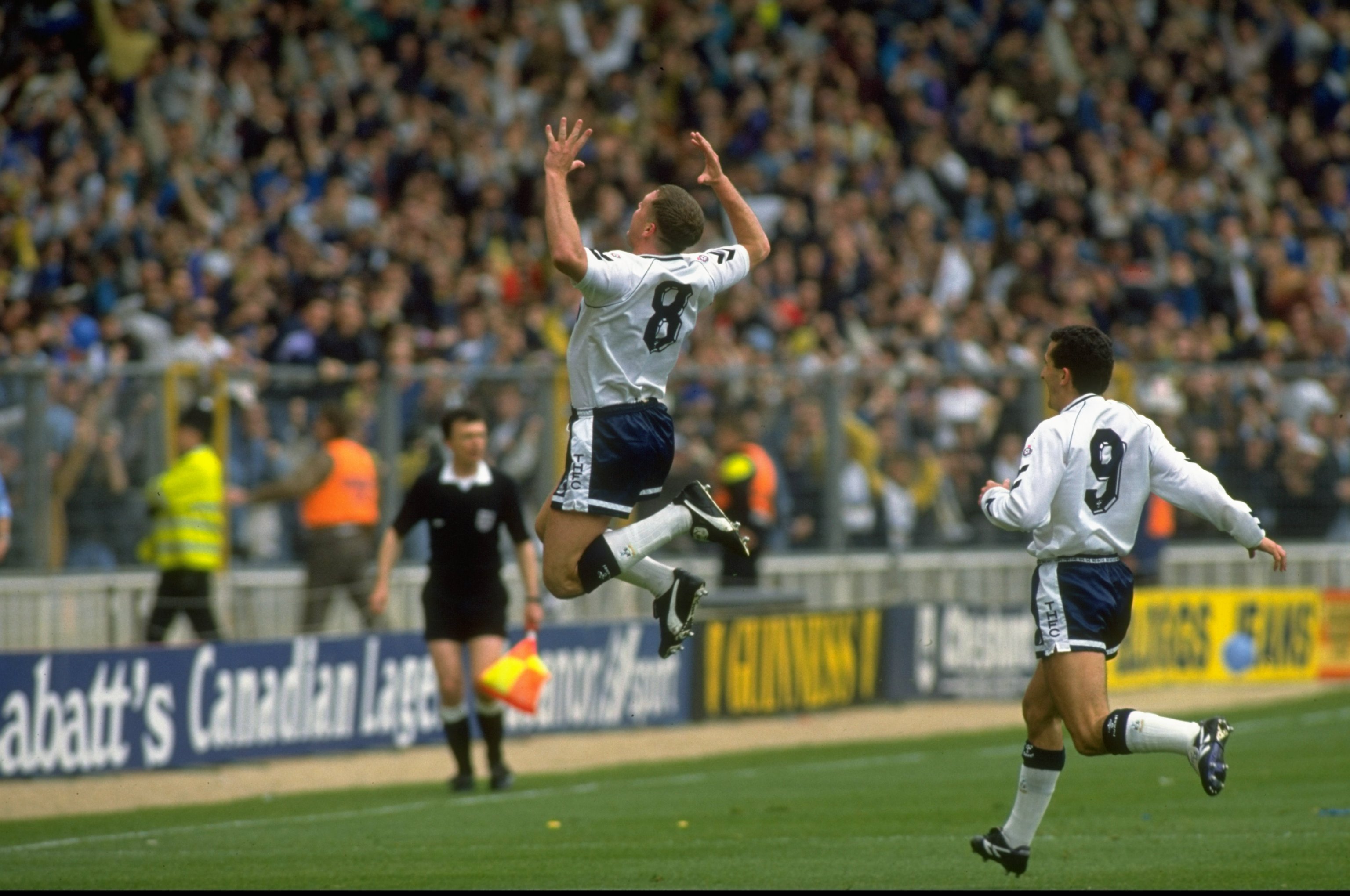
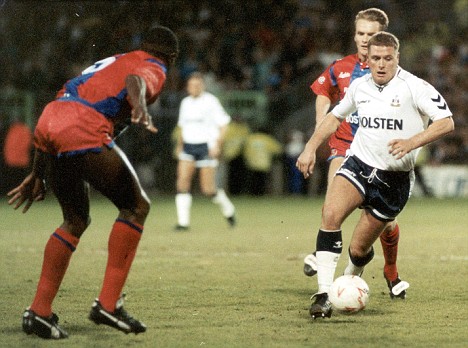
Paul Gascoigne – A True Tottenham Great

This profile of one of the finest players ever to grace the navy blue and white appeared first on http://www.sporting-heroes.net, an excellent source of pictures and information about Spurs, football and sport. Later this week, more reflections on Gazza the man.

Paul Gascoigne played football. That’s how Spurs fans know and love him. Not the World Cup tears, the media victim, the maddeningly infantile mischief, or the washed up celebrity. Forget that, because Gascoigne was simply the finest, most exhilarating talent of his generation with the capacity to astound and captivate by virtue of his sheer brilliance.

For three precious seasons, nothing else mattered. Gascoigne was a genuine rarity – a midfielder who really could do everything. When fully fit, which sadly was not consistently the case, he roamed midfield for 90 minutes, strong, alert, vigilant. Sublime passing allied with the vision to match provided rich pickings for attackers; first Waddle then Lineker prospered on a ready supply delivered with pinpoint accuracy.

In the area he snaffled chances with predatory instinct, but more frequently goals came from shots with pace and precision from around the edge or just inside the box. Free kicks were a speciality; walls were no obstacle, beaten either by power or by curling the ball in a graceful arc into the top corner.

The truly gifted stand out by their mastery of a distinctive skill, an exclusive, individual gift. Gascoigne’s was running with the ball at his feet. This was more than mere dribbling, although he could hold it close and weave a pathway through the tightest defence, both feet in total mastery of the ball. At other times, he would just collect the ball and run, characteristic 30 yard surges towards the opponent’s goal, elbows out for balance and protection, chest puffed out. Some defenders would be outwitted by ball-skill, others simply fell away as he breezed past. Then, as he approached the box he would disappear into a cluster of opponents, inexorably drawn to him, as were the eyes of every spectator, only to emerge from these seemingly insurmountable odds with the ball at his feet.

This precocious talent was already a regular for the Newcastle first team and England under-21s by the time Tottenham’s interest intensified after he scored both goals against Spurs in a 2-0 victory in January 1988, a performance the Spurs manager Terry Venables described as one of the best he had ever seen by one so young. As the season came to an end, a lacklustre Gascoigne felt unwanted by the club who had nurtured him since boyhood and as other clubs dithered Tottenham were quick to pounce, the £2.2 million fee a new club record.

Gascoigne’s talent amazed even the harshest judges of all, his fellow professionals. During his first training game at Spurs, he picked up the ball, beat 8 players and smashed the ball into the roof of the net. Everyone stood and applauded. His manager said that to see him play like that made the hairs on the back of your neck stand up.

In the years that followed, he would come to inspire his team-mates to greater heights, but the effects took time to emerge. His much anticipated debut was delayed for a week as over-running building works at White Hart Lane caused the opening game against Coventry to be postponed, so his opener was away to Newcastle, a 2-2 draw. The home fans were less than enthusiastic about his return. He dodged flying Mars Bars whenever he approached the touchlines, a better day for local sweetshops than Gazza, perhaps.

Gascoigne received a much warmer welcome in his first home game against arch rivals Arsenal, without delay endearing himself to the crowd with a cheeky goal. Controlling a through ball from Waddle, he lost his boot as he entered the penalty area but still managed to round the keeper and score with his stockinged right foot. However, that match was lost 3-2 and Spurs struggled to find momentum. With two points deducted because of the Coventry postponement and only a single league victory, they were bottom in the first week of November. Gazza’s career was faring better, however. His individual performances were garnering rave reviews and he made his England debut in September, coming on as a substitute against Denmark.

His next goal, a curling free kick against QPR at the end of November, inspired a comeback, Spurs drawing 2-2 after being two down at half-time. This humble point signalled a gradual upswing in fortune. One defeat in December plus the two points restored saw Spurs end the month in the safety of 9th position. Gascoigne’s free kicks were fast becoming his trademark; another swirled into the top corner against Millwall. Any significant momentum dissipated early in the New Year on a muddy Bradford pitch as Spurs went out of the cup in the 3rd round. Another trademark, the roll of midriff fat, had by now disappeared and the young man’s eye-catching individual brilliance brightened months of mid-table mediocrity. Against Norwich in February he rounded the keeper to score the first in a 2-1 victory. March saw another free-kick fly over the wall to net another three points, followed by a solo effort away to Luton. Five wins in the last seven games propelled Spurs to a final position of 6th.

Paul Gascoigne began the 1989/90 season in fine form, matched by his goalscoring. His first came in late August away to Manchester City, followed by further goals at home to Chelsea and a rebound off the post away to Norwich. The admiration earned by his growing contribution to Tottenham’s flowing football was not, however, matched by results. The defence was leaking too many goals and Spurs were one off the bottom after 6 matches, with just the opening day 2-1 success against Luton Town to show in the win column. In October Gascoigne scored in a strong 3-1 win at Charlton (his fourth goal in six league games), a characteristically direct, surging run carrying the ball from midfield, into the box, throw in two or three short strides for balance then stroked past the keeper. In similar fashion three weeks later he powered through the Southampton defence, this time finishing by taking the ball around goalkeeper Tim Flowers.

His League Cup goal against Tranmere at the end of the month proved to be his last until late April, but as the goals dried up his influence soared, for in the shape of Gary Lineker, signed in the close season from Barcelona, he now had a foil perfectly suited to exploiting his talents to the full. Not only was this supreme goal-poacher the grateful beneficiary of the full range of Gascoigne’s passing, Lineker’s movement created space for himself and for his team-mates. If he drifted wide, Paul could drive into the space. As defenders clustered around, Lineker then inserted himself into the resulting gaps. Often totally by-passing their colleagues, the understanding that lead to 26 league and cup goals for Lineker appeared remarkably prescient but the reality was more prosaic, based as it was on a system of signals. Lineker’s nod and short run towards the opponents’ goal was in fact a dummy and Gascoigne would knock the ball short, while a spinning finger gesture mimicked the striker’s spin away from his marker in pursuit of a longer ball into space behind the defence. No matter: 8 wins in the last 10 games, crowned by a memorable first half display against Manchester United when Gascoigne scored and made the other for Lineker, achieved a final league position of 3rd.

Given his head in Italia ’90, Gazza returned as the nation’s favourite son and he began the season in high spirits with a series of ebullient performances and goals to match. He scored in the opening day victory against Manchester City and against Derby he single-handedly won the game with a hat-trick, two of which were classic free kicks, from a virtually identical spot thirty yards out, differing only in that one went to Shilton’s left, the other to his right. Both were simply unstoppable, as, apparently, was Gascoigne himself, irrepressible and mesmerising in a series of dynamic displays. Hartlepool at home in the League Cup was hardly on a par with Germany, but he destroyed the visitors, scoring four in a 5-0 victory. In later rounds he notched the winner against Bradford and another versus Sheffield Utd as Spurs reached the 5th round of that competition.

After a barren spell he scored twice in December in two away defeats to Chelsea and Manchester City, his last in the League. As his powers waned, so did Tottenham’s fortunes. They fell away after a steady start, winning only two League matches in 1991 and limping home a disappointing 11th.

But his greatest impact, not merely in this season but in his Tottenham career, came in the FA Cup. After a solid away win at Blackpool in the third round, Gascoigne delivered two scintillating performances, scoring twice against Oxford, including a stunning individual effort, and again at Portsmouth in the next round, the winner coming from a long ball, a shimmy then an unstoppable left footer from the edge of the area. In round 5, at home to Notts County, he atoned for an early error with a memorable display that lifted the lifted the team, culminating in a late winner after it seemed that intense Spurs’ pressure would come to nothing.

This was Gascoigne at his finest, inspired to hitherto unknown heights by the magic of the Cup, but it is the unselfconscious energy, bravado and joy of his game that lingers in the memory. One reason perhaps why the fans loved him, because he would respond to their sense of occasion, not with trepidation but as the key to unlock his true, almost limitless potential.

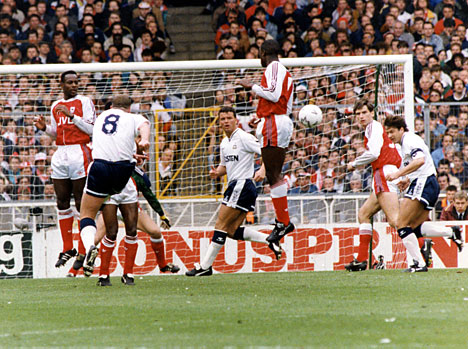
Yet unbeknown to his adoring public, all the while he had been carrying a hernia injury. Injections could no longer postpone the inevitable operation. Tension mounted as Spurs approached the semi-final, no ordinary game even in their illustrious history, for this was the first such match against bitter rivals Arsenal and the first ever semi-final to take place at Wembley. Gascoigne struggled back, his only preparation was half a game in a league defeat away to Norwich; he was substituted. His fitness was confirmed only hours before kick-off but Paul, roused not deterred by such drama, did not hold back. An early free kick, thirty yards out, struck with sweet certainty into the top corner, improbable, miraculous, glorious, the fan behind this author still bitterly castigating Gascoigne for his ridiculous nerve to shoot from that distance even as the ball furled the net.

Gazza leapt in the air with unconfined joy. He set up Lineker for the second and played a full role in a 3-1 victory that many Spurs fans still prize as the most memorable performance of the modern era.

By the day of the Final against Nottingham Forest, the drama had been cranked to fever pitch. As ever at Tottenham, turbulence off the pitch proved the catalyst for the theatre that was to follow on it. Rescue from crippling debt was possible only by selling its prize asset. Gascoigne went into the game knowing that it was to be his last for the club, an £8.5m fee having been agreed with Lazio. He started frantically, but this time the burden of expectation proved too great. An utterly reckless early challenge on Garry Parker went unpunished but signalled danger ahead. Later the referee reflected that had he been booked then, he may have calmed down. As it was, a few minutes later another dangerous high lunge at the edge of the box left Gazza and full-back Gary Charles in a heap. After treatment, Paul rose gingerly to his feet, only to see Stuart Pearce score from the resulting free kick.

Lucky not to be sent off, Gascoigne departed instead on a stretcher, an ignominious end to his Tottenham career, although Spurs went on to a 2-1 triumph after extra time. His victorious team-mates joined him at his hospital bed for the celebrations. The resulting injury meant a year out of the game, with the transfer to Lazio eventually going ahead, for a reduced fee of £5.5m. Although he was relatively successful in Italy, where he remains extremely popular with the Lazio fans, he never quite regained the excellence of his best Tottenham performances. For Spurs fans of a certain generation, Paul is but one thing, a true great who graced their colours with moments of genius. It was an honour and a privilege to watch him play.

Add to: Facebook | Digg | Del.icio.us | Stumbleupon | Reddit | Blinklist | Twitter | Technorati | Furl | Newsvine
A Weekend Off and Postponements of Yore

We looked good on Sunday, in my imagination at least. It felt like a good time to play them. Liverpool are formidable opponents but we have the talent to take them on plus invaluable momentum, whereas they are stuttering and uncertain. With the rearranged date likely to be at the end of March/early April, they may be mired in a Europa cup campaign but this is less about their problems and much more about the positives of our good form. I was burning to see how we faced up to the test of chasing a top place, away at Anfield.

Despite our preoccupation with the weather, trust the Brits to get the forecast wrong. The news was full of dire warnings about travel but ironically Sunday’s weather was better than expected. I spent the day whizzing around roads in the south-east that my radio was telling me were virtually impassable but it’s better that the match is postponed on the basis of the balance of probabilities than have those late postponements when loyal fans travel hundreds of miles only to find at 2.59pm on a Saturday that the game’s off.

On Saturday 5Live interviewed a senior partner from a large law firm (a proper one, not http://www.chasingambulances.com or ‘Whayhey You’re Hurt! PLC’) about personal safety and the liability issue. He said that basically it is indeed up to the individual whether or not they choose to attend a football match (or go shopping), that it is the individual’s responsibility to stay safe and that a club would not be liable if someone fell over outside the ground. Inside the ground, the club would be covered too, provided that they had stuck to the safety rules, but this was not an issue yesterday as the stadium was OK.

So this is about a police decision on crowd and public safety. They have to consider the worst scenario, e.g. someone in the crowd falls, others slip around them, pressure from people behind who don’t realise there is a problem….

There’s also the traffic issue – many of the problems on the roads in this cold spell have been caused by accidents that block the road. One of those on a busy route and thousands are stacked up behind.

In the end, this is little to do with a so-called PC approach to personal safety and everything to do with our total unpreparedness for bad weather. It’s also a function of our lousy transport system, where normal roads and public transport have to cope every two weeks or so with massive crowds.

In years gone by, postponements were a more common feature of watching Spurs not because of the travel arrangements but because of the state of our pitch, which for a few years was a notorious quagmire, cutting up in wet weather like a country field after the village ploughing competition. This is the real reason why the Perrymans and Pratts of the midfield had to roll up their sleeves and run forever, just to stay above the surface.

Walking down a wet High Road for a match in the seventies, which I’m sure was in fact against Liverpool, I reached the old Whitbread brewery before a few stragglers coming in the opposite direction suggested the match was off. But I had to press on and find out for myself, just to check. It was about 1.30pm, so not many there but still there was no official sign. Eventually enough people seemed to have the same message but I circled the entire ground in an adolescent fug of paranoia. The thought of leaving the ground and then reaching Ealing Broadway only to hear the half-tine score required detailed personal investigation in order to rule out this frankly far-fetched possibility.

Also around that time, although I confess that far back is a bit of a blur sometimes, a home fixture against Sheffield Wednesday at a fog-bound Lane was saved by issuing pass-out vouchers at the turnstile. The gates stayed shut until quite close to kick-off, then as we went through the vouchers entitled us to re-admission for the rearranged game, should today be called off if visibility worsened. I read afterwards that this saved the mach, which was completed, because otherwise the referee would have erred on the side of caution and called it off.

The only other time that I actually set off for a game that was then postponed was at the beginning of 1988-9, when the opening fixture against Coventry was called off at about 1pm because building work in the East Stand had not been completed in time for a safety certificate to be issued. This was a major cock-up and highly embarrassing: a top division team not having a safety certificate when it had all summer to finish the building. In the event we were fined three points, if memory serves, and although they were eventually reinstated, Venables’ team got off to a poor start and we were down the bottom in October, only to gradually pull round.

Finally, one game that did take place in the snow was in February 1969 versus Leeds. My mother had promised to take me but we had to wait until almost 1pm before the club confirmed it was on. No media information assault in those days. We kept ringing (turning the dial on the old phones, that’s why it’s called a dialling tone, kids) until the voice dispensed with all pleasantaries, said the magic words, “It’s on” and off we went on the 207.

The pitch was covered in snow, with the lines brushed clear, and the pitch was rock hard. Over forty thousand saw a 1-1 draw, the crowd swollen by neutrals attracted to the only top division match on in London that afternoon. It’s small details like that which highlight how much the nature of football has changed. It’s inconceivable in these tribal days where ludicrously expensive seats have to be booked months in advance that large numbers of fans would make the effort to watch another team play, just for the pleasure of seeing a game.

If You Know Your History – Spurs Players Score Four and I Was There (Mostly)

One of the good things about not having a crowded fixture list this season is that when we win, there’s more time to bask in the warm nourishing glow of victory. It’s a great feeling, something which Spurs fans have frankly not been accustomed to over the years. The reservations expressed in my match report about tactical weaknesses somehow ebb away, at least until Matty Taylor bangs one in from 30 yards against the run of play on Saturday, and thoughts turn to past glories.

Meticulous post-match historical research (chatting in the car on the North Circular on the way home) came up with 3 other occasions within the forty year timespan of my support for our beloved Spurs when an individual Tottenham player has scored four: Martin Peters away to Manchester United, Colin Lee in the famous 9-0 versus Bristol Rovers and Jurgen Klinsmann away to Wimbledon. Ironically we forgot the one previous occasion when all three of us had been present, Berbatov’s four against Reading in a mad 6-4 win.

I was present for four of the games, Wimbledon away preventing my nap hand. One thing they all had in common was that they were not exceptional matches. It’s the feat of four that remains in the memory, not the quality of the performance or, particularly, of the goals themselves. Against Burnley we did well, exceptionally so in patches, but we’ve played better and lost.

I saw Peters score all four goals in a 4-1 win in 1972 from the enclosure at Old Trafford. Many clubs had a standing area running the length of the pitch, like the one in the old West Stand at White Hart Lane, the space now occupied by the West Stand Lower seats. In those days you could stand there in safety at away grounds, getting a bit of stick but nothing serious. Liverpool, Old Trafford, Derby, even Highbury and, to truly demonstrate how times have changed, Upton Park, where in the early 70s I and other clusters of Spurs fans openly celebrated a 2-1 victory and lived to tell the tale. Then as now I preferred the view from down the side but also it represented a refuge from the increasing violence in the home and away ends. I watched the hoolies get stuck in from a safe distance.

We were three up well before half time but the only goal I can recall is the fourth, a header at the Stretford end I think. Peters was famed for ‘ghosting in’, in fact a simple manoeuvre that we now expect as routine from midfielders, coming late into the box, and he rose unchallenged to score. I vividly remember the total silence; the ground was stunned. On MOTD you could hear a solitary person applauding. It was me, stood near the cameras.

The 9-0 against Bristol Rovers was another odd one. We expected to do well in what was then the Second Division but this stroll was so easy it was unreal. Basically, everything worked. Again I don’t recollect any stunning football to break Rovers down, merely a succession of crosses converted by Colin Lee on his debut, plus three from Ian Moores. Two men less likely to score seven between them have seldom appeared together in the same Tottenham team. Lee was a round shouldered un-athletic signing from Torquay, willing but often with the touch of a full back in front of goal. Which he duly became as his scoring powers waned. Centre-forward to left back, a remarkable change of position.

Moores meanwhile enjoyed his day, although even when he scored a rare hat-trick, (or as time went on, scoring was rare full stop), he found himself out of the limelight. A signing that epitomised the way our standards and expectations had fallen, Moores was a limited target man, memorable for his beard but sadly not his talent. Think Rasiak without the skill….

Coming up to date, Berbatov’s four came in a crazy game against Reading, lots of fun in the total absence of any competent defending from either side. One goal stands out. In a crowded box, the ball dropped vertically from a great height and Berba, back to the target, swivelled to volley home. A dream goal scored with the lazy insolence of the most skilful player at Spurs since Gazza.

I’ve left Klinsmann to last not just because it was the one that I did not see. The 97-98 table shows that we finished a modest 14th but that does not tell the full story of this desperate season under Christian Gross. We went into this tricky away game, the penultimate fixture, teetering precariously above the drop zone and Wimbledon were hard to beat. Well, in fact, just hard, and they approached this match like the school bully lurking outside a sweet shop for passing year 7s. Defeat and subsequent relegation was the terrifyingly real prospect.

I listened at home on the radio, pacing the floor and cheering every Spurs move. Winning 6-2 was a bonkers result, given our pathetic season. Watching MOTD, the players congratulated Klinsmann, strutting around full of themselves. Even Saib had a good game, that’s how odd it was. Jurgen returned late in the year to save us all and he took his chances in the manner of the true master he was, but I still slightly resent the cockiness of his teammates. You were awful that year, lads.

Add to: Facebook | Digg | Del.icio.us | Stumbleupon | Reddit | Blinklist | Twitter | Technorati | Furl | Newsvine