The Ghost of White Hart Lane: Interview With Authors Rob White and Julie Welch

“If you didn’t know much about the Double side, or dad, and presented the story as a work of fiction, people would say it’s great but the ending’s not right. It’s too far-fetched.”

Rob White is talking about a journalist’s reaction to the Ghost of White Hart Lane, the book about his father John he has co-written with author and screenwriter Julie Welch. Judge for yourself. Working class boy from Scotland, born into a close, caring family, he’s so frail as a baby that he’s fed with an eye-dropper, like the runt of a ewe’s litter. At a young age his father dies but the family matriarchs see John and his siblings into young adulthood.

John runs to and from work to build fitness, shared the bathwater with the rest of the family and played football in every spare moment. Rejected by several clubs for being too small, Bill Nicholson brings him to London. Life in the city is almost too much for him but he fights homesickness and soon cements his place in the team. This is no ordinary side, this is the Spurs Double team, the greatest of them all and John’s distinctive style with his selfless hard work and sublime touch is at the heart of the side that carries all before them. Then, at the height of his powers, as Nicholson rebuilds the aging team around him, he’s struck by lightning on a Hertfordshire golf course as he shelters under a tree during a thunderstorm.

It’s the stuff of dreams for any Hollywood scriptwriter but for Rob it’s all too real, ending included. He was a babe in arms when tragedy struck and despite the enthralling footballing drama, it’s his story, the tale of his quest to find the essence of a father he never knew yet who shaped the man he has become that grips until the final page.

“There’s basically 3 strands to the book”, begins Rob. “A straight biography runs through the whole thing, then there’s John White as the final piece in the jigsaw for the Double side and its ups and downs. The third is my relationship with dad.”.

I asked how the book came about. “It’s something that I’ve wanted to do for a long time but never really found the right person to do it with.” A mutual colleague introduced him to Julie, who takes up the story. They do this a lot, picking up threads and taking them forward, two minds as one.
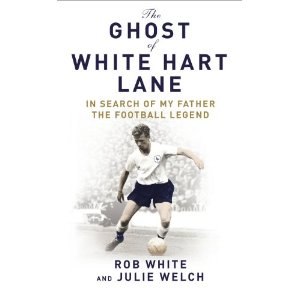
The Ghost Of White Hart Lane

“It’s all about seizing the moment! I was curious about the John White story. I’d been researching background on the Double but there’s not much on John. I thought about a straightforward biography at first, then it was obvious that there was this fantastic personal story to wrap around John’s life and death, the interwoven stories of father and son.”

They continue the conversation with little prompting from me, engrossed by a subject that remains fresh and vivid despite their many months of working together. New information and nuances come to the surface even now as they bat ideas back and forth, carefully weighing each word and born of a total commitment to get this precious story just right.

Rob readily admits he was in awe of Julie to start with. She was the first woman football correspondent for a national paper,  the Observer, and her lifelong love of Spurs found expression on the big screen in Those Glory Glory Days, a film about a girl’s passion for Spurs. “It was like therapy. We’d sit in the studio and just talk. No way could it have been written without Julie. She brought out my voice.”

Julie leans forward to pay tribute to Rob’s powers of expression. “It’s the quality of the consciousness that’s important. There’s a lot going on in Rob’s head and he presents it naturally.” She pauses. “It was the most marvellous experience of writing in my life. Can’t think of anything better that’s happened to me as a writer. Two people targeting one goal is just fantastic. I doubt I will ever have a better experience again, just to be able to write John White’s story and pay tribute to the Double side.”

In print, Rob’s voice comes over with disarming, touching integrity, to the point where you share his struggle to come to terms with his relationship with his father. He’s the same in person, honest and thoughtful with an underlying passion for telling this tale and a readiness to let others into his world.

“I’ve had real problems with this,” said Rob. “Not deep psychological problems but it was good to get these things out, to exorcise them.” Growing up, Rob’s identity was very much shaped by his being John White’s son. It’s a vivid portrayal of bereavement not in terms of freakshow trauma that has spawned a series of voyeuristic best sellers – Rob grew up in a close, caring family – but how others react to a bereaved child. Even as a young boy he noticed how people’s expression changed as soon they found out who he was, patting him sorrowfully on the head.

Rob laughs now about how he was a “walking cloud of sorrow. You grow up as a kid with this tragedy, people don’t know how to react. They look but they don’t know how to interact, and I didn’t want to upset people so I kept things to myself. From 13 to 42 I was scared of people’s opinions of me changing because I was John White’s son.” He describes how someone who had sat behind him at Spurs for many years – Rob is a season ticket holder in the Park Lane – was angry when he found out because Rob had not told him.

Defined by his father, Rob lived for many years with not knowing who this man was. As he child he searches for connections in a dusty box of attic artefacts. He watches the few snatches of film available of John in action, then convinces himself he runs in the same way as he studies his refection in shop windows. Dave Mackay takes him under his wing. He’s allowed on the team coach, into the dressing room, not just to hear about White’s exploits but more significantly to experience the smells and sounds of the dressing room, the pre-match tension rising as kick-off approaches, the evocative clatter of studs on concrete as the players run out. It’s comforting for a child to have so much information about a lost father. However, this is mixed with unease and frustration as the man eludes his grasp, walking beside him through his life yet when he reaches out to touch his presence, there’s nothing there, a ghost.

Rob embarked on a voyage of discovery in search of his father and, along the way, of his own identity. Some of the most moving passages cover the lost opportunities to do the everyday father and son things, like chat about football, ask him about mortgage advice or see his dad’s reaction when he gives him a present at Christmas. As Julie says, “The real heartbeat of the book is Rob’s longing to be a son to his dad in whatever way he could be.”

We’re talking when Rob is a long way down the road but there must have been tough soul-searching moments along the way. As men, we don’t talk about such things. I wondered if Rob feared what he might uncover and then reveal in the pages of the book, especially as he has such a candid approach.

“I reached the stage when I had to face up to it. It was the elephant in the room, something we didn’t talk about much in the family. Having children made me think more about this, then I had to face writing the dedication in the book. I struggled – to the memory of dad? the team? Then it seemed logical, for the kids.” The memories are handed on through the generations. Julie finishes the thought: “Pass it on, pass it on.”

He pays fulsome tribute to a major source of information, the Double side. ”Research was like King Arthur visiting the old knights, a pilgrimage  Their knowledge and wisdom, they knew my father and know you are your father’s son. That recognition meant a lot.”

It’s a perspective that enhances the reputation of this great side. Cliff Jones was White’s co-conspirator in the series of playful practical jokes, a comedy duo that brightened the dressing room and made John so popular and well-liked by everyone who knew him. Mackay has been a lifelong friend. Terry Medwin dissolved into tears as he recalled fond memories.
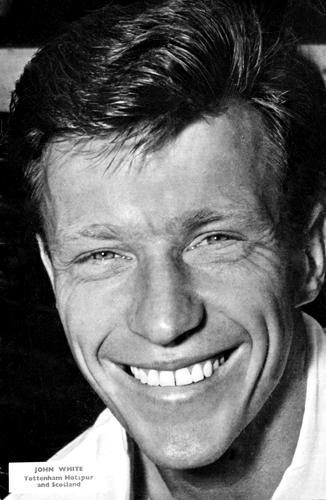
John White

The togetherness of the team was a major factor in their success. “They had 5 years close to dad, living, training, playing “ Rob continues, “It’s a band of brothers thing, not like an ordinary job. One day he goes, that’s it, John’s gone. The thoughts are less frequent as time goes on but he was always there. Then, something jogs them. Seeing me is like the closing of a circle.” “Healing”, chips in Julie.

Talk to the old-time fans about the Double and they will marvel at Blanchflower’s midfield drive, the bull of a centre forward that was Bobby Smith, Jones flying down the wing or Brown leaping high across the goal. Come to John White, suddenly they have a far-away look in their eyes and tail off into a reverential whisper. Here was a real footballer. Yet despite his distinctive style and telling contribution, he remains the least known of the Double side and Julie was determined to put that right.

“Mention John White and his name is always followed by ‘struck by lightning’, not something about this fantastic player whose assists helped Greaves be the player he was and indeed helped many men in the Tottenham side to be the players they were.”

Having read the book, I longed to see him play. “That’s the frustration,” Julie picks up my train of thought. “Couldn’t we do with him today? Just imagine what a player like that would achieve because of the way he played, so far in advance of his time.”

Rob picks up the baton: “He was like Cryuff, not the same type of player of course but in the sense that he’s an original – no one else was like him. Part of the sadness in the book is revealing what might have been.”

The book has been extremely well-received, topping the sports sales and entering the non-fiction top 50. The real benchmark, however, is its impact on readers rather than the book charts. The engrossing tale of John White and the Double side interacts with a profundly honest and poignant account of father and son that has reduced terrace-hardened grown men to tears. Did they find John in the end?

Julie: “I found the Apollo in him. Cliff Jones talks about running out onto the White Hart Lane pitch to be hit by the mass of noise. To be able to do that and play your best, you must have absolute confidence on your ability”

Rob’s journey was slightly different; “Found him? I’m a lot closer, yeah. You spend time looking for this person then realise the person is you. I was choked up about that.”

The journey isn’t over with the publication of the book. Well into Rob’s adulthood, the family revealed that John fathered a child during a short and abortive teenage relationship. He agreed to do the right thing but was advised against it by his commanding officer – John was on National Service at the time. Now his half-brother has come forward in a thoroughly modern fashion with a splash in the Mail. More thought and reflection and tricky, perhaps painful moments for Rob.

As I get up to leave, while Julie and I make small talk behind us Rob rummages in what looks like an ancient giant safe. He rejoins us, carrying in one hand his father’s football boots. They are tiny, size 6. Battered but lovingly cared for, the starch-white laces bear traces of black polish where the cloth in John’s hands rubbed them last. It’s almost impossible to believe that these dainty slippers mastered rain-sodden panelled leather footballs with the finesse and precision of a true artist, yet in my hands for an instant I’m touched by the spirit of a truly great footballer. Julie and Rob have a theory that John manages to play little tricks, as he did in life. The book may be finished but the Ghost of White Hart Lane is still around.

The Ghost of White Hart Lane – In Search of My Father the Football Legend  by Rob White and Julie Welch  Yellow Jersey Press

Spurs Hopes Flagging Because the Linesman Wasn’t

He shoots from distance. The keeper sees it early and gets everything behind it.

Ultimately it comes down to the keeper. Number one, at the back, unique in that he and only he has the precious gift of being able to use his hands to repel the voracious attackers. Sure there are tactics. he’s part of a team, the back four is really a back five, with him in a crucial role. Yet he alone has special powers, to leap and soar in defiance of anything that can be thrown at him, our very own superhero to save the day at the last gasp when the villain is about to snatch the crown jewels and the girl.

Like the best superheroes, they are mortal – it’s what makes them so fascinating. Because of what they do, their human frailty is played out in full view of the public. No hiding place. Effort or hard running can’t conceal an off-day. There they are, Waiting for something to come their way. Waiting for the moment that shapes their day, that defines the team as successful or failures. Most of all, the moment when their personality, their soul, their innermost thoughts and secret fears are waiting, waiting to be laid bare. As he shoots from distance.

The keeper, our keeper, defines the club as well as our fortunes. Sustained brilliance for extended periods made him and the team successful. Our belief soared as he reached high into the sky to keep the A******l at bay or flung himself sideways, Stretch Armstrong come alive. But inside, deep down, gnawing away at our guts, there are demons. Most of the time they are under control but this fear is a fatal flaw waiting to be surface, just lying there and waiting.

Our keeper is the team. However well we shift the ball around or roar down the flanks striking terror into the hearts of hapless defenders, there’s something nasty lurking in the background. There’s a weakness, hard to put your finger on it, but it’s there, in the fans’ hearts and the players’ minds. The name we give it is a lack of resilience. You can’t see, smell of taste it, but it’s there. Just waiting.

So in this game, our keeper is the team. At kick-off expectations are low. Last week’s disjointed disappointment lingers and our opponents have a fearsome home record. But our team can play, and so we do, very well. Our manager has a plan this week and outwits his rival. They think we are easy, can’t defend, so they play their two main strikers and an attacking midfielder. To begin with, we are surprised but our manager gestures frantically from the touchline and all settles down. Sandro’s in front of the back four so that both limits the space and he can track the runners into the box. Rafa slots into midfield but not so deep that he can’t be an outlet as we keep possession and move it forward. He and Lennon, not always the best defensively, work hard. Bale is circumspect with his runs.

Inspiration comes from the back. Reassured by the protection in front of them, Dawson and Gallas are rock solid. Alongside them, Corluka and Kaboul stay tight, for the most part at least. Both can’t resist the temptation to wander occasionally but it’s OK, because Gallas has Torres in his pocket. He made sure he was around whenever the Spaniard gained possession, and with Gallas around, he didn’t have possession for long. Gallas was ritually booed for his efforts, which is rich from a club that stakes its future on players agitating for a move for the sake of money. No doubt the irony was lost on the Chelsea faithful.

Never mind the organisation, there’s magic in the air. A clever touch from Rafa and Sandro bursts forward. He reminds me of Juantereno, the great Cuban runner who also had a powerful muscular build yet was the most remarkable athlete. This athlete slams it into the top corner, a terrific goal.

Now we have something to defend, something to fight for. Our keeper shares the mood. Efficient and businesslike in the box, he then positively took off to fingertip a Drogba free-kick away. Today is going to be a good day. Our manager is very much in charge. He tells Sandro to stick to his job, the goal has put us ahead but his defensive work is how we will win the match.

Then he shoots, from distance because he’s increasingly desperate. Can’t get nearer so Lampard shoots and our keeper has everything behind it. Everything. He does everything right, arms, legs, body, yet our keeper has a fatal flaw that has been brutally exposed these past few weeks. Our keeper lets it through.

As it rolls towards the goal, the season flashes past in an instant. The good football, cracking games, attacking brilliance undermined by unforced errors at the back….as it rolls towards the goal, agonisingly, waiting for the moment of searing pain as it dribbles over. Pain in the abject cock-up, utterly avoidable, pain in the Chelsea celebrations, pain as the season slips away.

Yet nothing compares with the pain of what follows. It looks in to me, certain in my vantage point of my sofa, but it isn’t. The referee and lineman, like our keeper, are human and fallible, and merit forgiveness, but this is not right. They can’t give a decision unless they are certain. If they cannot be sure it’s over, it’s not over.

In that instant, our keeper, our team, found redemption then lost it in the blink of a gnat’s eye. Mistake maybe but to keepers, versed in psychology greater than any university professor, it’s either in or it isn’t. Hit the woodwork five times a game? Great, the woodwork’s not in, is it? This was a save, a dodgy, unnecessarily dramatically close save, but a save it was.

And so the game and the season turns on the ref. Chelsea turn from the desperation as epitomised by the long shot that started this all to a potent attacking unit. We continue to play well and hold our shape but gradually we are pushed back, the team doing well save for Pav who is isolated and ineffective up front. Bale could have made more runs to push his man back and seize the initiative but with Torres vanquished by Gallas, Chelsea now look better with Drogba in the middle. Sandro and Modric are outstanding as first Lennon then Rafa fade, Sandro in particular makes three, four last ditch tackles as he tracks back. An outstanding game, closely followed by Luka who purrs throrugh the match.

It looks good but danger threatens. Our keeper is rigid with fear now. His rictus grin fools no one. It’s a horrible mask of terror. They shoot and he can’t move his feet but rooted to the spot he beats it away and with a bit of luck it’s cleared.

Then Chelsea rip us apart. It’s great move, with everyone back first Gallas then, fatally, Dawson is forced out of position. No alternative, we are so stretched. Drogba’s into that space, a touch and it’s in. From the all seeing eye of the sofa I shout “offside” to no one, more in desperation than expectancy. But look, here’s the replay and I was right.

No amount of organisation or effort can compensate for two errors by the officials. Chelsea were the better team but Spurs far exceeded my admittedly low expectations with a disciplined and determined rearguard action. After my criticism last week, full credit to Harry for his tactics and to the team for rising to the occasion. Pity the same can’t be said for the officials.

It’s a gloomy, headshaking how did that happen morning as I return to my sofa to write this. The way I feel, I may not get up, ever again. However, there was so much good in what we did yesterday, here’s a note of optimism to finish. Sandro and Modric could be as good a midfield partnership as any in the league, in Europe even. They are just remarkable. Hope that helps. It’s done something for me. Look, I almost smiled.

Part of the Team, Part of What Exactly? TOMM and the Baby Go Ryman League

Summer’s nearly here and the signs that mark the eternal passing of the seasons come round once more. Warm evenings, the goalposts in the park coming down (which always brings a pang of sadness when I first discover they’ve gone) and the arrival of my season ticket renewal pack.

This last option is no longer a reliable calendar as it seems to plop on the mat earlier and earlier each year. I’d make a joke about Spurs working it into a Christmas theme next time, were it not for the fact that some clubs have actually done this in the past. Spurs of course offered the two year ticket recently. A few extra weeks interest all adds up, after all.

The pack not only has my name on the front but also a row of Spurs shirts hanging in the dressing room, pre-match. Palacios is 12, Rafa 11 and next to him, side by side, is number 10, Fisher. I kind of like the idea that I wear the 10, the playmaker, revered in Brazil, Pele, Socrates…Be Part of the Team says the accompanying blurb. They can’t do without me.

Naturally I’ll renew. Like a besotted cuckold I watch as the object of my undying desire spurns my affections, behaves badly and and consorts with others, yet I’ll always remain loyal.  As ever, the transparently false marketing platitudes grate at the same time as I once again prepare to do my bit to keep Barclay’s profits in the middle billions. Pile that debt mountain high, lads, our children will paying for it long after we’ve gone!

Despite the cash I’ve willingly given the club over the decades and the atmosphere generated by the fans that on the good nights makes the Lane the best ground in the land, I’m not really feeling part of things. It’s odd if you think about it. The Spurs marketing mob undoubtedly get paid a fortune but they are so far divorced from reality, they actually believe this appeal is going to tip the balance. You know, after over 40 years I wasn’t going to renew but I’ve read the pack and goddammit I’ve changed my mind! To be frank, I’d prefer it if they send me a scribbled handwritten photocopied note: ‘Here it is, do what you want. makes no difference to us.’ I’d applaud the honesty.

Being part of the team, it’s feelgood inclusivity, a sense of ownership and belonging, it’s what I as a manager in my day job try to create in my charity. However, to be believable there has to be some substance, a grounding in real everyday experience. As a part of the team, the price as gone up by over 6%. I’m not consulted over a decision that could shape the club’s future for the next 125 years, the new stadium. A cup of tea costs £2. My renewal pack says I have free use of the ticket exchange scheme, yet they refund only 75% of the price. That’s not my definition of ‘free’.

Now I’m getting petty and it doesn’t suit me. I know what I’m doing. Tottenham is my pleasure, my passion, my sanctuary, my lifelong companion. It’s a fatal mistake for a writer to use these words but I really cannot fully put into words how exhilarated and fulfilled I felt after the derby, or beating Chelsea and L’arse last season. They exploit my obsession but I’m a willing participant.

Increasingly however, clubs cannot take that loyalty for granted. Many fans are becoming disillusioned. Lifelong supporters they will stay, searching for results, their moods swinging this way and that according to our futures, but they will do so in a different way. They’ll be less likely to attend matches regularly, to make the sacrifices, the journeys, the late changes in kick-off times. Nowhere is the problem with the modern Premier League experience illustrated more pointedly than with the contrast with going non-league.

Time constraints restrict my available Saturdays but non-league has its own buzz, welcoming, friendly and inclusive. Even after I left southeast London I drove up up to watch Fisher Athletic (the attachment is obvious), buried deep in the docks where the support was hard core in more ways than one. The first time I went, I smiled knowingly as an irate voice bellowed abuse at his own players from behind me in the main stand. After 10 minutes I turned round to discover it was in fact their manager, Keith Stevens the old Millwall warhorse. None of this new fangled motivational psychology there. On another occasion a woman in a motorised wheelchair parked right next to the pitch. A steward immediately strode purposefully towards her. “Two sugars, is it, Mavis?’ ‘Thanks darlin’’

On Easter Monday I renewed my acquaintance with this world, and it does seem like another world, with a visit to my local team who play in the Ryman Premier. The most noticeable difference is off the field, pre-match: spontaneity. Rather than plan months ahead with investments in time and tickets, 30 minutes before kick-off the family are debating whether or not to come. It’s a social thing: bit of football, bit of chat, lots of laughs.

At the ground it’s clear that scenario has been played out in many other local households. Park two minutes away, families and die-hards mingle together in the sun on the halfway line before trooping to the end the home side are attacking. Here you can walk round the ground.

The game kicks off amidst plenty of noise. The stadium has a cowshed stand at either end, small but an expert in acoustics could not have designed it better. You could hear the crowd three miles away. It’s noticeable how many women and children are here, a setting where they feel comfortable. A couple of families wander off and picnic in the corner, the boys having a sly kickabout in the practice nets. In front of me, a group of 6 year olds guzzle crisps and coke as they join in the abuse of the away keeper. When you’re that age, what more do you want from an afternoon out?

The home team are well on top, buoyed by a dodgy early penalty. The football is enthusiastic but poor, although they go against type by forsaking the long hoof in favour of an attempt to play out from the back. Premier stars would struggle on this pitch, the mountains of sand unable to smooth out the lunar landscape of stones and bumps.

At half-time we chat with acquaintances we bump into on the short trip to the other end and share news from far flung Lowestoft and Horsham re the rivals for automatic promotion. The noise continues unabated for the whole of the second half, vibrant and ribald as all good crowds are. There was one remarkable episode that is decidedly unusual, unique in my experience.

One of the home faces who gets the chants going has brought his baby, no more than 14 months old. He’s decked out in home blue and white, complete with a delightful little drum to match the home drummer. My mate tells me this guy has toned down his behaviour considerably since he became a father. Once, he spent the entire first half pitchside giving dog’s abuse to the away keeper, who was black. At half-time the keeper, silent until then, turns round, looks him straight in the eye and says, ‘”At least I’ve got a bigger di*k than you”. Whereupon our man was stunned into silence and ended up shaking the keeper’s hand.

He’s a doting dad now, paying him plenty of attention as the match goes on and periodically handing him to willing grandparents who are here too. Baby loves the racket and joins in, gurgling away contentedly. There’s a moment’s silence. Baby burbles ‘blue army’, wordless but the tune and intonation is crystal clear. He goes ‘blue army’, the crowd answer. First baby, then the crowd. Call and response on the terrace, led by a 14 month year boy.

Same game but a vastly different experience. The problem for the Premier League is that many are saying it’s not different, it’s better. Close to the pitch and the players, feeling part of something, a sense of belonging that cannot be replicated by marketing ploys, however professional. I went with Villa and West Ham fans, both of whom used to have season tickets, both still follow their teams avidly but who rarely attend games now because they are disillusioned with the whole spectacle and the way they are treated.

In the short term it won’t make much difference. Cue Levy intoning the season ticket waiting list and whatever it has gone up to this week. However, unless something changes I fear Spurs and the entire league are setting up long term problems that will harm the game. Already the average age of premier league spectators is in the thirties, higher in some grounds. Football is still loved deeply but a new generation defines being a fan as watching on TV and buying the shirt rather than being there. Many of the spectators last week wore the colours of league teams but they choose to come here.

It can never be the same at the Lane and I don’t expect it but if they want us to be part of the team, the club could pay us a little more attention. Keep down ticket prices, food in the ground at an affordable cost, plenty of consultation, don’t rush to move kickoff days and times for TV, it would all help and all those points are easy to put into practice. My name on that shirt – it’s not a first team shirt. If it were, you could see some blue on the back and the collar’s wrong. I’m a fan, you see, I spotted that because I know the club better than the merchandising department. I know what’s happening and I understand my role but that doesn’t mean you have to take that for granted.

New Dawn? Just That Same Old Feeling

The media have taken a solemn and binding oath never to say a bad word about Harry Redknapp. He’s teflon-coated, surrounded by a legion of sycophantic pundits who at the slightest hint of a problem adopt Roman strategy and surround their man with an impenetrable wall of shields. Spurs fans ringing the phone-ins who dare speak his name in vain are showered with ridicule, for example.

I was going to write about this at the end of the season, when we can properly and soberly reflect on a season of wildly fluctuating emotions, but suitably deflated after West Brom’s equaliser, this seems as good a time as any to bring the subject up. It’s a remarkable achievement in an era where the media covers football as never before, not merely examining their subjects with a fine tooth comb but individually picking out each and every head-louse, then sticking that under a microscope. If they can’t find a louse, they’ll invent one.

Yet Redknapp is immune. I can’t recall the last time I read or heard any sustained critique of his managership at Tottenham from a professional pundit. Any suggestion of negativity is met with snorts of derision, not even examined but immediately and forcefully ruled out of bounds. No other manager has such protection, not even Alex Ferguson. Nothing sticks, rather like Pav trying to trap the ball yesterday.

How did the ball get over there?

I am genuinely and sincerely grateful for the progress made by Tottenham Hotspur under Harry Redknapp. Harry bless him has obviously been told to stop intoning his mantra but for once I’ll save him the trouble: I have not forgotten that we did have 2 points from 8 games. To me that seems like if not yesterday, then only last week. The tilt at fourth place, the Champions League, the players, the football, all of this I’ve loved and will never forget. Building  a team takes time and I’m not impatient. I’m not expecting overnight success. However, Harry’s mantra can’t hide the problems and in the midst of the final few games that will define the season as one of success or failure, the old problems that we hoped had gone away have bubbled back to the surface.

Redknapp had a bad game yesterday. Starting with the team selection, he ignored the evidence that the pairing of Crouch and Pavyluchenko had worked pretty well. Now this was Harry’s selection in the first place and he deserves the credit: TOMM regulars will know that whilst I love each and every one of my lovely boys, Crouch is not my favourite son. Yet it’s been good so unless there was an injury, I saw no reason to break it up.

Harry will say, of course, that the job of a striker is to score goals and both did yesterday. However, there is no hiding from the reality that both were downright awful. Our problems stemmed from the fact that JD was never in the game (if he touched the ball at all in the first 20 minutes then I missed it) and Pav’s ball-control was a comic tour de force worthy of top billing at the Edinburgh festival. Leading the line is not his game, there’s been plenty of evidence over the years. He’s fine if he can push the ball a metre ahead of him. Do that, suddenly he’s a world-beater, as he was against Chelsea at home and yesterday he took his chance superbly. Then, as West Brom closed us down and left us no room in the box, he and Defoe looked so ordinary and ineffective. Time and again we played the ball to him, only to see it ping back from his rubber boots. When they call strikers ‘spring-heeled’, this is not what they had in mind.

It was odd not to see Benny up and down that wing. He’s been injured before but his presence is reassuring somehow. I missed him after he went off and so did Gareth Bale. He was at fault to some extent for the early goal, giving the player too much room inside him. However, he managed to get back, as he so often does, and the slip/injury did us in. Well-taken but so much room. Old failings.

Pav's boots are made of revolutionary new material

Sandro came on and had an excellent game, adding attacking drive and bounce to his defensive work. However, to fit him in required our two best players, Modric and Bale, to move out of position. This weakened our team more than if we had brought on Bassong, not a full-back and certainly not ideal but a quick and competent defender. Luka’s body language when he heard the news was a picture. He visibly slumped.

Taking of body language, an expert on Radio 4 said that tugging or touching the neck was the surest sign on a person that something was up. Feel free to use that in your next poker game or contract negotiation. As the game wore on, my neck resembled that of a turkey in early December. We never kicked on after our equaliser. It was one of those ‘nearly’ performances. Lots of good passes or touches that nearly came off but not quite. The pass looked a good one but was just cut out, or the flick opened up the defence – almost. In games like these, what begins as promising and inventive becomes over-optimistic and downright naive, as time after the moves broke down. Credit to West Brom here. Even though we pushed them further and further back towards their own goal, their defensive shield did not crack and they were always able to break quickly.We ended up trying to pass through the eye of a needle. Nothing to aim for up front because nothing was going on.

My neck

We needed a change but were treated to a mystifying substitution. For better or worse, usually better, throughout the season we’ve played with two wide men, Lennon and Bale, and this is the shape where we feel comfortable. Not only that, the combination of width and extra pace was ideal to stretch and break down the resolute WBA defence, so for the life of me I can’t see why Lennon stayed left. I can only presume that Harry wanted to double-team our opponents who had Brunt filling back to protect the full-back from Bale’s runs. Instead, it cluttered everything up and neither player was half as effective as they might have been.

Moreover, it left Kaboul unprotected on our left, as VDV was cutting inside at every opportunity. Several times WBA exploited this themselves. They found it easier to get two on one than we did. Kaboul did well enough in the circumstances but WBA had several opportunities, scoring from one, an admittedly excellent shot from deep but still Cox had plenty of room. He may well never score another like that in his career but that’s not the point. We were unbalanced by the formation.

On 5Live, after the obligatory ‘it’s been a great season’ Harry muttered something along the lines of, ‘I suppose we could be more defensive but that’s not how we are’, then he let the sentence trail away. This isn’t a precise quote as at the time the topical storm over east London had turned the North Circ into a tributary of the Ganges, not the best moment to discover that there was something wrong with my windscreen wipers. Well actually Harry, that’s precisely how we should be at times like that. Fair play again, in the bad old days we would not have fought back to go 2-1 up and that is much of the manager’s doing. However, even if we had had Lennon back on the right we would have been not only more solid to protect the hard fought lead, we could have still attacked on the break.

Rafa had a fine second half. Coming off his wing he worked tirelessly, prompting and probing, looking for an opening. Much more effective when he doesn’t drop deep, this is his position, in the area in front of the back four. However his and the runs of others were too often lateral rather than penetrating. The West Brom midfield shield pushed them across. No width and they weren’t stretched out of shape. Kaboul could not attack because he was occupied with defensive considerations. Luka had a decent rather than commanding game. Tiring towards the end, even slightly off colour and out of position he remained inventive, but there was so little room.

So Rafa ran hard but he did not run back. Two up front plus Rafa, that’s three out of the reckoning when they had the ball and that’s too much, especially at a time when we were a goal up. I enjoy the cavalier football but there is a time and a place for caution. Unbalanced and unprotected, West Brom could get at our back four all too easily. One on one, Dawson did very well and Gallas was OK. However, left one on one, unprotected, they are left with an invidious choice. Dive in and there’s no one behind. Stand off and our opponents have space to create, or in this case line up a curling shot that they wouldn’t have the time to do in training. The midfield are there to protect, and survive, but they were absent. Redknapp should have reorganised.

Same old story. Weak up front and not converting our superiority into goals and points. midfield not defending. Without taking anything away from a well-organised and determined West Brom team, these points dropped against teams we should have beaten have virtually done for our hopes of the CL. Never mind that, now we are looking over our shoulders and the key match of the season is now the trip not to Manchester but to Anfield. What a waste.