The first in a new series of interviews with Spurs fans to find out what it means to be a Spurs fan. Julie Welch is an author, journalist and screenwriter.
Julie Welch is not merely a lifelong Spurs fan, she recently became the club’s biographer. It’s clear from first page to last that “The Biography of Tottenham Hotspur” is a labour of love that with honesty and deep affection defines the very character of the club. The process uncovered the essence of not only what it means to be a Spurs fan but also that this is one club that stands for something more fundamental that the immediate pursuit of trophies or profit, and that we fans are part of a proud heritage that stretches back to Victorian times and the founding of the club under a lamppost not far from White Hart Lane.
“I wanted to treat Tottenham as a person or a personality. It’s hard to apply the word ‘artistic’ to football but it fits Spurs. It’s a club you associate with excitement and glamour. It’s prepared to take risks or at least it was in the past. Also, it’s a club that doesn’t forget its roots. Just think how awful it would be if we were owned by Roman Abramovich, there is so much solidity about Spurs because it has so much history.”
In the book, fans line up to pay tribute to the Spurs Way, thrilling, flowing attacking football that prizes creativity and passing  rather than hoof and brawn. Julie articulates this culture and philosophy with dexterity and in the gentle telling makes it tangible and bold, something to cherish and nurture. It’s one thing for the fans to appreciate this but it’s surprising how former managers and players past and present recognise exactly the same phenomenon. Julie describes how Gareth Bale is moved by the pictures of the former greats he sees every day at the training ground, but it’s perhaps best summed up by the rueful comments from Gerry Francis, “In most clubs winning is what it’s all about, and people are happy with that, but at Tottenham you have to win with style as well.” He failed to deliver in either respect.
The continuity over the years is remarkable, given that Spurs are 130 years old and still going strong.
“What I hoped would come across was that kind of continuity that we do pass on, that Spurs doesn’t die. The club itself will always be the club.” Even if we move grounds? Julie pauses to think this over carefully.
“I don’t feel emotional about the fabric of the buildings because to me the real White Hart Lane was before Irving Scholar, who pulled down my West Stand which was one of my favourite places. I wrote a column in the Observer about it. I was so gutted it went. It’s not sentimentality, just that reckless over-spending. “
Now this most charming and accommodating of interviewees is gazing into the middle distance with fire in her eyes at the indignity perpetrated upon her precious club. She’s visibly bewildered and upset. “I can remember really feeling that Tottenham was going to be shut down at one stage. The whole Irving Scholar thing, I regard that era with such distaste.”
Reading the biography reminded me of the numbing awfulness of those seemingly endless so-called transitional seasons from the mid eighties onwards where mid-table mediocrity became something to aspire to. Disappointed but philosophical about the many managers who have let us down in recent times, like most long-suffering Spurs fans Julie is able to bounce back.
“There were so many mistakes made in that period and that’s the bit that I’ve found most depressing to write. Each carefree new chapter I started, there was a new manager. The new manager turned out to be just as bad as the last and it was hard to put your finger on it why it went wrong.”
It’s the chairmen who bear the brunt of her resentment, a moral outrage born of the right values that people could not put the club’s interests first. Lord Sugar, who appointed many of our failed managers, look away now: ” Sugar saved the club financially but had absolutely no idea. He was not attuned to the club and I think there was a sort of crassness about everything. He wasn’t a football man.”
After Spurs success in the early eighties, Julie’s first love went sour for a time: “I was kind of off Spurs when Keith Burkinshaw walked away. It seems to have been such a travesty of what the club was and what it stood for.”
“At least Daniel Levy does get Tottenham.You know under the present setup Tottenham isn’t going to go broke. We may not be able to afford the best players and we may have a bolted down wage structure but the clubs finances are safe.”
That theme of continuity runs throughout. History provides the basis for those myths and legends that help us tell our tale and understand what we believe about our team, but also there’s a pragmatism. This is who we are and to succeed, we must remain true to ourselves. We defy our history at our peril.
Another feature of our character is that we have so many firsts to our name. The first to win the Double, to win a European trophy, to fly fans to an away European game, the first to become a PLC, to take the risk and sign Ardiles and Villa. Julie is herself a pioneer, becoming the first woman football writer in Fleet Street to receive a byline above her reports. With throwaway modesty, she maintains she fell into sports writing only because she was a failure at her proper job, a secretary on the Observer sports desk. Her knack of finding the emotional heart of the game stems from her enduring passion for Tottenham Hotspur. She wrote the feature film Those Glory Glory Days about three girls who become obsessed with the Double side, based on her own experiences.
“It’s a complete accident that I became a Spurs supporter. The school I went to embraced a part of the London jewish community and the daughters of these families brought me into Spurs. It’s hard to explain but there’s a real flavour about Spurs that you don’t get with other clubs. I could identify with Spurs, they were exciting and glorious.”
Spend any time with Julie and there’s no need to ask who her favourite player is.
“I loved Spurs for the fact that they could accommodate the genius that is Danny Blanchflower. Spurs can accommodate independent-minded, intellectual players like Blanchflower who can do other things. Spurs is a club for the one-offs. That’s what attracted me to Spurs in the first place. With us, he could emerge in his true glory.”
Julie also returns frequently to the Bill Nicholson for his achievements and as a touchstone for what Spurs has become and can be in the future.
“I love the Bill Nicholson story. It’s so resonant of biblical myth – the hardship, the struggle, the glory, some failure, then exile followed by redemption.”
Here’s that look again. “I still feel absolutely gutted he was never given a knighthood. I’m so angry I can’t begin to tell you. You know what happened – Tony Blair came to power and they wanted to be associated with football but they knew nothing about it. Ferguson, Shankly, Bobby Robson was a lovely man who did our family so many kindnesses but in terms of achievement it does not begin to measure up against what Bill Nick achieved.” She pauses. “It’s the lack of care that makes me angry. Mind you, knowing Bill he would not have given a toss. He would have regarded it as an honour for Tottenham Hotspur and his team.”
Another great memory was the 1981 Cup Final and Ricky Villa’s goal. “I can still see it in my mind’s eye. More disbelief than surprise in the way he kept going. It really sums up Spurs, that team that manager and of course I loved Crooks and Archibald. I interviewed Crooks, lovely man.”
Coming up to date, Modric and Berbatov have caught the eye. She interviewed Bale and Dawson for the book. Both are pleasant, intelligent and fully embrace the Spurs identity. On the day of the interview, Dawson could have gone to QPR but he still made time for her, “what a decent man.”
Julie is full of praise for Bale: “He’s a great player, could be captain one day, he has that quality. Like John White he’s a one-off, like Dave Mackay and Cliff Jones all the really great players are in a category of their own.”
Of the others, she picked out Caulker and Lloris as promising while the beast that is Sandro has the stuff of myth and legend about him.
By now any pretence of an interview had long since dissolved as the endless fascination of talking Tottenham in such engaging company held sway. Julie’s a fan, sure, but more than that, she’s unashamedly in love: “There’s a physical and romantic attraction. There’s something very mysterious about what draws you to a club, a parallel between falling in love and the club you find yourself with. It’s never a conscious choice.” And once you’re hooked, you can’t let go.
“To me the pitch is sacred, not the same patch of grass by any means but there’s something about it. We all came together over the years for more than a century to that little bowl of land. It contains all our hopes, dreams, fears and uncertainties. It is hallowed ground because it contains so much of our humanity. And Bill and Darkie’s ashes are under the pitch. I will get so emotional when they dig it up.”
We could still be talking but I had to get back to work, so one last question. Two scenarios: a Russian billionaire oligarch appoints Tony Pulis as manager and his long-ball, muscular side are certain to win the League. Or, we have a team that plays the Spurs way but is vulnerable, we are top 6 material with a possibility of doing better. The destiny of the club is your hands – which would you choose?
Julie’s expression gave the answer before option one had been outlined. “Oh dear, you’ve made me feel poorly at the very thought of it. I shan’t sleep tonight. What a nightmare.” For Julie Welch, the Spurs Way is the only way.
Julie and Rob White have written a superb book about John White, The Ghost of White Hart Lane, interviews and reviews here and here.
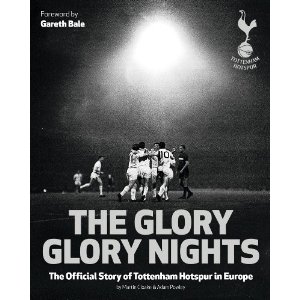 Martin Cloake wryly describes as the best thing he ever did for the club. It keeps two key elements of the style too, the liberal use of photos and incorporating quotes and headlines from the following morning’s backpages, which gives a sense of time and place. As Martin says, until comparatively recently fans relied on the papers for an account of the match because there was no other way of finding out what happened. Even the radio was confined to the bigger ties.
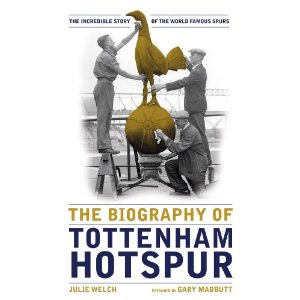 writing is easy on the eye and draws you in. This is no dull history textbook. Rather, Julie is a storyteller, engaging and curious. She communicates her passion without allowing her voice to intrude or detract from the telling of the tale. It’s a measure of her skill and dexterity that she makes the journey from Tottenham Hale through the industrial landscape that covers the old marshes to our first pitch sound enthralling. And she’s not averse to the occasional gratuitous dig at our rivals: after all, she is a lifelong fan.
 TOTTENHAM ON MY MIND