John White: The Ghost of White Hart Lane by Rob White and Julie Welch

On my daughter’s mantelpiece sits a photo of her son, then aged about 3, walking along the beach with his father. Taken from behind, they are unaware of the camera’s presence. Their stance and gait are identical. Size and stature come from shared genes, the rest, the bit that matters, just happens.

For Rob White, denied the chance to bond with a father he never knew, there’s a gaping hole where that bit that matters should be. The story of his dad, John White, the former Spurs and Scotland international who rose from working class poverty to become one of the most distinctive players of his generation before dying in a tragic accident, is dramatic and fascinating in itself. Yet this is no ordinary biography. His story is interwoven with Rob’s search not just for his father’s ghost but for his own identity.

Rob was born a few months before White was fatally struck by lightning, sheltering alone under a tree on a golfcourse during a thunderstorm. White was in his prime: 26
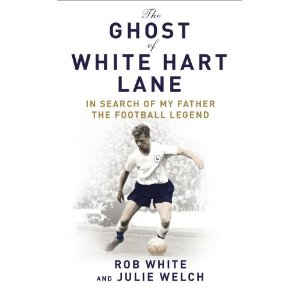
The Ghost of White Hart Lane

years old, a Double and Cup Winners Cup behind him, the man around whom the incomparable Bill Nicholson intended to rebuild the ageing Tottenham team.

The touchstone for Rob’s quest is a dusty box tucked away at the back of the loft. As a boy, he scrapes off the dirt and prepares himself for the wonders within, like an archaeologist about to enter a hitherto unknown Egyptian pyramid. Inside, he sifts through the cuttings and medals, tries on his father’s tiny boots, size six and a half. Tries to conjure up his father’s spirit.

The search continues into adulthood. There’s no shortage of material as White was well liked and respected by his fellow professionals. Much is made of the camaraderie and team spirit of the Double side and he is still deeply mourned by those who knew him in the game. His close friends Cliff Jones and Dave Mackay in particular remain bewildered by his absence.

Little wonder White was so popular. On the field, not only was he supremely talented, a superb passer of the ball with excellent control, he was also tireless and unstinting in his work on behalf of the team. From boyhood backstreet kickabouts to the great stadiums of Europe, you underestimated him at your peril. This small man had the heart of a lion and lungs to match, with a phenomenal workrate. He made himself constantly available for his teammates for Spurs and Scotland, ready to pick up a pass and move it on. To his opponents, they simply could not get near him. He appeared and was gone again in the blink of an eye, hence the nickname the ‘Ghost’.

Despite Welch’s meticulous research and consummate storytelling, there’s a sense of never quite defining the man. Contradictions appear. Diffident in company, he was also an inveterate joker and confident in his ability. This little boy lost in the Spurs dressing room when he came to London from Falkirk in 1959 could easily delight crowds of 65,000 at the Lane, 160,000 at Hampden Park, yet each winter, after Christmas, his mood and form dipped until the spring.

This may be because White, a loving father and husband and good friend to many, always held something back, a reserve shaped perhaps by self-protection at the loss of his own father at a young age and of a series of rejections in his formative years because people were unable to see beyond his small stature. However, his childhood in a caring extended family dominated by matriarchal figures instilled a powerful determination, epitomised by a ferocious desire for supreme fitness. He played football all the time, in the back yards and on the green, challenging his brothers, both of whom good good enough to play professionally, to races and keepie-uppys, delighting in the fact that he beat them every single time.
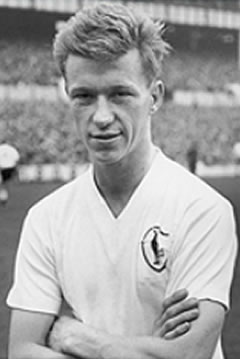
 

John White - Spurs and Scotland

Along the way there are solid gold nuggets of Spurs history. The Double, John’s rise to prominence and his growing influence is well chronicled and there’s a touching piece on Tommy Harmer, whose talent deserved more but who peaked in the mid 50s, between the great Tottenham teams of Push and Run and the Double. Blanchflower’s status and role in the club is perceptively defined, as is his decline, memorably instanced by the image of White steaming past him on a pre-season training run.

As with other biographies from this era, there are frequent reminders of how much the game has changed. White played for Spurs on a weekend pass from the army as he had to complete his National Service. The players lived up the road from ground. When sacked as manager to make way for Nicholson, Jimmy Adamson had been at the club for 51 unbroken years. White’s transfer was facilitated by a Scottish journalist, Jim Rodger, who took no fee – all he wanted was the scoop.

However, in other ways, at Tottenham nothing alters – Blanchflower, arguably the most influential midfielder in our post-war history, dropped for not fulfilling his defensive duties. The team criticised post-double because they were ‘only’ third or fourth.

Admirably the book leaves the reader in no doubt as to White’s ability. The only modern comparison is made, surprisingly perhaps, not with a midfielder but with Dimitar Berbatov, who like White has a picture of the game in his head and can anticipate several passes ahead. In my mind’s eye, the similarity with Luka Modric is inescapable, both small but tough, tireless with superb touch and almost prescient vision.

All this information and more unfolds for Rob as he grows up. The most poignant passages concern his search for connections with his father as a child. He watches the few snatches of film available of John in action, then convinces himself he runs in the same way as he studies his refection in shop windows. Mackay takes him under his wing. He’s allowed on the team coach, into the dressing room, not just to hear about White’s exploits but to experience the smells and sounds of the dressing room, the pre-match tension rising as kick-off approaches, the evocative clatter of studs on concrete as the players run out.

It’s comforting for a child to have so much information about a lost father. However, this is tempered with unease and frustration as the man eludes his grasp, walking beside him through his life yet when he reaches out to touch his presence, there’s nothing there, a ghost.

Rob is still searching into adulthood. He hears the stories, even sees a medium. His family are there for him, yet adulthood brings initiation into family secrets. Far from offering resolution, there is deeper mystery in the news of a half-brother from a fleeting teenage army relationship.

My first Tottenham game was in 1967 so I never had the privilege of seeing White play. Talk to fans from the Double era, they laud the greats, Mackay, Blanchflower, Smith up front, then invariably turn to the best footballer of them all, ‘John White, now there was a player’, and with a gentle shake of the head, tail off into wistful silence. The least known of this team, the book is a fitting tribute to his supreme talent and should bring him the recognition he deserves.

You find the man, however, in Rob White’s disarmingly open and honest search for his identity. His loss is laid bare as he works through familiar grieving patterns. Anger at what he can’t have. He can’t know his father, turn to him for advice or, as an adult, give a him a Christmas present. Seeking information, from people who knew his dad, family, press cuttings. Agonising over the might-have-beens and if-onlys. On the day of his death, if Jones or Jimmy Robertson had accepted his invitation in the dressing room after training to play golf, if Jones had run back with his trousers that he accidentally picked up, thus delaying him for precious moments…

This excellent book succeeds in being both a fascinating portrayal of a fine footballer and a profound, touching insight into how our origins shape our sense of self, of interest to all fans whether they support Spurs or not.

Rob’s a season ticket holder in the Park Lane now. I hope he enjoys the game and the club still. One wonders if, perhaps in the intensity of European games under lights in this venerable old ground, he catches a glimpse in the corner of his eye of the spirit of a true Tottenham great, his father. For me, there’s only one more thing to say about this book: having read it, I ache to see John White play.

The Ghost of White Hart Lane by Rob White and Julie Welch      Yellow Jersey Press
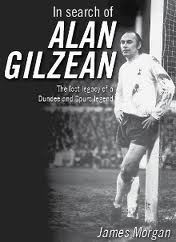
In Search of Alan Gilzean

Looking back, Gilly almost ruined things, just as it all began. The impeccable touch, leaping headers and sharp finishing – even as a teenager I knew this was class. Trouble was, unconsciously I compared everything that followed with this benchmark, little realising that what I took as a wide-eyed youth to be the norm was in reality the gold standard, never to be surpassed. It took many years and a great deal of heartache before the penny dropped.

Even in his prime, Alan Gilzean did not look like a professional athlete, let alone one of the finest strikers the club has ever seen. Thinning hair slicked back and a shambling, slightly stooping gait made him look older than he was. He didn’t so much run as ambled, for all the world suffering from the hangover that surely must follow his legendary appetite for alcohol. Yet appearances can be deceptive because Gilzean is the very epitome of the modern centre forward, a man who scored goals and made them too.

In Search of Alan Gilzean

He had no pace to speak of but the mind was keen and clear. In the hurly burly of a frantic penalty area, the greatest remain calm and still. Let the others move, then the space is revealed. Gilly would be there, pouncing on a loose ball or touching home a cross.

Sometimes he would wait, then move a fraction ahead of the rest. Possibly others had tried the near post glancing header before but if so I don’t remember and anyway, Gilzean perfected the art. Other more orthodox crosses, he leapt, soaring from a standing start, so sure and certain was the contact that I swear I heard the smack of leather on bald pate above the celebrations of the crowd.

All truly great players possess a distinctive move, unique and unforgettable that marks them out as extraordinary. For Gilly it was the glancing header. Long ball or cross, he would step in front of the defender then rise to meet the ball, sometimes body tall and taut, at others contorted in effort but with the sole aim of head to ball for the perfect touch. If Chivers was stampeding through or Greaves loitering with intent, it arced precisely into their grateful stride. The accuracy was astonishing and there is nothing like it in contemporary football. If as an admirer states he was “Nijinsky in studs”, then Crouch is a three legged carthorse on his way to the glue factory.

On the cover is an iconic image. Gilly leans laconically against a post, legs crossed, maybe a slight smile playing on his lips. The area must be bulging with bodies but he’s alone, a master of his own time and space. Don’t be fooled – in the mud on shorts and legs lies evidence of sweat and labour. My own favourite photo came from an early 70s programme. Jennings saves his second penalty in the game at Anfield. As Beal and Knowles rush in to congratulate him, Gilly is already wheeling away with not a flicker of emotion on his face. It happened, now let’s get on with it.

He was an easy man to underestimate, but try telling that to the defenders who faced him. Many give testimony to his prowess in the book. He seldom blew his own trumpet, preferring to slide away after training, usually to the pub. Hunter Davies in the Glory Game concluded that he saw football as a job and that he didn’t like the game, but that was mistaken. He loved playing but could leave it behind at the club gates.

Part biography, part detective story, James Morgan’s excellent book is propelled by his quest to solve the mystery of why so little is known or remembered about a footballer who was prodigiously successful on both sides of the border. A lifelong Spurs fan, he involves the reader not only in his search for the great man, rumoured to be a destitute recluse, but also in his dogged pursuit to right a profound wrong and secure a place for Gilzean in the Scottish Hall of Fame.

Gilzean was born and brought up in Coupar Angus, a small Scottish town. A natural sportsman, he played with distinction for Dundee, for whom he totalled 113 goals in 134 appearances. When the time came to leave, Bill Nicholson’s Tottenham was always his preferred destination and he turned down several more lucrative offers, including one from Italy. Much was made at the time of his disloyalty in letting Dundee down. However, he made his move only after careful deliberation and at the age of 26, hardly a money grabbing tyro.

A great favourite of Billy Nick’s, he completed 10 years with Spurs, during which time he adapted his game to create two superlative partnerships with Greaves and then Chivers, no mean achievement as their styles could not have been more different. In the process, he selflessly put aside his own glory for the sake of the team, converting from an out and out striker into the perfect partner.

Gilzean’s apparent indifference on the field hid a fierce competitor who worked hard at his game. What emerges most from the many entertaining stories told by those who knew him and played alongside him was how well he was both liked and respected. His taciturn appearance belied a man with a playful sense of humour. His team mates revered his awareness and touch: he brought out the best in them, and they are grateful. When I interviewed Greaves recently, without hesitation he named Gilly as the greatest he played with.

Morgan is a fine storyteller, weaving his tale with the same dexterity as his subject demonstrated on the pitch. With thorough research and the copious use of anecdotes, he allows the reader to build up a detailed insight into the character of a man who hid from the limelight. Like any good mystery writer, he maintains the air of anticipation to the end and I found myself rapidly turning pages as the denouement of a possible face to face meeting approaches.

Along the way, there’s plenty of entertainment as he reels out stories from a bygone age of football. Gilly was a fearsome drinker with an eye for the ladies, and used to frequent the Bell and Hare with Mackay, Jones and others, chatting to the fans while Bill Nick turned a blind eye. It’s a different world, with home being an average semi in Enfield, outrage from Dundee when in the mid sixties he demanded an increase on his weekly wage of £25 (John White was on £85, after all…), reporters nicknamed ‘Scoop’ and, most tellingly in this age of the celebrity footballer, a move to London would mean greater anonymity, compared with small town life.

A passionate fan, Morgan need agonise no more that his subject has not received due credit for his achievements as his highly readable account has set the record straight. Not only an antidote to every ghostwritten, mind-numbing footballer biography that you have ever read, it’s a fitting tribute to a truly wonderful Tottenham Hotspur player.

As a kid, I didn’t know much about football and even less about life but I knew one thing about Gilly, the King of White Hart Lane: he had style, and when I watch our team, I search for it still and let me tell you, it’s hard to find. The very best thing about this book is that if you never had the privilege of watching him play, you’ll understand.

In Search of Alan Gilzean by James Morgan   Back Page Press

See links for website or click here: http://www.backpagepress.co.uk

Add to FacebookAdd to DiggAdd to Del.icio.usAdd to StumbleuponAdd to RedditAdd to BlinklistAdd to TwitterAdd to TechnoratiAdd to FurlAdd to Newsvine

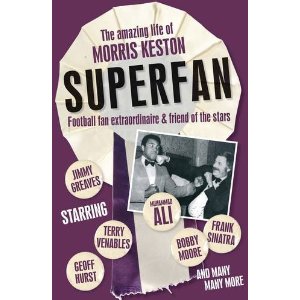
Morris Keston – Superfan

Imagine sitting, say, on a train or in a pub. You’re having a relaxing chat about football with one of your best mates. He’s brought along a couple of other people, you’re introduced and get on really well with them. The conversation and the beer flows, a good time is had by all. It’s a familiar enough story for most of us, one of the pleasures of being a fan, and something we share with long-time Spurs fan Morris Keston. The only difference is that he’s sitting next to Bobby Moore, who’s brought along half the 1966 World Cup squad for company.

Since he began supporting Tottenham Hotspur in the mid forties, Morris Keston has watched them nearly 3000 times. He’s followed them all over the world, whether it be a major final or a meaningless friendly, not that any Spurs match is meaningless for Morris. He curses his triple by-pass operation because it broke his run of watching every home game since the early fifties, but he missed just the one game.  Not only that, during this period he’s known most of the Spurs and England players and counts everyone from Moore, Greaves and Hurst through to Jennings, Venables and Crooks as personal friends. You name them, he name-drops. The book’s title is no publisher’s hyperbole – Superfan he most certainly is.

Most Spurs fans of my generation have probably heard of Keston. Often interviewed over the years, he’s featured in the Glory Game, Hunter Davies’ classic inside story of  the club’s season in the mid 70s, where he incurs the wrath of the board because the players chose to attend his ’67 Cup Final celebration party rather than the club’s official function. I always regarded him with a mixture of envy and resentment. Although I’d kill for the chance to mix freely with my heroes, as an equal, I begrudged the wealth that bought the travel, the parties and, frankly, access to the club. The reality is somewhat different. Keston is indeed a successful businessman but he started from nothing. Brought up in the Jewish community of the East End, he was evacuated during the war but suffered from malnutrition because the care he received was so poor, a not untypical story that remains largely hidden because it is at odds with the myths of Britain in wartime. His mother figured he would be safer in the comfort of his family, despite the rigours of the Blitz, so he spent the rest of the war in London, earning a scholarship and beginning a lifelong obsession with football. Leaving school at 14, he was sacked from his first job in a barber’s after he refused to work on Saturday afternoons. Eventually he got into the schmutter business, schelpping around the country for a fortnight at a time, taking in third division reserve games and any football that he could, and co-ordinating his return to London with the home fixture list.

There’s little more about these fascinating early years here, a shame in my view but then again that’s not the story. Or rather stories: this book is a series of entertaining tales and anecdotes about Keston’s relationship with football and the people in the game.  They are mostly Spurs related but not all. He knew directors and players at other clubs clubs including Chelsea and Stoke, and was personal friends with almost all the Boys of  ’66. Oh, and for good measure Frank Sinatra and Muhammad Ali. As you do.

Some remind me of those speech bubbles in Roy of the Rovers, where they begin by summarising the plot in case you missed last week’s episode- Voice in the Crowd – ‘Melchester have to win this 3-0 after the bruising encounter in Poland where Blackie was butchered then sent off’. Second Voice: ‘Yes, and the club will go bust if we don’t reach the next round and Roy’s girlfriend was run over by the team bus’. But never fear – like any good storyteller Keston is quickly off and running. It’s an easy, pleasant read that rattles along, and will undoubtedly carry you along with it.

His access was astounding. Moore, Hurst, Greaves and others regularly popped in for a for a cup of tea during the 1966 tournament. He stayed in the same hotels and travelled on the same planes when Spurs and England went abroad, and could get a seat in the director’s box for most games, the only exception being at the Lane, where the Wale family who ran the club in the 60s and 70s regarded him with suspicion. He sat alongside Terry Venables (Uncle Terry to his children), holding a seven figure cheque as they waited in vain for a call that would have transferred ownership of the club from Irving Scholar. Business and financial advice to a legion of players, chairing testimonial committees, negotiating transfers, all in a day’s work. And those parties.

Perhaps the most telling anecdote comes not from the author himself but from Graham Souness, who Keston helped out as a cocky 16 year old tyro. Now Morris had nothing to gain from that, no prestige or kudos. No one knew who the hell this anonymous apprentice was. He did so because he wanted to, because he cared about the club and the young players. And yes, the parties, but the players came round for a cuppa and a slice of his long-suffering wife’s apple crumble.  He entertained in his home, with home-made cooking, and although it’s not acknowledged specifically here, that’s the real secret of his appeal. He emerges not as a glory hunter but as a homespun, friendly and generous bloke, often a little star-struck, who is deeply in love with football and Tottenham in particular.

It will appeal more to the older Spurs fan and it’s great fun. There’s little analysis of how the game has changed over the years – that’s not the aim of the book. However, ultimately it’s a tale of a bygone, arguably better era, where you could turn up on the turnstile and get in, where players were open and willing to chat rather than be surrounded by a forcefield of PR and agents, where players understood that they and the fans are one and the same, not a different class.

The Amazing Life of Morris Keston – Superfan by Morris Keston and Nick Hawkins   Published by Vision Sports Publishing.

Look out for book signings with Venables, Jennings, Hurst and others in and around London


Add to FacebookAdd to DiggAdd to Del.icio.usAdd to StumbleuponAdd to RedditAdd to BlinklistAdd to TwitterAdd to TechnoratiAdd to FurlAdd to Newsvine