The day began basking in the warm glow of the celebration of the life of Bill Nicholson, the greatest figure in the long and distinguished history of Tottenham Hotspur Football Club. It ended in ignominy as Spurs folded the moment the slightest pressure was applied to their fragile egos.
I’m still struggling to wash away the stench of complacency that lingers like the odour of smoke and stale beer from a night out in a 70s pub. This shower are happy to strut and showboat against inferior opposition in midweek but disappear as soon as they are required to step out of their comfort zone. The intelligence and effort required to hold onto a lead or fight back is apparently beneath them. When they said ‘wear white for Bill’, I didn’t think waving the white flag was what the club had in mind.
Embed from Getty ImagesSpurs eased into control early on and maintained it throughout an undistinguished first half without playing especially well. They didn’t have to. An injury-hit Newcastle side low on morale and points offered little resistance. We made fewer chances than we should have – Chadli missed the best of them – but had the comfort of Adebayor’s far post header from a carefully considered cross by Ryan Mason.
Oblivious to the big bloke on the left who came on for the second half, Spurs were undone by the cunning ploy of him getting the ball and running towards our goal. Unchallenged, unnoticed by some defenders, Ameobi scored, the only dispute being whether it was after 7 or 8 seconds. Utterly inexcusable. The whistle had gone but really, the cheek of starting a game before we were ready. At least for their second we tried to get in the way, another run down the left, Sissoko bulldozed through puny challenges before a cross found the smallest guy on the pitch, far too good in the air for our international centre halves.
Embed from Getty ImagesFrom then on, Spurs had no idea of how to score. Eriksen briefly flattered to deceive then faded into the morass with the rest of this sorry bunch. We shuttled the ball back and forth across the edge of the box, with each man holding on to the ball just long enough for them to be tackled. Could not keep the ball. I’ll excuse Rose, always available on the left even if not every cross was accurate, and Mason, who seems to be the only one who’s read the memo about playing the ball quickly and forward. Lennon came on to add pace and width, and resolutely kept as far away from the touchline as possible. This was beyond tactics, it was just stupid.
Last weekend I tried to pick the bones from a performance of contradictions. There was good and bad, progress since Pochettino took and regression. Now I think we have a clearer idea of where we stand.
The striker problem has been done to death. Levy has left us ludicrously short of options. Thursday night was part of Kane’s development not a sign that he’s a matchwinning Premier League striker, although I’m delighted with his progress. Other things that in the recent past I have noted but left as asides or footnotes have come centre stage. Kaboul’s heroic performance at the Emirates could, should have been a sign of much needed resilience. Instead that good game is the blip amidst a mediocre run. I read about his inability to motivate as captain – that’s not the problem. He needs to play better, especially alongside Vertonghen who’s just coasting. And if the mananger’s key job is to judge players, I question the wisdom of putting so much store in a man who has lost the spring and suppleness that made him stand out, or for that matter selling Dawson when there’s no effective back-up.
After the QPR game I characterised Lamela as our hero in waiting, and supporters have waited so long for such a figure. He doesn’t seem to want it. Rabonas are for the hipsters and the showreel. Easily crowded out by defenders when he has the ball, off it he doesn’t cover. No coincidence Newcastle put that big bloke on our right. Dier was exposed: suddenly he looked so young, the aura of strength and promise slipping away. Mason screamed at Lamela, “F**king get back”. He didn’t.
Eriksen unable to control a midfield. Chadli happy when he can play the game at his own pace but unwilling to graft when that’s required. He was not alone. Our hopes for goals largely rest on that midfield three but all they gave us was indifference.
Most worrying of all, we do not have the players to suit Pochettino’s style. A pressing game, early forward passes, high tempo – if these are his trademarks this group of players are not responding. It’s noticeable that Mason, the player who does, is young, new and so presumably willing to listen and learn. Lamela, Chadli and Eriksen remain resistant. Yesterday Poch was unable to influence matters on the pitch. This unresponsiveness from the players does not auger well for the future and is of grievous concern, given that by and large this squad will take us through to the end of the season.
No doubt you’ll read invocations of the spirit of Billy Nick in stark contrast to the lack of commitment and application of yesterday’s team. There’s a great deal of truth in that. Nicholson would indeed have been furious at the sight of such a sorry spectacle but it’s not as if he would have been unduly surprised. On plenty of occasions during his reign, Spurs’ soft centre was laid bare and the slow handclap echoed round the Lane. He may have set the standards but many times the players failed to achieve them and not in the ‘defeat has echoes of glory’ sense either. I’m talking about inconsistency and defensive openness.
There are differences though that the players, manager and board would do well to reflect upon this week as they try to turn things around. In the current climate, Nicholson would have faced persistent calls for his dismissal in the media and from supporters on social media. Spurs finished 7th, 6th and 11th in the 3 seasons following the ’67 Cup win. After the glorious Cup Winners Cup victory in 1963, league form was patchy – 6th and 8th in the next two seasons. The League Cup wins in 71 and 73 would have been adversely compared with the Double and Europe – ‘only’ the League Cup.
In fact, these seasons demonstrate Nicholson’s great strength as a manager – he rebuilt teams, twice, going on to success each time. He wasn’t dismissed. He was allowed to choose his own players, albeit within a constrained budget. He was given time.
The other difference is Nicholson’s personal committment. This was no golden age of unbroken glory. He watched many poor performances and it hurt him, deep inside. I doubt very much if anyone at the club felt that pain this morning.
To celebrate his life, I did exactly what I normally do at every home game. I think that’s what he would have wanted. ‘Wearing white for Bill’ is OK as it goes. I’m not sure signing the wall in the club shop is quite the appropriate tribute but if people want to sign, why not.
Yet on the same day, there are more stories in the papers about a possible move to Milton Keynes while the new ground is built, something that supporters in the recent Trust survey overwhelmingly opposed. I don’t know anyone who understands why the club would consider this even for a millisecond, let alone be in favour of a move.
Once again it was left to supporters to say the one thing that truly matters right now. A flag in the north west corner displayed another quote from the great man: “We must always consider our supporters for without them there would be no professional football.”
Signing a wall or buying a shirt with Nicholson’s name inside the collar is marketing, not involvement or a tribute. To me, it’s an insult. Yesterday the stands, the trains home, the burger queues, all were filled not with anger but with apathy. The distance between club and supporter inches ever wider. It’s no way to run a football team.
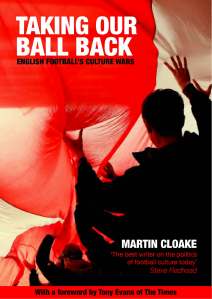
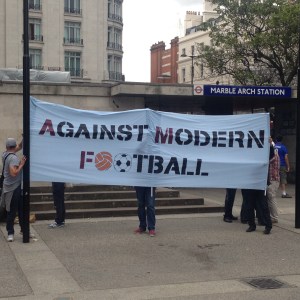 There’s plenty of fascinating detail but Martin is not afraid to confront the big questions about the future of football. This is about a battle over the definition of what football is and what it means to be a supporter, timely given many are questioning their . Many of the examples are familiar to Spurs fans and readers of this blog. He piles into Stubhub and the ‘Y word’ debate is a perfect example of how the law has been used unfairly to target football fans. His incisive approach to the football authorities slices through the hypocrisy and flannel. Throughout explicit links to history and culture provide perspective and solidity that’s absent from most debate around these fundamental issues. For example, the discussion on the ‘new ultras’, including our own 1882 movement, is situated in a broader context of oppositional culture and protest. The very different topics of business and football and the law in football, vital but often overlooked, are placed in context too.
 TOTTENHAM ON MY MIND