Tottenham Hotspur desperately need a player like Emmanuel Adebayor. His strength, pace and goalscoring ability on the ground and in the air will if all goes smoothly become the long sought after focal point for our attacking play. No one who was at the Lane to witness his exquisite volley in the 3-1 defeat by our neighbours will need to be convinced – it’s seared in my brain, probably forever, which can’t be said for many of the goals we’ve scored since then.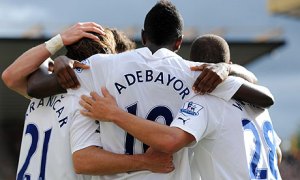
So the real question is not do we need Emmanuel Adebayor but why does he need us? Specifically, and let’s not beat around the bush here, why does he want to play in front of fans who have given him dogs abuse, more calculated and vile than any I can recall in over 40 years of watching Spurs?
That Song is nasty, brutish and racist. Many say that’s not a legitimate interpretation. I wrote about this last year and nothing I’ve heard before or since has altered my opinion. I am neither a prude nor averse to the abuse that crowds dish out during matches. In fact, there’s a powerful argument to say that abuse is all fans have left in the face of intransigent and distant administrators, a game driven by profit and power and players who value money and celebrity above pride in their performance.
Despite this, there are limits and this song goes too far. In so doing, it shames the tradition of tolerance in the stands at Spurs. We are rightly indignant when subjected to the equally despicable insults relating to the yids tag, especially as no one does anything about it, indeed in some quarters we are blamed for bringing it on ourselves. However, in the dark days of football racism in the seventies and eighties, when WHam and Chelsea fans racially abused their own black players, when bananas were routinely chucked onto the pitch and not as an energy aid, you never, ever saw that at Tottenham. Yet this song is sung out of habit these days, when until recently the player had nothing to do with us, didn’t even play in the same league. I’m not particularly aware of him having a real go at us, although I am happy to be corrected. Not in the way Terry and Lampard, Henry and Pires have gone out of their way to taunt us.
The song is sung just for the delight of it. He first heard when his father had been dead for less than a year. And we are not the only ones. L’arse sung it when he scored against them for City after his infamous length of the field run to their end.
So in the face of this extraordinary abuse, which he heard for himself at the Bernabeu only a few months back, knowing the fans detest him, he signs. If he strung us along until deadline day only to spurn us at the last second, I wouldn’t have blamed him.
The easy answer is ‘money’. No doubt there’s plenty on offer, not just in terms of matching his salary but also a hefty bonus for signing on the dotted line. However, that’s not the sole reason because he could have achieved that aim by staying where he was or by accepting the other offers that were around.
Professional pride is a factor. He wants to play regularly and knows he will be first choice at Spurs. Harry made him welcome and despite any misgivings about his image expressed on this blog and elsewhere, his reputation with most players is justifiably high. Our style suits Manu perfectly, and if it all goes according to plan, he will be a star again.
Yet professional pride can’t be the full answer because there’s plenty of evidence portraying the striker as disruptive and selfish. At our neighbours he became bored and agitated for a move, cited in the process as an unwelcome influence in the dressing room, while at City he had a right sulk on after being left out, including a fight with one of his team-mates. When the mood takes him, he’s not professional in the slightest.
For us mere mortals, it’s nigh on impossible to fully understand the psyche of a professional footballer. They’re like you and me, flesh and blood after all, yet so different at the same time. In your world, whatever your job, if you had been viciously and publicly abused over a sustained period by your main rival company, would you go and work for them for the same money and if you had an alternative job offer? At your sales conventions, in the pub, in your trade press, you were the butt of all the jokes, now you’re on the payroll. I wouldn’t, and I’m the most reasonable man I’ve ever known.
Some players deal with this by being mercenaries, flitting from club to club with little or no loyalty to anything other than themselves and their paycheque, but that doesn’t ring true in this case. There’s something more to Adebayor. Many professionals react to the pressure by retreating into their own world as a form of self-protection. They assiduously guard this sense of self-worth, to the point of absurdity at times where their self-importance becomes arrogance. However, without their self-confidence, they are lost, unable to cut it in the face of the demand to succeed in the public eye, endless analysis of their faults compounded with stark abuse from fans. In Adebayor’s case, this resilience is not just about football, it’s survival.
The messageboards and twitter greeted Adebayor’s signing with a flood of suitably positive new versions of That Song, and very amusing and self-depreciating they were too. In a small way I like to think I set the ball rolling. Granted my effort in that article last year is unlikely to be adopted by the Park Lane – “Your father undertook a series of menial jobs despite the probable stigma and damage to his self-esteem in order to care for his family and give his son the best possible opportunity to further his footballing career.” It doesn’t even scan but has the advantage of historical accuracy.
 Manu was born and raised in Lome, a town near Togo’s border with Ghana, where in order to eke out a living for her son and his 5 siblings, his mother sold dried fish. One account states that his family were so poor, they could not afford to pay for medical treatment so he was left in the hospital for a week or so. At 11 he was staying in a football academy close by a border where drug and arms trafficking was rife, moving on to France in 1999. This in an era where England’s internationals complain about the pressure of being in a 5 star training camp for a few weeks.
Despite his wealth, Adebayor hasn’t forgotten his roots. He’s built a house for his mother and family as following his father’s death in 2007 he’s taken responsibility for the household, and he regularly returns to his country to put something back into the society from which he escaped because he could play football.
Perhaps it’s not merely a common language and heritage that cements the friendship between Benny Assou Ekotto and Abebayor. Both have known hardship in their early lives, both present a detached attitude to the game that does not detract from the quality of their performance. They are self-contained, secure and confident in their sense of self. It gets them through.
This inner strength was tested to its limits and beyond when along with his Togo team-mates, Adebayor clung for cover in the twisted wreckage of a bullet-ridden coach as it was attacked before a tournament. His friend, the team’s press officer, died in his arms. He’s lived a life most of us could not imagine and he’s only 27. Perhaps the songs don’t have the same impact.
So there’s plenty to admire in Emmanuel Adebayor but the reasons behind his success mean that we’ll never become that close to him. And what does it say about us, the fans? Most didn’t sing that song, of course, but many have, and anyway he was on the receiving end of more than his fair share of abuse just for wearing the red shirt.
We’ll never take him to heart but I believe he will receive a warm welcome tomorrow and he will earn our respect if he gives of his best, as his former team-mate and fellow subversive Willy Gallas has done. Fans of all clubs are often accused of hypocrisy and there’s truth there. However, our loyalty is like no other in sport, in life perhaps, and that loyalty, blind, crazy, illogical, harmful, unwavering and unstinting, is to the shirt, to the club. Our club. That’s the point from all this.
In my own silly immature way, when Manu first comes over to the centre Shelf tomorrow, I’ll shout his name and applaud. He’ll hear me and I like to think it will mean something but it won’t. And if he scores, and runs over to the fans, and the fans sing his name, if he winks and raises an eyebrow in ironic surprise, I wouldn’t begrudge him his moment. Good luck to you, Manu. You’re one of us now and we’ll look after you.
 TOTTENHAM ON MY MIND