Tottenham Hotspur That Was The Season That Was. The Manager

Harry Redknapp has met me. Years ago my neighbour at the time organised a testimonial for one of the Charlton players against West Ham and my wife’s family are rabid Hammers, so there we were in the director’s box at the Valley. Before kick-off Peter waves to me and beckons me down to the front. I’m happy to thank him but he says, “Where are the rest of you? Come and meet Harry. Harry!” he shouts, “Someone I want you to meet.” Harry strolls over, is as pleasant as can be as we exchange a few words and the photo, once pride of place in my wife’s daughter’s living room, is now shoved behind a cupboard in their loft but I’m there, hanging back and forcing a smile.

Peter Varney and I used to work for Lewisham Council – he was something in building – and we got to know each other better during the 5 week strike over, well, I forget now but it was important. Lovely bloke and a good neighbour. He used to cut the thick hedge that divided our front gardens and it was only when he moved that I realised it was on my side of the line but he never mentioned it. A lifelong and long-suffering Charlton fan, he did a bit for the supporters club and for charity. We’d be chatting over the fence and his wife would call out, “Pete, phone. Again!!!”

“Coming. Who is it”.”

“Kevin Keegan”

“Tell Kev to hang on a minute, I’m busy.”

Although he was too modest to speak about it, he must have been good because one day it was announced that Pete was the new CEO at Charlton. From humble beginnings on the picket line, he was in the boardroom and moved away. I, um, downsized.

I never took to Harry. I wanted to, for him to be the football man with a heart of gold who brought success to clubs in the right way. Fact is, my image of him has been tainted from the start as my wife’s family chronicled his dodgy wheeler-dealing that left him in pocket (allegedly) and successive clubs in a ruinous state financially. I refused to succumb to his assiduously cultivated persona of all-round good ol’ Uncle Harry. It was none of my business, until a couple of years ago anyway, but I don’t like being manipulated. Despite his generosity towards me, perhaps I was the first of those ungrateful Spurs fans he’s told to go elsewhere.

Never mind the man. My club comes first, last and always: there’s only one question, what has he done for Tottenham Hotspur? I’m genuinely and sincerely grateful for the progress we have made since Redknapp became manager. It’s not just about the league position, although I’m convinced those advertising boards that form the post-match interview backdrop flash subliminal messages saying “2 points after 8 games”, lest we forget. For me it’s also about the pleasure of watching wonderful footballers in (almost) white shirts playing scintillating flowing football. No trophies but everlasting memories. All Spurs fans are disappointed that we failed to qualify for next season’s competition but let’s just pause and say it out loud: “In 2011 Tottenham Hotspur reached the quarter finals of the Champions League.” Enjoy the sensation. One of the problems of the modern game is that we never stop to savour the feeling, it’s all about what happens next. Relish it, taste it, roll it round your tongue and chew it over, because these moments don’t come around that often. Then think back to February or March last year and tell me you believed that was possible. Be honest.

Yet our undoubted achievements this season have been tinged with regret. It’s realistic rather than greedy to say we could have done so much more. Our woeful lack of firepower up front has been the main problem – the strikers  have been downright dreadful for much of the time. Coupled with regular disappearing acts from our defenders and keeper (where the hell did they go?), we failed to dispatch teams we should have beaten. Had just a few draws become wins then we would have overtaken Arsenal and secured 4th place.

Redknapp has to take some of the blame for this, yet he appears unwilling or unable to do so. Win and he basks in the glory. Lose and it’s down to the players. Harry has infamously been dismissive of the value of tactics in the past. He doesn’t really mean this of course, the very last thing he can be accused of is naivety, but he likes us to think he sends the players out to, well, just play. However, he has to take some greater responsibility for our performances, good and bad

The regular selection of Crouch encouraged the use of the long ball. Earlier in the season it went straight down the pitch, often too early, varied as time went on by the player pulling away to the far post, hence the long looping ball. When Pav played, we did the self-same thing. Whilst this brought some rewards, too often it negated the advantage gained from our skilful, clever midfield. Luka and Rafa don’t want to see the ball flying over their heads. Defenders have a fair idea of where the ball will go, therefore it’s easier to handle. Too frequently our strikers were ahead of the ball, stationary and waiting for the ball at the edge of the box. Problem is, the defenders are waiting too.

Also, and as a lover of attacking style it pains me grievously to say this, we were often too open to succeed in the Premier League. Although we developed greater resilience and an ability to hang on to possession, we lost it more easily than we should have on too many occasions and the midfield did not work hard enough to tuck in and protect a lead. It’s not about outright defence, rather, it’s about adapting to the conditions on the pitch. That’s the way it is in this league. This is tactics. This is the responsibility of the manager.

Redknapp’s great strength is that he is good with players. He takes their skills, fits them into position and asks them to do what they are good at. Find a group of players whose skills dovetail and you have a fine team. That’s why players always say they like playing for him, because he plays to their strengths. Nothing wrong with that and his loyalty to some men by giving them a run in the side has meant Bale, Dawson, Assou Ekotto and latterly Sandro have developed their full potential.

He’s more shaky when there’s a gap. He doesn’t adjust or enable the whole side to be as flexible and mobile as the best teams. For example, if Bale was out or he felt compelled to squeeze Van Der Vaart into the side we struggled because we did not have another man to step in to play the same role. Square pegs in round holes. Modric shifted to the left, unaccountably taking our finest player from his best position or Rafa wandering aimlessly  from the right. Also, if he has it in for you, it’s less Uncle Harry and more evil stepfather. Bent was never played in the right way, back to goal too often when he likes it in front of him, then ridiculed and off elsewhere. What we could have done with half the goals he’s scored since he left.

Redknapp is immune from criticism and has taken umbrage recently against Spurs fans who have dared to go where the media refuse to and question his tactics, selection and status. I first commented on this a few weeks ago after the West Brom game. In an age where the media unstintingly dissect their subjects like a pathologist dragging out the innards of a corpse then examining the entrails under a microscope, his protection is a truly remarkable achievement. I can’t recall any sustained critique of his era at Tottenham from a professional pundit. Any suggestion of negativity is met with snorts of derision, not even considered but immediately and forcefully ruled out of bounds. No other manager is shielded in this way, not even Alex Ferguson. Nothing sticks.

Harry would do well to remember that we the fans were here when he came and will be here long after he’s dumped us for the England job. He can’t control us the way he looks after the media. He’s done a good job for us but should also look back to his appointment and be grateful because his record as a manager didn’t merit the role. I’m sure he’s as frustrated as we are at some of the problems, so why can’t he acknowledge that and share the pain and joy we’ve felt over the past 9 months.

Redknapp must carry on as manager. Consistency is key and the process of team building should continue. Above all, he must hang on to Modric, Van der Vaart, Sandro and Bale. Sell his grandmother and his precious Sandra if he has to, just the build the team around these gems that he did not unearth but has polished almost to perfection.

This man of the football world is still learning, even in his early sixties. He’s never been in this position before. He’s had little experience in Europe, let alone the Champions League, or at the top end of the table. Neither has he previously worked with players this good nor been in a position to buy the highest quality footballers. No more bargains or cheap but useful veterans for the short-term. Never mind the team, he has to step up in quality too, like managers with 15 or 20 years less experience in the game. I have the niggling feeling that he’s an old dog who can’t learn any new tricks and shed the underdog mid-table mentality. I desperately want him to prove me wrong.

Pouring over his individual comments has little value but over time you get a broad sense of what he’s up to. At the moment he’s gone on the defensive, talking down our ambitions and dropping hints to Levy that we need the money to buy quality this summer. It’s familiar territory, as is the rubbishing of the fans. Most of us do not have over-inflated expectations. Within our frustrations we realise both the potential of the club and the work still to be done. To fulfil that potential, Redknapp has to move out of his comfort zone in terms of the players we buy, the way we play and the manner in which he relates to the fans. He has to work hard this summer. I for one look forward to August.
Tottenham Hotspur That Was The Season That Was – The Players

The second in a series this week – the Players

Rubbishing Crouch and Jenas, demanding a wholesale clear-out, insisting on bids for every striker in La Liga. If only it were that straightforward.

It’s not just about the individuals, it’s where they will fit into the shape of the team as defined by our tactics and how they combine with each other in crucial areas of the field such as up front and in central defence. It’s also going to be a busy old season, with two European games before the end of August let alone the league and two cups.

The absurd demands of the Europa League mean that we have to have a squad capable of playing consistently well over a long period of time. Old heads to steady the ship alongside youngsters who should relish the chance not only of first team experience but also of reminding the manager that they deserve a step up into contention for a league start. We have much to learn in this respect – last season we could not rotate the squad to any extent without significantly reducing our chances of winning.

Redknapp has some big decisions to make regarding our approach next season. In the previous piece I advocated a more cautious approach – reality dictates that our open formation neglectful of our defensive responsibilities will not bring sustained success.That doesn’t mean we have to be dull and boring – that’s not what I want from my Spurs and that too does not win trophies. It’s asking a lot but we have the nucleus of a team who are able to deliver, better perhaps than for twenty or thirty years. Top class players who could be the heart and soul of a consistently successful team for years to come.

Some of those partnerships are well defined. Our strikers have looked lost and lonely for much of the season, an estranged couple waiting for the divorce papers to come through. At the back Dawson’s game has improved but he’s mightier still alongside Ledley’s pace and anticipation. Other combinations are no less important, however. If our wide midfielders are going to attack, perhaps they are better off having a defensive minded full-back behind them, who prefers to stay back. Alternatively, a flank combination of full-back and attacking midfielder is potent going forward, then an extra defensive midfielder to slide across can protect us at the same time. It’s about equilibrium – change one part of the system and the rest has to readjust to maintain the balance.

Finally, one formation isn’t enough. We need not only to have  plan B at our disposal, we should be comfortable  and familiar with any changes necessitated by the strengths and weaknesses of our opponents or the need to change gear during a game.

The very roles themselves have been altered by the demands of success in the modern game. Flexibility has a high value, the ability to be mobile and alert physically and mentally, to play a variety of roles often within the same minute or two never mind in the same game. Midfielders have to defend whether they like it or not. A player like Defoe suffers because he’s geared to do his best work in the box but doesn’t bring other players into the game. In the crucial position of defensive midfield it is no longer sufficient to be able to run and tackle. You have to be able  to pass the ball and turn defence into attack.

Goalkeepers

Ah Gomes, you were so nearly the love of my life. Our very own cult hero, derided by many, we could see the potential. We nurtured and protected you until the world saw what we already knew – you could really do it. Until this season when you kept chucking the ball in your own net. Overall he’s not had a bad season, making many vital saves almost as a matter of course. The problem is, the high profile cock-ups have ben recent and stick in mind. Better on crosses lately, the real problem was not the soft one against Madrid or Chelsea (although of course actually that was a save because it didn’t go in) but the panic shown against Blackpool and earlier versus Inter. Mad dashes off the line are one thing but pulling down players for no real reason indicate a lack of composure essential for any reliable keeper.

Reliable, that’s all we need. Solid rather than spectacular will do, good handling, takes the crosses, cuts out the mistakes in front of a sound defence and maybe doesn’t always get into the top the corner. I’d keep Gomes unless we can buy a world-class upgrade.

Cudicini has been a capable back-up but we need more. His legs have lost their spring and anyway I’d prefer to see someone challenging Gomes for the first team place rather than just hanging around for injuries. Pietklosa came well rated but ignored, while if Alnwick cost a penny it was too much. His signing shows the dangers of buying a back-up as opposed to someone who could mount a proper challenge for the first team.

Defenders

A few weeks back i started selling the house and all my possessions, not for the Rapture but for a charitable medical foundation with the sole aim of healing Ledley knee. A true Tottenham great, I raved about him a couple of weeks ago. His magnificence radiates not just from his pace, ability to read the game and perfect timing, it’s his dedication to just playing. he’s adapted his game, using short scurrying strides when once he strode across the turf, minimising his running to save every last drop of energy for the few yards that take him into the right place at the right time. The many fans who wrote him off should be ashamed of themselves. They failed to recognise the willpower of the truly great.

However, he can’t play every game. Dawson can, or appears to want to. Undeterred by a serious injury sustained whilst playing for England. he’s come back stronger than ever. He’s learned to deal with his lack of pace and doesn’t plough in high up the field, timing his interventions with assurance. He does his best work  in the box, however, as does Gallas, so Spurs benefit from some defensive midfield protection. This was conspicuously absent in the matches where our back four were stretched. Any defender on the planet looks uncertain if left exposed and vulnerable.

Gallas and Assou Ekotto both demand special praise for outstanding seasons. Harry’s best acquisition, once fit Gallas has proved himself a fierce warrior. His performance at the Emirates was one of my highlights of the season, his goalline clearance against Milan one of the moments. No hint of the dressing room disruption that has tainted his reputation. On the contrary, everyone around him must surely learn from and respect his attitude. In two or three games he has been injured yet played on as if nothing happened. At the Lane I sit close enough to the pitch to see his pain was real, yet he simply will not bow to the pressure.

If Redknapp likes a player, he will give that man a chance. Although Benny appears not to be moved by anything much, he’s taken his chance, upped his game and become a canny consistent footballing full back, good touch, bit of pace and neat on the ground. He still makes mistakes, usually due to his welcome obsession with not conceding possession – ironically he tries so hard to hang on to it for the team rather than wang it away that he ends up being caught – but the moments where his brain checks out have virtually disappeared. He still needs to tuck in closer to his centrebacks, though.

Another player given his chance by Harry and who has taken it is Kaboul. Sometimes he still looks like an overgrown Labrador puppy but once those growing pains disappear, we have a top class centre half versatile enough to cover at full back. These things are important if we are playing over 60 games a season with squads limited to 25. Another one with a great attitude.

Woodgate’s demise seems to be premature with rumours of a pay as you play deal on the table. Only the club know his true fitness but it will have to be good to get a squad number, given that Ledley will certainly be there.

Less good news on the right flank. Corluka has been extremely disappointing this term. We’ve seen little of the positional shrewdness and strength on the ball that used to cover his chronic lack of pace, whilst his distribution has not been up to previous standards. I still see him as a centre back playing out of position. With Hutton, it’s the opposite – his pace can’t make up for his dreadful positioning. He has no future here.The speed of  Walker’s development has certainly surprised Harry but he will be first choice and vindication of our policy of armin gout young players to gain firs team experience, although from what little I’ve seen, he has work to do on his defensive play.

Bassong needed a run but never quite deserved it on the basis of his play. he had a good subs appearance marking Drogba but fatally he lets players get behind him

Danny Rose. Was he a winger or a central midfielder? No, he’s a full-back and a damn promising one at that. Remarkably good positioning and determined in the air, he’s definitely a first team squad man.

So we are in good shape at the back. Bassong will probably depart although he has the ability to stay, and we will go for another centreback, It’s up to the coaches to weld them into a unit – the raw material is there already.

Midfield

I have never made any secret of my love for Luka and I remain besotted despite his many other suitors and admirers who belatedly have succumbed to his charms. My eyes linger for a fatal fraction of a second after the ball has left his foot, just to see him run. One of my moments of the season was against Newcastle, when as the knee-high tackles flew in, three opponents descended upon him in the centre circle, scenting blood. Waiting until he could feel their breath on his collar, he dropped one shoulder, left two of them stranded, beat the third and was away in a flash, the same focussed, purposeful expression on his face, already looking to shift the ball forward in search of an opening. World-class, he makes football beautiful. One of my favourite players of the last thirty years.

Gareth Bale suffers from being too good. Fans’ expectations reached absurd heights, then he gets criticised for not doing the impossible. This is the Premier League not Melchester Rovers. He’s marked by two or three players most games so he can’t run through the lot of them any more. To me it is astonishing how often he almost does. I’ve never seen someone as big and powerful with such pace and touch. If our strikers had been half decent he would have twice as many assists. He delivers more than enough excellent crosses despite the attention he receives now, and his exploits against Inter are the stuff of legend. Long term his best position may be full-back, where his height and pace will be handy in defence and he can make runs from deep.

Sandro is the discovery of the season. His performances against Milan were those of a man who’s played 210 games, not 10. He’s everything a modern DM should be – moves well, slots into the back four and tracks the runner, yet in a trice is up the other end, and he can pass it too. Genuinely a world-class prospect, he and Modric are already a magnificent pairing and could be the cornerstone of years of success.

Pienaar will fit in well next season: his movement and passing can keep attacks going. I’m less enamoured of Kranjcar, Jenas and Palacios. The former may be able to hammer the ball in from distance but he’s overweight and does not work hard enough. If a theme of this year has been the way several team-mates have made the most of their opportunities, he seems intent on wasting his considerable talents, although to be honest he’s had little chance to shine of late. I always liked JJ although he’s so frustrating. he seems to have the ability to do anything and everything, effortlessly, yet he’s never consistent. His arrival as sub has injected drive in the second half when we have been flagging but he’s now in Sandro’s shadow. Palacios is more of an old-fashioned midfield ball winner and does not either pass the ball well enough or tuck himself into the back four when required. We may have outgrown them all.

Lennon’s game is still developing and he’s come on again this time but his final ball, although much improved, needs further polishing. He’s a fine sight whizzing down the wing: his future to me is more about the shape of the team and whether we can afford to have so many attack-minded players in the team at once. Believe me, I hate to say this, but he and Bale have to work back more than they do.

Hud did well before his injury. We seemed most comfortable when he slotted in in front of the defence and we don’t make the best use of his passing range. For someone who once played centre half, he has little awareness of his defensive responsibilities: it’s partly his stature but mainly he does not have that sense of anticipation. A fine player, if he had that first yard in the head he’d be a world-beater.

Van der Vaart was a steal at £8m. We’ve learned enough to know that he must play in that free role between the midfield and the striker. More about this in my final segment of this series, about the future, but suffice to say I would gear the team to play to this strength, perhaps sacrificing a winger and definitely finding a striker who can genuinely play up front on his own. Rafa can play off and around him with the midfield piling through to help out.

Once again we have riches almost beyond my dreams. Another wide man with different skills to those of Lennon to prevent Luka being moved wide is on the cards and perhaps some experience for the long haul ahead. Again the coaches have to the get the formation right. If Hud could lose 7 pounds, who knows?

Strikers

This is the shortest section but has been the biggest problem all season. Shortest because I’ve been banging on about the same things all season, most recently in the previous blog post.

Crouch is immobile, his touch is dreadful and his accuracy from the balls he wins in the air is poor. We’ll always get something but I want more than a percentage game. Moreover, his mere presence encourages the high ball, thus negating the advantages presented to us by the skilful players in the rest of the team. If he hammered in towards the goal with headers, touches and deflections, that would be fine, but he doesn’t know where the goal is half the time and a nudge in the back takes him out of the equation.

Pav is great if he has the time. Many of his goals are scored when he can push the ball a metre or so ahead of him and move onto it. Sunday was the prime example. The reality is, this seldom happens in the Prem and his touch lets him down more often than not.

Also technically poor is Defoe. Erratic ball control, inadequate positioning and a reluctance to get in where it hurts in the box have led to a poor season punctuated with a few great goals, again when he has the space to move onto it. He’s worked harder than ever (not on Sunday) and his link up play is better but that does not mean it’s up to scratch. Hugely disappointing.

In this department, major surgery is required.

The rest

Some players have not been around for a while and we’re never going to see them in a Spurs shirt again. Keane has been an example to every professional footballer that the grass is not always greener. Stick to what you know, where you feel comfortable, and it will bring out the best in you. I’m sure he’ll find another club that he supported as a boy.

I was all for the signing of David Bentley – he worked hard and his crossing would be just what we need, so I take no pleasure in identifying why it’s not worked out. The signs were there early on. Suddenly he began to appear in the media, opinion pieces and interviews. His agent was shaping him to be the star he was in his own head but he failed to realise you have to work at it. He didn’t have the nouse to realise that alongside Modric and others, he could cover up his inability to beat players and his lack of pace. A real shame.

Dos Santos never showed any consistent talent. To be fair to him, he was always stuck on the wing (small and skilful, see) whereas for Mexico he has a freer role across the pitch. Levy will have to take the hit on all three.

Next – the manager

Ledley’s Knee Beats Liverpool

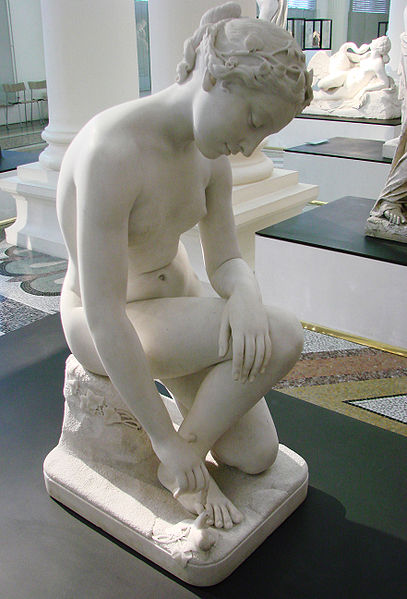
What the new ground needs, wherever we may end up, is a statue. It’s the thing these days, dignifying our improvised chaotic representation of beauty with the use of an art-form that stretches back beyond antiquity. Wolves and Wembley have had one for a while but there’s been a spate in the last few years. Bremner outside Elland Road, grinning wildly whereas to make it lifelike he should be scowling into the eyes of opponents spreading fear and loathing.  Jimmy Armfield stands outside Blackpool’s ground, all fitting tributes to true club greats and then at Fulham there’s Michael Jackson.

Outside the New Lane fans will gather pre-match to worship. Children will clamber over the plinth and pose for photos. Their parents’ stories of past glory days and the legend behind the bronze will pass down the love of the club through the generations as the kids rush off to the club shop. Only one symbol from the modern era can truly represent Tottenham Hotspur’s heart and soul: Ledley King’s knee. Shiny metal, each ligament, bone and cartilage in detailed relief, sadly more solid in perpetuity than in life. If only.

Written off by many, although not by this blog, even I had almost given up hope that we would ever see him play again. Dignity in retirement seemed the future

Ledleys Knee. An Artists Impression

rather than a series of limping comebacks. Barely a flicker’s difference in the expression as he trudges off but the slumped shoulders betray the agony of failure that for this dedicated Spur outweighs the pain in his leg. Yesterday he’s back as if he had never been gone, like he’s had a couple of weeks break in the sun. The familiar scuttling run, feet low to the ground to save precious energy and minimise impact. Running on empty, he conserves what’s left for short bursts over 5 and 10 yards, that’s all you need in the box. Above all, the mind is keen and alert, match sharp like he’s played every game he’s missed in his head. Perfect positioning, a refusal to be shifted out of place by dummy runs, uncanny anticipation born of years of experience.

A quiet man on the field, he has no need for conspicuous fist-pumping or bellowed vocal encouragement. True leaders inspire by other means. He lifted Dawson in particular, the two of them a solid central barrier to an attack fast becoming one of the most feared in the league. Danny Rose once again slotted into an unfamiliar role with aplomb and he and Kaboul stayed tighter in defence, close to the regal reassurance of their leader and master. Sandro patrolled in front of them, diligent and tough.

A couple of Spurs sites are doing their ‘Best Ever’ polls at the moment. Too young to see Norman at his mightiest, I was brought up on England, a giant in the middle with Beal sweeping up around him. Mabbutt and Gough, the latter teasing us with what have been if he stayed for longer. A few votes for Miller, but not mine. Since 67 I’ve seen them all and Ledley King is the first name that goes down. His injury has cruelly robbed us of the finest centre half in the last 40 years, so let us relish what we have.

I’ve been critical of some of Redknapp’s recent tactical decisions and player choices but full credit for what was a brave option, plunging King back into action in the game that could save our season sliding into oblivion. Also, Rose at full-back is a fine piece of player potential judgement. Yesterday the team was balanced throughout. Sandro and Modric once more showed that they are a formidable combination in centre midfield. Sandro’s progress is astonishing, as is Luka’s consistency. Everything flowed through and around him: selfless work, the touches, he holds it when it needs to be held and gives it when it needs to go. He does penalties too, apparently.

Unfortunately my opportunities for more detailed comments, and indeed for my enjoyment of the bloody game, were severely hampered by a stream so dodgy I may as well have drawn stickmen on the corners of a notebook’s pages and flicked through them. Try it – it’s like having Peter Crouch right there in your living room. Liverpool may have had some dangerous moments but my screen was frozen in anticipation for so long, I wondered if I had stumbled on a photo site by mistake. ‘This has been withdrawn through possible copyright violation’ – well, copyright violation is the whole point, isn’t it?

As the teams played the best game of statues ever (I’m not inviting you lot to my kids party at Christmas), attention wanders to the message stream in the sidebar. Correspondents named ‘lovespurskillgooners’, ‘parklane007’ and ‘spursbigboy’ readily share their views not just on the game but on life itself with ‘redtildead’ and ‘nukemancs100’. Presumably the number is to helpfully distinguish him from the 99 other ‘nukemancs’ out there.

I’m up for a bit of football banter as much as the next fan but these boards expose the reality that ‘fan banter’ is in fact rank abuse. ‘Scousers rule’ Spurs provokes the witty rejoinder, ‘no they don’t, Spurs rule scum.’ Terrace wit, this is what the younger generation will never know. U f off, no u f off out of it. And so it goes. It’s the process behind it that gets me. It’s Sunday, there’s football on, I know what I’ll do. I’ll go online and abuse other fans in textspeak. Out of the blue, another voice appears. ‘Grimsby are going nowhere!’ It came from the heart.

The ether cleared suddenly to reveal the penalty in stunning clarity. I say penalty but we all know it wasn’t. If anything Pienaar took the Liverpool’s player’s ground. It sealed the win and from then on we played well but it must have been a difficult moment for all the Spurs Howard Webb conspiracy theorists out there.

Adopting a less gung ho madcap attacking approach, we looked more comfortable and composed, more of a unit. It’s got to be the way to go. Praise for the attitude of the manager and the players. Redknapp has been talking down our prospects, to the point where we might have gone on holiday with two games left. Maybe that’s the way he likes it, comfortable with the underdog role, which in itself does not bode well for a top team but we’ll let that aside go for now. The players lifted themselves, showing determination to finish on a high.

The same attitude next Sunday will see us in Europe, and I’m all in favour of that. I understand but don’t accept the anti-Europa Cup arguments. The tournament itself has been ruined by UEFA’s insistence on the group stages, although to be accurate, it’s the clubs who make up UEFA and want the guaranteed cash that demand it. To be a top club, you fight on all fronts. You can’t turn a proper winning mentality on and off when you feel like it. It’s precisely the art of scraping through games, winning those we have drawn or lost this season when we should have done better, to handle squad rotation without falling apart, that we need to learn. Concentrating on the league isn’t a viable option, it’s a cop out, with no guarantee of any success. It limits us severely in the transfer market, and being out of the CL will be bad enough in that respect anyway.

Above all, I’m old fashioned enough to still believe that winning something is better than coming 4th and having a decent bank balance. Play a weakened team, get through the group and then go for it. Imagine bouncing your grandchildren on your knee. They look up at you with adoring big eyes, moist with emotion. ‘Tell us about the good old days, granddad’.

‘Well kids, I remember the time when our income stream exceeded salaries and other outgoings by 10 or 20%.’

‘20% granddad. Wow, things were so different in the old days…’

With winning comes the memories, and memories last. I know which I would rather have.

The Ghost of White Hart Lane: Interview With Authors Rob White and Julie Welch

“If you didn’t know much about the Double side, or dad, and presented the story as a work of fiction, people would say it’s great but the ending’s not right. It’s too far-fetched.”

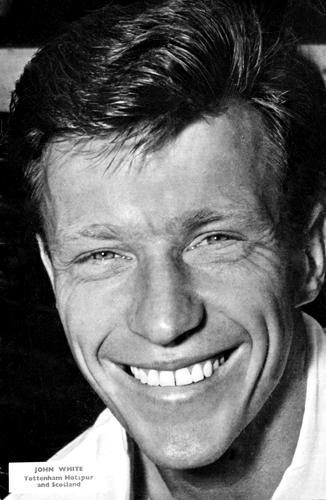
Rob White is talking about a journalist’s reaction to the Ghost of White Hart Lane, the book about his father John he has co-written with author and screenwriter Julie Welch. Judge for yourself. Working class boy from Scotland, born into a close, caring family, he’s so frail as a baby that he’s fed with an eye-dropper, like the runt of a ewe’s litter. At a young age his father dies but the family matriarchs see John and his siblings into young adulthood.

John runs to and from work to build fitness, shared the bathwater with the rest of the family and played football in every spare moment. Rejected by several clubs for being too small, Bill Nicholson brings him to London. Life in the city is almost too much for him but he fights homesickness and soon cements his place in the team. This is no ordinary side, this is the Spurs Double team, the greatest of them all and John’s distinctive style with his selfless hard work and sublime touch is at the heart of the side that carries all before them. Then, at the height of his powers, as Nicholson rebuilds the aging team around him, he’s struck by lightning on a Hertfordshire golf course as he shelters under a tree during a thunderstorm.

It’s the stuff of dreams for any Hollywood scriptwriter but for Rob it’s all too real, ending included. He was a babe in arms when tragedy struck and despite the enthralling footballing drama, it’s his story, the tale of his quest to find the essence of a father he never knew yet who shaped the man he has become that grips until the final page.

“There’s basically 3 strands to the book”, begins Rob. “A straight biography runs through the whole thing, then there’s John White as the final piece in the jigsaw for the Double side and its ups and downs. The third is my relationship with dad.”.

I asked how the book came about. “It’s something that I’ve wanted to do for a long time but never really found the right person to do it with.” A mutual colleague introduced him to Julie, who takes up the story. They do this a lot, picking up threads and taking them forward, two minds as one.

The Ghost Of White Hart Lane

“It’s all about seizing the moment! I was curious about the John White story. I’d been researching background on the Double but there’s not much on John. I thought about a straightforward biography at first, then it was obvious that there was this fantastic personal story to wrap around John’s life and death, the interwoven stories of father and son.”

They continue the conversation with little prompting from me, engrossed by a subject that remains fresh and vivid despite their many months of working together. New information and nuances come to the surface even now as they bat ideas back and forth, carefully weighing each word and born of a total commitment to get this precious story just right.

Rob readily admits he was in awe of Julie to start with. She was the first woman football correspondent for a national paper,  the Observer, and her lifelong love of Spurs found expression on the big screen in Those Glory Glory Days, a film about a girl’s passion for Spurs. “It was like therapy. We’d sit in the studio and just talk. No way could it have been written without Julie. She brought out my voice.”

Julie leans forward to pay tribute to Rob’s powers of expression. “It’s the quality of the consciousness that’s important. There’s a lot going on in Rob’s head and he presents it naturally.” She pauses. “It was the most marvellous experience of writing in my life. Can’t think of anything better that’s happened to me as a writer. Two people targeting one goal is just fantastic. I doubt I will ever have a better experience again, just to be able to write John White’s story and pay tribute to the Double side.”

In print, Rob’s voice comes over with disarming, touching integrity, to the point where you share his struggle to come to terms with his relationship with his father. He’s the same in person, honest and thoughtful with an underlying passion for telling this tale and a readiness to let others into his world.

“I’ve had real problems with this,” said Rob. “Not deep psychological problems but it was good to get these things out, to exorcise them.” Growing up, Rob’s identity was very much shaped by his being John White’s son. It’s a vivid portrayal of bereavement not in terms of freakshow trauma that has spawned a series of voyeuristic best sellers – Rob grew up in a close, caring family – but how others react to a bereaved child. Even as a young boy he noticed how people’s expression changed as soon they found out who he was, patting him sorrowfully on the head.

Rob laughs now about how he was a “walking cloud of sorrow. You grow up as a kid with this tragedy, people don’t know how to react. They look but they don’t know how to interact, and I didn’t want to upset people so I kept things to myself. From 13 to 42 I was scared of people’s opinions of me changing because I was John White’s son.” He describes how someone who had sat behind him at Spurs for many years – Rob is a season ticket holder in the Park Lane – was angry when he found out because Rob had not told him.

Defined by his father, Rob lived for many years with not knowing who this man was. As he child he searches for connections in a dusty box of attic artefacts. He watches the few snatches of film available of John in action, then convinces himself he runs in the same way as he studies his refection in shop windows. Dave Mackay takes him under his wing. He’s allowed on the team coach, into the dressing room, not just to hear about White’s exploits but more significantly to experience the smells and sounds of the dressing room, the pre-match tension rising as kick-off approaches, the evocative clatter of studs on concrete as the players run out. It’s comforting for a child to have so much information about a lost father. However, this is mixed with unease and frustration as the man eludes his grasp, walking beside him through his life yet when he reaches out to touch his presence, there’s nothing there, a ghost.

Rob embarked on a voyage of discovery in search of his father and, along the way, of his own identity. Some of the most moving passages cover the lost opportunities to do the everyday father and son things, like chat about football, ask him about mortgage advice or see his dad’s reaction when he gives him a present at Christmas. As Julie says, “The real heartbeat of the book is Rob’s longing to be a son to his dad in whatever way he could be.”

We’re talking when Rob is a long way down the road but there must have been tough soul-searching moments along the way. As men, we don’t talk about such things. I wondered if Rob feared what he might uncover and then reveal in the pages of the book, especially as he has such a candid approach.

“I reached the stage when I had to face up to it. It was the elephant in the room, something we didn’t talk about much in the family. Having children made me think more about this, then I had to face writing the dedication in the book. I struggled – to the memory of dad? the team? Then it seemed logical, for the kids.” The memories are handed on through the generations. Julie finishes the thought: “Pass it on, pass it on.”

He pays fulsome tribute to a major source of information, the Double side. ”Research was like King Arthur visiting the old knights, a pilgrimage  Their knowledge and wisdom, they knew my father and know you are your father’s son. That recognition meant a lot.”

It’s a perspective that enhances the reputation of this great side. Cliff Jones was White’s co-conspirator in the series of playful practical jokes, a comedy duo that brightened the dressing room and made John so popular and well-liked by everyone who knew him. Mackay has been a lifelong friend. Terry Medwin dissolved into tears as he recalled fond memories.

John White

The togetherness of the team was a major factor in their success. “They had 5 years close to dad, living, training, playing “ Rob continues, “It’s a band of brothers thing, not like an ordinary job. One day he goes, that’s it, John’s gone. The thoughts are less frequent as time goes on but he was always there. Then, something jogs them. Seeing me is like the closing of a circle.” “Healing”, chips in Julie.

Talk to the old-time fans about the Double and they will marvel at Blanchflower’s midfield drive, the bull of a centre forward that was Bobby Smith, Jones flying down the wing or Brown leaping high across the goal. Come to John White, suddenly they have a far-away look in their eyes and tail off into a reverential whisper. Here was a real footballer. Yet despite his distinctive style and telling contribution, he remains the least known of the Double side and Julie was determined to put that right.

“Mention John White and his name is always followed by ‘struck by lightning’, not something about this fantastic player whose assists helped Greaves be the player he was and indeed helped many men in the Tottenham side to be the players they were.”

Having read the book, I longed to see him play. “That’s the frustration,” Julie picks up my train of thought. “Couldn’t we do with him today? Just imagine what a player like that would achieve because of the way he played, so far in advance of his time.”

Rob picks up the baton: “He was like Cryuff, not the same type of player of course but in the sense that he’s an original – no one else was like him. Part of the sadness in the book is revealing what might have been.”

The book has been extremely well-received, topping the sports sales and entering the non-fiction top 50. The real benchmark, however, is its impact on readers rather than the book charts. The engrossing tale of John White and the Double side interacts with a profundly honest and poignant account of father and son that has reduced terrace-hardened grown men to tears. Did they find John in the end?

Julie: “I found the Apollo in him. Cliff Jones talks about running out onto the White Hart Lane pitch to be hit by the mass of noise. To be able to do that and play your best, you must have absolute confidence on your ability”

Rob’s journey was slightly different; “Found him? I’m a lot closer, yeah. You spend time looking for this person then realise the person is you. I was choked up about that.”

The journey isn’t over with the publication of the book. Well into Rob’s adulthood, the family revealed that John fathered a child during a short and abortive teenage relationship. He agreed to do the right thing but was advised against it by his commanding officer – John was on National Service at the time. Now his half-brother has come forward in a thoroughly modern fashion with a splash in the Mail. More thought and reflection and tricky, perhaps painful moments for Rob.

As I get up to leave, while Julie and I make small talk behind us Rob rummages in what looks like an ancient giant safe. He rejoins us, carrying in one hand his father’s football boots. They are tiny, size 6. Battered but lovingly cared for, the starch-white laces bear traces of black polish where the cloth in John’s hands rubbed them last. It’s almost impossible to believe that these dainty slippers mastered rain-sodden panelled leather footballs with the finesse and precision of a true artist, yet in my hands for an instant I’m touched by the spirit of a truly great footballer. Julie and Rob have a theory that John manages to play little tricks, as he did in life. The book may be finished but the Ghost of White Hart Lane is still around.

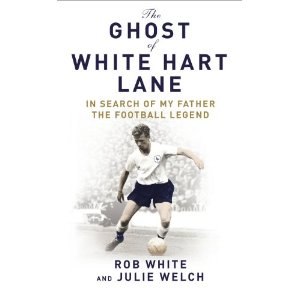
The Ghost of White Hart Lane – In Search of My Father the Football Legend  by Rob White and Julie Welch  Yellow Jersey Press