Martin Cloake On Danny Blanchflower, Spurs’ Geezers and the Current State of Play

Dead easy, this interviewing malarkey. Turn on the recorder, sit back, arrange the gems in some semblance of order and there you have it. At least you do when you speak to someone with the infectious enthusiasm of Martin Cloake. A leading authority on Spurs in print, many books written alongside co-author Adam Powley, his ardent passion for the club as journalist and fan remains undiminished.

His latest venture is an E-book called ‘Danny Blanchflower’, the first in a series of SportsSpurs Blanchflower Shots, extended essays that permit the analytical depth of a book but are accessible and readable for those of us without the time or cash to invest in the longer form on a regular basis. It’s new, it’s exciting and Martin is an evangelist for the medium

“What we have is a set of ideas about the growth of e-readers. This series of Spurs E-books which we hope will be part of something bigger, is tapping into people. Longer than an article, shorter than a book.”

Powley and Cloake have spotted a gap in the market. Given the amount about the club on Amazon, Kindle has been slow to catch up. “If you look at the Kindle store, put Tottenham Hotspur in, there’s not a lot of stuff there. It’s a market that people are using. We may be arrogant enough to think we are good enough but we have written books that people buy. We’ve had very good feedback, so we thought let’s put it out there and see how it goes.”

“Blanchflower is the first one, one on Hoddle which has just been completed. We’ll see how they sell and at the moment we’re looking at individual player profiles but depending on how this goes we may expand into other areas. What we don’t want to do is do something that we could do with a publisher. Horses for courses.”

Martin is at pains to stress that he is neither neglecting nor in competition with existing publishing methods. During our discussion he repeatedly emphasises his admiration for Dave Bowler’s book about Blanchflower and for those of us who see the name Cloake or Powley as the kitemark of quality when it comes to Spurs’ writing, the news that they have an excellent relationship with their publishers Vision and Mainstream means there’s probably more of the good stuff to come.

The e-book is something different. “What we can do with the e-books is to get something into the public domain relatively quickly. We are doing a lot of the marketing ourselves anyway. We have the technical expertise to put this up. It’s a much more complicated process than you would imagine”

He’s researched this carefully, noting that whilst there’s some evidence that on desktops people read long-form journalism, on mobile devices they won’t sit and read the 50,000 words in a book. My mind wanders to a blogger’s comment on twitter recently about how he rejected an idea for a post because it would have absorbed 1500 words, whereas readers stop after 300.  Which if true means two thirds of anything I’ve written has been a waste of time, including this piece, but Martin’s energy pulls me back from the brink.

“To justify charging, it can’t be a blog post so we’ve gone for about 10 -12,000 words, shorter than a book, longer than an article. We’re still having a debate,” he muses. “Maybe we shouldn’t be obsessed by the length at all. It’s as long as it should be.”

It certainly works for me in terms of price, length and quality of content. It covers both Blanchflower’s career and the character of the man himself, as well as making pertinent links with contemporary football plus an evaluation of his lasting contribution to the game. £2 on my iphone, read on the train, thanks very much. Perfect. This is precisely the author’s intention.

“We will make sure there is plenty of information and some original comment as well. We’re conscious that a lot of content on the web is recycled, it’s easy to stitch stuff together and put it out there. That’s not the way we want to work. Without sounding high-falluting, we seem to have built up a reputation as people who do things that are high quality. It’s hard to build up a reputation and the quality of the content is what we hope is the thing that sells the books. Quick and quality reads that people can hang on to.”

For the first book in the series, Blanchflower was the natural choice because of his  influence not only on Spurs but also on Martin as a fan. “I’ve always had a bit of an obsession with Danny Blanchflower. I never saw him play – my first game was 1978, 1-0 against Bolton, Don McAllister diving header” We pause momentarily to consider the frankly frightening prospect that this journeyman defender could have been a formative influence on the young impressionable schoolboy, even at this, his finest moment in a white shirt. Less diving, more toppling earthwards, but who am I to say because we are both sufficiently obsessive to remember it.

Moving on swiftly. “I was aware of Spurs since the early 70s when I lived in Haringey. When I started looking at the history of the club, the Double and Blanchflower comes up fairly quickly. He’s a fascinating figure for me. Working as journalist, it became not just the player but the man himself. His journalism was very good. He was very much of a different generation. If we ever got the chance to sit down together we may not have seen eye to eye but I think he is a fascinating character for football as well as Spurs. You’d be hard pushed  to find a more significant figure. Just look at what he was about, what he did and represented.”

“I genuinely do believe that the team was part of something which completely changed the way British football operated. It finished the process started by Arthur Rowe’s push and run team in the early 50s. It changed English football for the better, taking it out of its insularity. Blanchflower was a real thinker and was attracted to us because the club was about changing the way English football was played. He’s a man ahead of his time.”

This boyish passion plus the ability to situate Blanchflower in a broader context makes the e-book compulsive reading. Forget the idea that this is a mere potted biography. It says more about its subject and the English game than a hundred best-selling autobiographies of modern players.

“Football can be self-important and we all slip into it, but Blanchflower wasn’t trying to be important, just a professional getting on with this job who thought about things.” Martin warms to his theme of the bigger picture. “I have 2 young boys. There’s a danger that being clever is seen as wrong, at school we took the pee out of swots. but Danny showed that ordinary people can be very intelligent, that it’s right to search out knowledge to improve things, to be good at something and think about how it was done. There’s a danger that people see intelligence as being elitist, a bit posh, so wrong and dangerous.”

Influential figure that he was, Blanchflower was met with considerable suspicion by chairmen and officialdom in general, threatened by his combination of prestige and intellect. He was overlooked for jobs in the game, including perhaps at Tottenham. Any antipathy was not helped by his public platform in journalism: Martin rates him highly in that respect too.

Blanchflower wasn’t averse to using the press for his own ends. There’s nothing new under the sun and Spurs are juggling with these issues at the moment, except it’s the manager rather than a player who is arguably using the media to influence club policy. Martin felt it was less sophisticated in Blanchflower’s day.

“He would never admit he was using the press but used a nudge and a wink as leverage to get what he wanted. He wasn’t afraid of speaking his mind.”

Inevitably when two Spurs fans get together, the discussion turns to Redknapp. Martin’s sense of dynamics of the club’s history once more enables some context for Harry’s proclamations, which I for one have criticised over the last few months, August in particular.

“The press loved Venables – he always had a quote. He defined his position regarding the chairman, and you can’t blame him for that.” Redknapp is doing the same, in other words. Martin goes on, “Redknapp is unfairly criticised sometimes. His relationship with the media protects us sometimes.”

Compare the reaction to a few bad results this season at, say, the Emirates or Everton with the silence that greeted our run of one win in 13-odd games last season. However, as Martin shrewdly concludes, “As the great philosopher Ronan Keating once said, ‘you say it best when you say nothing at all’. It would be fascinating to sit down in a few years time with the present regime, it would be a great interview but I can’t see it happening”.

So how would it turn out if you did a ‘Boys From White Hart Lane’ with the current team? Martin can’t resist the idea but envisages problems that encapsulate the different status of the modern players and their relationship with outsiders.

“ You just wouldn’t be able to do it. You wouldn’t get access to players. They [the BFWHL squad] didn’t earn a lot. We tried to make sure everybody was looked after. These guys don’t need the money and they don’t need to talk to anybody. With the best will in the world they are on a different level. I’d love to sit down with Gareth Bale, watch that guy, you can’t take your eyes off him during a game. He seems fully grounded. Top of my list for BFWHL 2011! Benny is a hugely underrated full back and a fascinating character who understands where he comes from, that football is part of something much bigger. The squad seems to be full of likeable individuals. Luka has blotted his copybook but there are no whinging, unpleasant, offensive characters as in other teams. Van der Vaart seems like a good guy. Gomes, I’d like to sit down with him. No shortage of candidates and if they read your blog and they want to write it, give them my name and address, I would love to do it! I’d really love to get the real story, the inside story.”

Much as I like the idea of Bale or Gomes coming across TOMM and being inspired to unburden themselves, it’s unlikely, but if it does, Martin, you’ll be the first to know. Co-authors, OK?

What’s next? As you would by now expect, there’s no shortage of ideas. “Spurs have a rich history of players and personalities. Read these [i.e the ebooks] and find out a bit about the person, what they were like as a player and what they meant, but also look at the wider influences. I’d like to create a space for a debate, possibly a website for the books, forums maybe. Interactivity – the days when journalists or experts handing down wisdom from on high have gone. It’s about having that conversation with the audience who often know more about particular areas than you do. There’s also the opportunity to stretch the remit to include other teams and their players, other sports too, and perhaps other writers.”

Next up, Glenn Hoddle. “Ask any Spurs fan who was the greatest ever, he’s there but he had a lot more criticism than people care to remember. Spurs fans and football in general used to moan about him because he didn’t tackle back.” Like I say, nothing changes. One of my earliest memories at Spurs was hearing fans pile into Martin Chivers.

“He’s accused of being aloof, but just ask the other players about him. They are a bunch of geezers but they are amazed that there could ever be any animosity. Why would there be? They say he was brilliant and we were there to make sure that he could do the things he did. Good guy, we got on with him.”

I look forward to it.


Danny Blanchflower by Martin Cloake, edited by Adam Crowley, is available on Kindle from Amazon, £2.99

http://www.amazon.co.uk/Danny-Blanchflower-Sports-Shots-ebook/dp/B005G6TFEK/ref=sr_1_1?ie=UTF8&qid=1317823559&sr=8-1


Manu – We Need Him But Does He Need Us?

Tottenham Hotspur desperately need a player like Emmanuel Adebayor. His strength, pace and goalscoring ability on the ground and in the air will if all goes smoothly become the long sought after focal point for our attacking play. No one who was at the Lane to witness his exquisite volley in the 3-1 defeat by our neighbours will need to be convinced – it’s seared in my brain, probably forever, which can’t be said for many of the goals we’ve scored since then.

So the real question is not do we need Emmanuel Adebayor but why does he need us? Specifically, and let’s not beat around the bush here, why does he want to play in front of fans who have given him dogs abuse, more calculated and vile than any I can recall in over 40 years of watching Spurs?

That Song is nasty, brutish and racist. Many say that’s not a legitimate interpretation. I wrote about this last year and nothing I’ve heard before or since has altered my opinion. I am neither a prude nor averse to the abuse that crowds dish out during matches. In fact, there’s a powerful argument  to say that abuse is all fans have left in the face of intransigent and distant administrators, a game driven by profit and power and players who value money and celebrity above pride in their performance.

Despite this, there are limits and this song goes too far. In so doing, it shames the tradition of tolerance in the stands at Spurs. We are rightly indignant when subjected to the equally despicable insults relating to the yids tag, especially as no one does anything about it, indeed in some quarters we are blamed for bringing it on ourselves. However, in the dark days of football racism in the seventies and eighties, when WHam and Chelsea fans racially abused their own black players, when bananas were routinely chucked onto the pitch and not as an energy aid, you never, ever saw that at Tottenham. Yet this song is sung out of habit these days, when until recently the player had nothing to do with us, didn’t even play in the same league. I’m not particularly aware of him having a real go at us, although I am happy to be corrected. Not in the way Terry and Lampard, Henry and Pires have gone out of their way to taunt us.

The song is sung just for the delight of it. He first heard when his father had been dead for less than a year. And we are not the only ones. L’arse sung it when he scored against them for City after his infamous length of the field run to their end.

So in the face of this extraordinary abuse, which he heard for himself at the Bernabeu only a few months back, knowing the fans detest him, he signs. If he strung us along until deadline day only to spurn us at the last second, I wouldn’t have blamed him.

The easy answer is ‘money’. No doubt there’s plenty on offer, not just in terms of matching his salary but also a hefty bonus for signing on the dotted line. However, that’s not the sole reason because he could have achieved that aim by staying where he was or by accepting the other offers that were around.

Professional pride is a factor. He wants to play regularly and knows he will be first choice at Spurs. Harry made him welcome and despite any misgivings about his image expressed on this blog and elsewhere, his reputation with most players is justifiably high. Our style suits Manu perfectly, and if it all goes according to plan, he will be a star again.

Yet professional pride can’t be the full answer because there’s plenty of evidence portraying the striker as disruptive and selfish. At our neighbours he became bored and agitated for a move, cited in the process as an unwelcome influence in the dressing room, while at City he had a right sulk on after being left out, including a fight with one of his team-mates. When the mood takes him, he’s not professional in the slightest.

For us mere mortals, it’s nigh on impossible to fully understand the psyche of a professional footballer. They’re like you and me, flesh and blood after all, yet so different at the same time. In your world, whatever your job, if you had been viciously and publicly abused over a sustained period by your main rival company, would you go and work for them for the same money and if you had an alternative job offer? At your sales conventions, in the pub, in your trade press, you were the butt of all the jokes, now you’re on the payroll. I wouldn’t, and I’m the most reasonable man I’ve ever known.

Some players deal with this by being mercenaries, flitting from club to club with little or no loyalty to anything other than themselves and their paycheque, but that doesn’t ring true in this case. There’s something more to Adebayor. Many professionals react to the pressure by retreating into their own world as a form of self-protection. They assiduously guard this sense of self-worth, to the point of absurdity at times where their self-importance becomes arrogance. However, without their self-confidence, they are lost, unable to cut it in the face of the demand to succeed in the public eye, endless analysis of their faults compounded with stark abuse from fans. In Adebayor’s case, this resilience is not just about football, it’s survival.

The messageboards and twitter greeted Adebayor’s signing with a flood of suitably positive new versions of That Song, and very amusing and self-depreciating they were too. In a small way I like to think I set the ball rolling. Granted my effort in that article last year is unlikely to be adopted by the Park Lane –  “Your father undertook a series of menial jobs despite the probable stigma and damage to his self-esteem in order to care for his family and give his son the best possible opportunity to further his footballing career.” It doesn’t even scan but has the advantage of historical accuracy.

Manu was born and raised in Lome, a town near Togo’s border with Ghana, where in order to eke out a living for her son and his 5 siblings, his mother sold dried fish. One account states that his family were so poor, they could not afford to pay for medical treatment so he was left in the hospital for a week or so. At 11 he was staying in a football academy close by a border where drug and arms trafficking was rife, moving on to France in 1999. This in an era where England’s internationals complain about the pressure of being in a 5 star training camp for a few weeks.
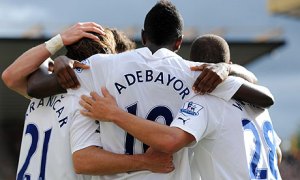
Despite his wealth, Adebayor hasn’t forgotten his roots. He’s built a house for his mother and family as following his father’s death in 2007 he’s taken responsibility for the household, and he regularly returns to his country to put something back into the society from which he escaped because he could play football.

Perhaps it’s not merely a common language and heritage that cements the friendship between Benny Assou Ekotto and Abebayor. Both have known hardship in their early lives, both present a detached attitude to the game that does not detract from the quality of their performance. They are self-contained, secure and confident in their sense of self. It gets them through.

This inner strength was tested to its limits and beyond when along with his Togo team-mates, Adebayor clung for cover in the twisted wreckage of a bullet-ridden coach as it was attacked before a tournament. His friend, the team’s press officer, died in his arms. He’s lived a life most of us could not imagine and he’s only 27. Perhaps the songs don’t have the same impact.

So there’s plenty to admire in Emmanuel Adebayor but the reasons behind his success mean that we’ll never become that close to him. And what does it say about us, the fans? Most didn’t sing that song, of course, but many have, and anyway he was on the receiving end of more than his fair share of abuse just for wearing the red shirt.

We’ll never take him to heart but I believe he will receive a warm welcome tomorrow and he will earn our respect if he gives of his best, as his former team-mate and fellow subversive Willy Gallas has done. Fans of all clubs are often accused of hypocrisy and there’s truth there. However, our loyalty is like no other in sport, in life perhaps, and that loyalty, blind, crazy, illogical, harmful, unwavering and unstinting, is to the shirt, to the club. Our club. That’s the point from all this.

In my own silly immature way, when Manu first comes over to the centre Shelf tomorrow, I’ll shout his name and applaud. He’ll hear me and I like to think it will mean something but it won’t. And if he scores, and runs over to the fans, and the fans sing his name, if he winks and raises an eyebrow in ironic surprise, I wouldn’t begrudge him his moment. Good luck to you, Manu. You’re one of us now and we’ll look after you.

The Transfer Pantomime. This Is Where I Came In

When I was a kid, we didn’t have much time for going out as a family. My dad had a small shop that was open 12 hours a day, every day except Sunday when he closed at 2. Sometimes for a treat he’d shut a few minutes early, scrawl a hurried apology on a paper bag that he would sellotape to the glass shop door and we would escape for a few precious hours. The favourite was a trip up west. The Central Line still has a touch of magic for me, a sentiment not shared by commuters, but in half an hour it took me to the centre of the capital. Window shopping around Marble Arch, egg and chips at Lyons Corner House (a man of simple tastes, my dad) followed by the Jacey cartoon cinema.

In those days there were a few cartoon cinemas in town. My love for Tom and Jerry, Tex Avery and the Warner stable is with me still and the Looney Tunes music has a special resonance. Interspersed with newsreels, the programme ran on a loop for an hour or so. You could come in and leave at any time and remain as long as you liked but usually you left when your first cartoon came round again. This is where I came in.

My Seat (some bloke got in the way of the pic)

I’ve taken a break from the blog for a few weeks. Not sure why, if truth be told. Haven’t been away although I have been infernally busy at home and at work. Pointless really: I’m constantly drafting articles in my head, for Tottenham is genuinely always on my mind. A lot has happened in that time, mostly to do with Luka Modric, or maybe nothing has happened whatsoever. To put fingertip to keyboard at this moment is pretty pointless too (as if the rest of this guff has some significance…) because take an overview and nothing’s changed. It’s fun but I’m not sitting through this for a second time.

The media have lapped it up, not just a transfer story in a relatively dull close season but a veritable saga. Modric wants to go. Levy says no. Modric says OK, then it’s not OK. Levy still says no. Modric says Levy is not a very nice man. Levy doesn’t care.

A bit of knockabout fun but it’s no different from the situation I predicted a couple of months ago now. Because Luka Modric is the best midfielder outside the top four, there will be an auction for his services involving Chelsea and Manchester United. I doff my stylishly battered straw pork pie hat to the brave souls who saw Luka’s interview in a Croatian paper on Sunday morning and hit Google translation around the time I was staggering around trying to wake up and kvetching about another bloody weekend of DIY. However, the only surprise is that other top European clubs have not expressed a stronger interest. The key has always been Daniel Levy. He wants to build a top class team but he knows the price of everything. Whatever his protestations to the contrary, he may be tempted to sell. Nothing has changed.

The comedy dialogue that characterises the contemporary transfer pantomime is in full swing. Luka’s scriptwriter, presumably his agent, has gone for audience but his man emerges as the villain of the piece, a guise unbefitting a maestro who has has graced the Lane for the past few seasons. In the process he’s managed to alienate large sections of Spurs fans: if a relationship turns sour, dump before you get dumped. But it’s all the same. Leverage in the negotiations and a message to Chelsea to keep bidding. If it works, fine, if not, there’s a fat 6 year contract at Spurs to cushion the blow with the distinct chance that we will up his salary again.

Hello Roman? Roman? Can you imagine how I feel about it, Roman? Yes, I'm sorry too..

My position hasn’t changed one jot either. Keep him at all costs. This is a watershed season for Tottenham Hotspur. If we graft a few quality players, strikers first and foremost, onto the existing squad we are ready to take on all comers, now and in the years to come. Modric, Bale, Sandro, riches beyond my dreams.

Modric’s recent comments don’t alter that view. He should show some loyalty, and also it may further his career to stay at Spurs where he will be the star rather than face the highly critical Chelsea support. However much as we don’t like it, the attraction of double the salary plus the CL would give anyone second thoughts. Also, as we have a pop at him, we have no problem luring away the best players from other teams. If Samba, today’s alleged top target, wants to come here, we won’t berate him for his lack of loyalty to Blackburn, the team who took him from relative obscurity. If he says he’s always wanted to join Spurs, that’s not true, now is it? The tired and stilted script of the transfer pantomime.

Forget the statements and media bluster. Instead look out for these two things that really matter. One, Modric. Professionals have a different attitude to this football business compared with the supporters. If he stays, as I desperately hope he does, it’s about how he performs. I reckon the professional in him will buckle down and give his utmost. That’s what being a professional means. So I’m not joining this wave of villification because I’d rather judge him on how well he does against that benchmark, nothing else, certainly not the rubbish from his agent.

Secondly, this has turned into a test of Daniel Levy’s integrity. Boldly and bravely, he has made a clear, unequivocal statement: we are not selling our best players. He has my wholehearted support. He too will be tempted by the money, so judge him on how well he resists. If he goes back on his word, his reputation will be shot to pieces. We won’t take a blind bit of notice of anything he utters, ever again. Perhaps the stakes are highest for our chairman rather than any of his players.

Tottenham Hotspur That Was The Season That Was. The Manager

Harry Redknapp has met me. Years ago my neighbour at the time organised a testimonial for one of the Charlton players against West Ham and my wife’s family are rabid Hammers, so there we were in the director’s box at the Valley. Before kick-off Peter waves to me and beckons me down to the front. I’m happy to thank him but he says, “Where are the rest of you? Come and meet Harry. Harry!” he shouts, “Someone I want you to meet.” Harry strolls over, is as pleasant as can be as we exchange a few words and the photo, once pride of place in my wife’s daughter’s living room, is now shoved behind a cupboard in their loft but I’m there, hanging back and forcing a smile.

Peter Varney and I used to work for Lewisham Council – he was something in building – and we got to know each other better during the 5 week strike over, well, I forget now but it was important. Lovely bloke and a good neighbour. He used to cut the thick hedge that divided our front gardens and it was only when he moved that I realised it was on my side of the line but he never mentioned it. A lifelong and long-suffering Charlton fan, he did a bit for the supporters club and for charity. We’d be chatting over the fence and his wife would call out, “Pete, phone. Again!!!”

“Coming. Who is it”.”

“Kevin Keegan”

“Tell Kev to hang on a minute, I’m busy.”

Although he was too modest to speak about it, he must have been good because one day it was announced that Pete was the new CEO at Charlton. From humble beginnings on the picket line, he was in the boardroom and moved away. I, um, downsized.

I never took to Harry. I wanted to, for him to be the football man with a heart of gold who brought success to clubs in the right way. Fact is, my image of him has been tainted from the start as my wife’s family chronicled his dodgy wheeler-dealing that left him in pocket (allegedly) and successive clubs in a ruinous state financially. I refused to succumb to his assiduously cultivated persona of all-round good ol’ Uncle Harry. It was none of my business, until a couple of years ago anyway, but I don’t like being manipulated. Despite his generosity towards me, perhaps I was the first of those ungrateful Spurs fans he’s told to go elsewhere.

Never mind the man. My club comes first, last and always: there’s only one question, what has he done for Tottenham Hotspur? I’m genuinely and sincerely grateful for the progress we have made since Redknapp became manager. It’s not just about the league position, although I’m convinced those advertising boards that form the post-match interview backdrop flash subliminal messages saying “2 points after 8 games”, lest we forget. For me it’s also about the pleasure of watching wonderful footballers in (almost) white shirts playing scintillating flowing football. No trophies but everlasting memories. All Spurs fans are disappointed that we failed to qualify for next season’s competition but let’s just pause and say it out loud: “In 2011 Tottenham Hotspur reached the quarter finals of the Champions League.” Enjoy the sensation. One of the problems of the modern game is that we never stop to savour the feeling, it’s all about what happens next. Relish it, taste it, roll it round your tongue and chew it over, because these moments don’t come around that often. Then think back to February or March last year and tell me you believed that was possible. Be honest.

Yet our undoubted achievements this season have been tinged with regret. It’s realistic rather than greedy to say we could have done so much more. Our woeful lack of firepower up front has been the main problem – the strikers  have been downright dreadful for much of the time. Coupled with regular disappearing acts from our defenders and keeper (where the hell did they go?), we failed to dispatch teams we should have beaten. Had just a few draws become wins then we would have overtaken Arsenal and secured 4th place.

Redknapp has to take some of the blame for this, yet he appears unwilling or unable to do so. Win and he basks in the glory. Lose and it’s down to the players. Harry has infamously been dismissive of the value of tactics in the past. He doesn’t really mean this of course, the very last thing he can be accused of is naivety, but he likes us to think he sends the players out to, well, just play. However, he has to take some greater responsibility for our performances, good and bad

The regular selection of Crouch encouraged the use of the long ball. Earlier in the season it went straight down the pitch, often too early, varied as time went on by the player pulling away to the far post, hence the long looping ball. When Pav played, we did the self-same thing. Whilst this brought some rewards, too often it negated the advantage gained from our skilful, clever midfield. Luka and Rafa don’t want to see the ball flying over their heads. Defenders have a fair idea of where the ball will go, therefore it’s easier to handle. Too frequently our strikers were ahead of the ball, stationary and waiting for the ball at the edge of the box. Problem is, the defenders are waiting too.

Also, and as a lover of attacking style it pains me grievously to say this, we were often too open to succeed in the Premier League. Although we developed greater resilience and an ability to hang on to possession, we lost it more easily than we should have on too many occasions and the midfield did not work hard enough to tuck in and protect a lead. It’s not about outright defence, rather, it’s about adapting to the conditions on the pitch. That’s the way it is in this league. This is tactics. This is the responsibility of the manager.

Redknapp’s great strength is that he is good with players. He takes their skills, fits them into position and asks them to do what they are good at. Find a group of players whose skills dovetail and you have a fine team. That’s why players always say they like playing for him, because he plays to their strengths. Nothing wrong with that and his loyalty to some men by giving them a run in the side has meant Bale, Dawson, Assou Ekotto and latterly Sandro have developed their full potential.

He’s more shaky when there’s a gap. He doesn’t adjust or enable the whole side to be as flexible and mobile as the best teams. For example, if Bale was out or he felt compelled to squeeze Van Der Vaart into the side we struggled because we did not have another man to step in to play the same role. Square pegs in round holes. Modric shifted to the left, unaccountably taking our finest player from his best position or Rafa wandering aimlessly  from the right. Also, if he has it in for you, it’s less Uncle Harry and more evil stepfather. Bent was never played in the right way, back to goal too often when he likes it in front of him, then ridiculed and off elsewhere. What we could have done with half the goals he’s scored since he left.

Redknapp is immune from criticism and has taken umbrage recently against Spurs fans who have dared to go where the media refuse to and question his tactics, selection and status. I first commented on this a few weeks ago after the West Brom game. In an age where the media unstintingly dissect their subjects like a pathologist dragging out the innards of a corpse then examining the entrails under a microscope, his protection is a truly remarkable achievement. I can’t recall any sustained critique of his era at Tottenham from a professional pundit. Any suggestion of negativity is met with snorts of derision, not even considered but immediately and forcefully ruled out of bounds. No other manager is shielded in this way, not even Alex Ferguson. Nothing sticks.

Harry would do well to remember that we the fans were here when he came and will be here long after he’s dumped us for the England job. He can’t control us the way he looks after the media. He’s done a good job for us but should also look back to his appointment and be grateful because his record as a manager didn’t merit the role. I’m sure he’s as frustrated as we are at some of the problems, so why can’t he acknowledge that and share the pain and joy we’ve felt over the past 9 months.

Redknapp must carry on as manager. Consistency is key and the process of team building should continue. Above all, he must hang on to Modric, Van der Vaart, Sandro and Bale. Sell his grandmother and his precious Sandra if he has to, just the build the team around these gems that he did not unearth but has polished almost to perfection.

This man of the football world is still learning, even in his early sixties. He’s never been in this position before. He’s had little experience in Europe, let alone the Champions League, or at the top end of the table. Neither has he previously worked with players this good nor been in a position to buy the highest quality footballers. No more bargains or cheap but useful veterans for the short-term. Never mind the team, he has to step up in quality too, like managers with 15 or 20 years less experience in the game. I have the niggling feeling that he’s an old dog who can’t learn any new tricks and shed the underdog mid-table mentality. I desperately want him to prove me wrong.

Pouring over his individual comments has little value but over time you get a broad sense of what he’s up to. At the moment he’s gone on the defensive, talking down our ambitions and dropping hints to Levy that we need the money to buy quality this summer. It’s familiar territory, as is the rubbishing of the fans. Most of us do not have over-inflated expectations. Within our frustrations we realise both the potential of the club and the work still to be done. To fulfil that potential, Redknapp has to move out of his comfort zone in terms of the players we buy, the way we play and the manner in which he relates to the fans. He has to work hard this summer. I for one look forward to August.