The Glory Glory Nights by Martin Cloake and Adam Powley

Order this book. As a Spurs fan, you must, or else drop so many hints to your loved ones that you wake up on Christmas morn to find ten coffee-table book sized parcels under the tree. Between now and then, listen to the radio, read the blogs, watch TV and make a note of how many callers and pundits say either that the Champions League is vital for financial survival or that finishing fourth defines success.

Then read the Glory Glory Nights. Take a quiet moment, all to yourself. Turn the pages slowly. Take in every detail of the photographs that cover every page. Read the text that describes the exploits of bygone times, of heroes whose time has passed but who will never be forgotten by those of us who ever seen the all-white strip with the proud cockerel.

Now close your eyes. Under lights, your world is spread before you. Nothing exists beyond the shimmering bright rim, not for 90 minutes at least.  Close your eyes and feel the chill in your lungs, the breath billowing steam from 50,000 pairs of lungs rising high into the dark north London sky. Feel the Lane shaking beneath your feet. This is what Europe means to Tottenham Hotspur. Glory. It’s what football means. Read and marvel at the glory of those european nights and anticipate nights to come.

This loving history takes its title from a book written in the mid 1980s and commissioned by Irving Scholar, which co-author Spurs blog 87Martin Cloake wryly describes as the best thing he ever did for the club. It keeps two key elements of the style too, the liberal use of photos and incorporating quotes and headlines from the following morning’s backpages, which gives a sense of time and place. As Martin says,  until comparatively recently fans relied on the papers for an account of the match because there was no other way of finding out what happened. Even the radio was confined to the bigger ties.
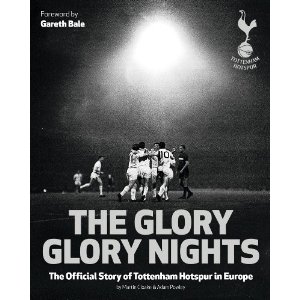
However, this is no mere revamp. It stands up in its own right as a tender tribute to a glorious past and brings out the enticing beauty and wonder of this entralling, all-consuming passion. The unobtrusive but insightful text sets the match reports, one for every single game, in context. Then, it allows the reader to explore the story for themselves as it unfolds. The images are stunning, chosen with care by Doug Cheeseman with an eye for the drama and passion the glory glory nights inspire. While the book rightly gives due regard to our modern successes, the black and white images are irresistibly evocative. Fans with rattles and cut-out cups gathering at the gates, players celebrating together and plenty of goals frozen in time. Mixed in is the surreal too; the Double team on an open-top bus with a man dressed as a clown clutching a stuffed monkey toy, Peters leading out the team past a row of giant Romanian urns in the tunnel or a man dressed as an ‘Aspurnaut’ parading round the pitch in the early 70s.

As a kid I had no doubt as to the meaning and significance of Spurs in Europe. My glory years began in the early seventies. We may have put 9 past Icelandic part-timers Keflavik but I knew I was part of a great tradition, the first British side to win a European trophy. Erratic and underachieving in the league (nothing changes…), play in all-white under the lights and we were transformed, a team that could beat any side in the competition. Frequently the glory glory lifted us to new heights, and to see Spurs win the UEFA Cup on our own ground not once but twice will live with me forever.

The book does my memories justice. There are extensive interviews with managers and players. In an age when we tend to think of players as primarily motivated by personal glory and vast wads of cash, it’s refreshing to see that they too bought into the myth. Europe was special to them and still is. The book avoids falling into the trap of becoming just a nostalgia-fest by giving due prominence to our remarkable Champions League run. Gareth Bale and Michael Dawson both fully recognise the magic of the Glory Glory Nights and were inspired by them. Make no mistake: those games away and home versus Inter or the astounding away victory at Milan rank up there with the best of the best.

European ties were magical affairs in far-off, mysterious places. It’s not that long ago, for example, when Spurs would kick-off not having seen their opponents play before. They had to think on their feet, changing tactics at half-time in order to cope with the unknown.  And Spurs were pioneers; the Cup-Winners Cup in 1963, the first to win two trophies, the first fans to fly abroad to watch their team. It tells the story of why Spurs and Europe have a special relationship, the tale of what it means to be a Spurs fan. Simply wonderful.

The Glory Glory Nights: The Official History of Tottenham Hotspur in Europe by Martin Cloake and Adam Powley published by Vision Sports. Click here for a special site to see inside the book

Look out for an interview with Martin Cloake, coming soon.
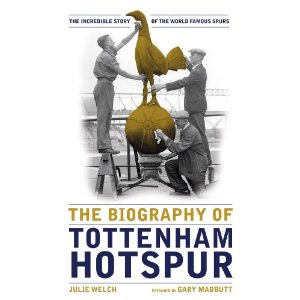
Review: The Biography of Tottenham Hotspur by Julie Welch

Why do we do it? The heartache and pain, the time, energy and money, the fury and frustration, all expended in support of a cause over which we have absolutely no control or influence whatsoever. Because we support Tottenham Hotspur. Read Julie Welch’s lovely, insightful and touching book and you will be inspired all over again.

More than just a history, The Biography of Tottenham Hotspur reaches into the heart and soul of the club. What marks out this club from most others is that it stands for something. Danny Blanchflower’s  famous statement that it’s not just about winning, it’s about glory and doing it in style, isn’t mere aspiration but articulates explicitly a culture and identity that dates back to the origins of the club in the 1880s on Tottenham Marshes.

For Tottenham Hotspur, it has to be good football, creativity and innovation. The Spurs Way is the right way. The pass and move approach lauded at Barcelona brought Spurs a league title in 1951 when Arthur Rowe called it ‘push and run’.Back in the early 1920s another great manager Peter McWilliam defined his tactics in exactly the same way. The mixture of flamboyance and exasperation, the sublime and the erratic that is familiar to readers of this blog would be instantly recognisable to Spurs fans of past generations.

As befits a biography, the book describes the club’s history while allowing the character to unfold and open up. Like Spurs, the Spurs blog 86writing is easy on the eye and draws you in. This is no dull history textbook. Rather, Julie is a storyteller, engaging and curious. She communicates her passion without allowing her voice to intrude or detract from the telling of the tale. It’s a measure of her skill and dexterity that she makes the journey from Tottenham Hale through the industrial landscape that covers the old marshes to our first pitch sound enthralling. And she’s not averse to the occasional gratuitous dig at our rivals: after all, she is a lifelong fan.

She freshens familiar tales such as the success of the Double side, the Nicholson era or the sordid conspiracies that brought the Gunners from Woolwich to north London, and by placing them in the broader context of the club’s culture and origins, enables the reader to look anew at more recent events that we’ve lived through. It kind of sneaks up on you, involving you in the story then in a couple of killer sentences nails its wider significance like a fine historian should. Be warned – set aside some time when you first open the covers because you’ll want to keep the pages turning, just to see what happens next.

Not all of which makes for pleasant reading. The late eighties onwards was a sobering read. Gross, Graham and Francis, and the inglorious reigns of Spurs idols Ossie Ardiles and Glenn Hoddle, goodness me how dispiriting they were, but as the current side teeters on the brink of new glory or yet another near-miss, it brings a vital sense of proportion. Being a fan isn’t about instant gratification. Read it and I defy you to rant on about the all-consuming Champions League.

Nothing really changes. Around the turn of the century the club was run by two dynasties of Jewish businessmen. ‘Up and coming club taken over by wealthy businessman in order to enhance his prestige. Club moves ground’ – 1890s or early 21st Century? ‘Club buys Scots, leads to great team’ – 1890s or 1950s? ‘Finances restricted by ground improvements, team slumps only to be rescued by a saviour who changes fortunes totally’ – that’s just page 58.

This is an enduring love affair. For better or worse. In any long-term relationship, there’s some give and take, although I suspect we supporters have put more into the relationship than the club has given back over the years. Through the anger and disappointment,  having been let down so many times, it’s worth it because when she touches me, nothing else matters. It’s a passion that makes us swoon and shake with unbridled joy, an experience like no other. Share that with thousands of others at the Lane and these are the unforgettable moments that make life worth living.

By the time you reach the end of the Biography, you feel closer than ever before to the club.  You will know more about the club and about yourself. About why you do those crazy things to watch a football team. About what it means to be a Spurs fan – about flowing football, pleasing the fans, about good football. About what it means to be you.

Look out for an interview with the author Julie Welch, coming soon.

The Biography of Tottenham Hotspur by Julie Welch is published by Vision Sports

The Europa League: A Help Not A Hinderance

Spurs’ qualification into the knock-out stages of the Europa League won’t settle the long-running argument about the importance of this tournament. However, there’s no doubt that this Europa League has been of huge benefit to this Spurs team. In future years, maybe not, but it’s moved the team-building process on more swiftly than if we had not participated.

The theme running through my last few posts is progress. Andre Villas-Boas is closer to understanding what suits his players and is getting the best from them. Many managers make little effort to hide their irritation with the Europa League but for Tottenham it has been a help not a hinderance.

I wonder if it is a generational thing. Games against teams like Maribor that take place in the early stages of each group barely keep the pulse beating, never mind set it racing, but those of us of a certain age still hear echoes of glory glory, however faint. I suspect that they are out of range of younger generations brought up on the Champions League for whom the EL has the equivilent importance of the Anglo-Scottish Cup. Commenters, let me know.

Villas-Boas has taken the bold step of playing strong teams throughout. Granted there’s the danger of burn-out later in the season but right now I can’t recall a Spurs team in recent years that has looked so bright-eyed and bushy-tailed. AVB is building a new side rather than scrabbling together the remnants of the old, so what better way to move forward than get them to play together.

He’s seen the Europa League as an opportunity not a threat. Each game is another chance for him to put over his methods and ideas, to enable the players to become familiar with their roles and those of their team-mates. Not everything has worked – there have been some flat-spots along the way – but better to make them in a EL group game than in the glare of the Premier League.

Contrast his approach with what’s going on a couple of miles up the road. Wenger likes a moan at the best of times but their league form is solely down to fatigue, apparently. It won’t wash. Maybe Spurs have better fitness coaches because we haven’t seen any signs of that. On the contrary, the team to a man appear invigorated by the growing realisation that they could be part of something good.

It’s more an attitude of mind. The difference is that the years have wearied Wenger as he creates yet another side without the full backing of his board in terms of buying players of the highest quality. In contrast, Villas-Boas’ desire to succeed burns like an everlasting flame. Without a footballing career behind him, like Wenger the only way he can prove himself is through his team and he has communicated that enthusiasm and desire to his players. They want to play, to play for him, and he deserves credit for getting through to them. Few can now doubt that this is his side, that this young, mild-mannered man is in charge and has the respect of the players. The risk he took in playing virtually full teams in the Europa League has paid off.

Dempsey, a man who needs to fit in more than most, has been played throughout, giving him game time and his performances are slowly improving. More assists on Thursday night. Dawson’s role and the authority of captain meant he wasn’t excluded from the first team action and helped produce those fine Premier League performances when his chance came. Carroll, Huddlestone and Sigurdsson have all had useful time on the pitch, while AVB’s gradual introduction of Lloris to the English game, much derided in September and October, could in hindsight be a managerial masterstroke. Everyone has had some chance, none have been excluded. This is all shrewd man-management.

I wasn’t at the Lane on Thursday but watched on TV. We did more than enough to win without playing well throughout. Just as the jitters set in, class told. We think it’s always us, these periods where we seem to switch off. While we have to cut them out if we are to get close to the final, every other team does it. All the other British sides that I’ve seen have the same inexplicable lethargy at some period, making the games dull to watch. If it helps us learn lessons, then I wouldn’t worry about it. Two-legs ties increase the pressure, let’s make a judgement then.

The Night Hugo Lloris Became a Spur

Ironic that The Glory Glory Nights, Martin Cloake and Adam Powley’s luscious history of Spurs in Europe should arrive unexpectedly just before kick-off. I’ve preserved its shrink-wrapped beauty until now. Seemed wrong somehow to expose it to Spurs in Europe, the 2012 version. Borey Borey night, more like.

This otherwise forgettable effort contained one notable feature. Lazio away marked the arrival of Hugo Lloris as a Spur. He spent the evening flinging himself across his goal and all over his area. Diving saves, calmly snaffling crosses, hurling himself at forwards’ feet like a fifties custodian. He kept Spurs in the game. One point to Lazio, one to Hugo Lloris.

Lloris has the hallmark of a real Spur. He’s classy, catches the eye and distinctive. And he also possesses the classic characteristic of all great Spurs: the man has style. There’s no other keeper in the Premier League like him. Because he’s so different, he has his moments. We must get used to his punching and his fondness for coming off his line will lead to wincing as well as gasps of gratitude. However, as I said earlier this week, the good far outweighs the scary. He leads from the back.

It’s not as if he’s a flamboyant man. Many keepers are ‘characters’, or bonkers as their team-mates would call them, and they relish the limelight. Lloris does not strike you as that kind of man. This, he’s decided, is the best way to do his job and how well he did it last night. His is a quiet determination to protect not just his goal but his area too. A relatively slight man, he maintains a presence by fearlessly getting amongst the bodies in the box. His mind is sharp too. He can see the play spread before him and as sweeper he dashes to the edge of his territory and beyond to snuff out danger. This in turn enables us to play a higher line and have more bodies in midfield.

He’s even got that magic ingredient, that somehow the headers and shots are drawn to his feet and legs rather than a foot or so either side. My son who was at the game reports that he threw his shirt and gloves into the crowd at the finish. One of us now. It may not even rate a footnote in the next edition of the Glory Glory Nights but his emergence could be the catalyst to energise our fortunes this season and for years to come.

He certainly had more than enough opportunity to demonstrate his talents. The defence was porous throughout and Lazio earned a steady stream of chances, created by clever passing picking out forwards who consistently found the gaps between our back four. They were far too wide apart and the full-backs should have tucked in much more than they did. Sandro did some sterling work in front of them and Carroll is always willing but mostly we failed to cut those passes out at source. Pressing from the front was effective in the second half on Saturday but we seemed to quickly forget that lesson. Given that Dempsey and Adebayor failed to get in a goal attempt between them, they were badly anonymous.

Overall, the match was characterised by the timid vagueness typical of our away performances in this season’s Europa League. The fans are waiting for something to happen – it’s as if the team are too. These group games have ‘dull’ wired into them but we could have been actively dull yesterday by holding onto the ball better, even if we were unable to create any chances. Siggy on the right allowed for more men in the box at times, something I’m in favour of, but he hardly made much of an impact. Once more Carroll showed his maturity. Apparently unfazed by the pressure, he is always looking for the ball and his touch means often he can do something valuable with it. Things might have been different if his superb early through ball to Bale had met with the plaudits for an excellent goal it deserved rather than an unjustified offside flag.

AVB (boring, some say…) went for the points but the arrival of Lennon and Defoe merely hastened the deterioration in our defence. An away point in Rome is fine. As it happens, my suspect maths confirm that the task would have been the same even if we lost. Win or draw in the last game and we are through. At last – proper cup football where results matter now. It’s how the Glory Glory Nights were created.

The Glory Glory Nights by Cloake and Powley is published by Vision Sports, review to follow next week

Last week I was copied into a letter from Alex Stein re the Spurs yids issue, which was sent to the editors of the Guardian, Times and Telegraph, Peter Herbert, Daniel Levy and me. That’s the company I keep. It’s the first item in the comments section and adds some perspective as the premeditated attacks on Spurs fans in Rome could well be the work of fascists.