This profile of one of the finest players ever to grace the navy blue and white appeared first on http://www.sporting-heroes.net, an excellent source of pictures and information about Spurs, football and sport. Later this week, more reflections on Gazza the man.
Paul Gascoigne played football. That’s how Spurs fans know and love him. Not the World Cup tears, the media victim, the maddeningly infantile mischief, or the washed up celebrity. Forget that, because Gascoigne was simply the finest, most exhilarating talent of his generation with the capacity to astound and captivate by virtue of his sheer brilliance.
For three precious seasons, nothing else mattered. Gascoigne was a genuine rarity – a midfielder who really could do everything. When fully fit, which sadly was not consistently the case, he roamed midfield for 90 minutes, strong, alert, vigilant. Sublime passing allied with the vision to match provided rich pickings for attackers; first Waddle then Lineker prospered on a ready supply delivered with pinpoint accuracy.
In the area he snaffled chances with predatory instinct, but more frequently goals came from shots with pace and precision from around the edge or just inside the box. Free kicks were a speciality; walls were no obstacle, beaten either by power or by curling the ball in a graceful arc into the top corner.
The truly gifted stand out by their mastery of a distinctive skill, an exclusive, individual gift. Gascoigne’s was running with the ball at his feet. This was more than mere dribbling, although he could hold it close and weave a pathway through the tightest defence, both feet in total mastery of the ball. At other times, he would just collect the ball and run, characteristic 30 yard surges towards the opponent’s goal, elbows out for balance and protection, chest puffed out. Some defenders would be outwitted by ball-skill, others simply fell away as he breezed past. Then, as he approached the box he would disappear into a cluster of opponents, inexorably drawn to him, as were the eyes of every spectator, only to emerge from these seemingly insurmountable odds with the ball at his feet.
This precocious talent was already a regular for the Newcastle first team and England under-21s by the time Tottenham’s interest intensified after he scored both goals against Spurs in a 2-0 victory in January 1988, a performance the Spurs manager Terry Venables described as one of the best he had ever seen by one so young. As the season came to an end, a lacklustre Gascoigne felt unwanted by the club who had nurtured him since boyhood and as other clubs dithered Tottenham were quick to pounce, the £2.2 million fee a new club record.
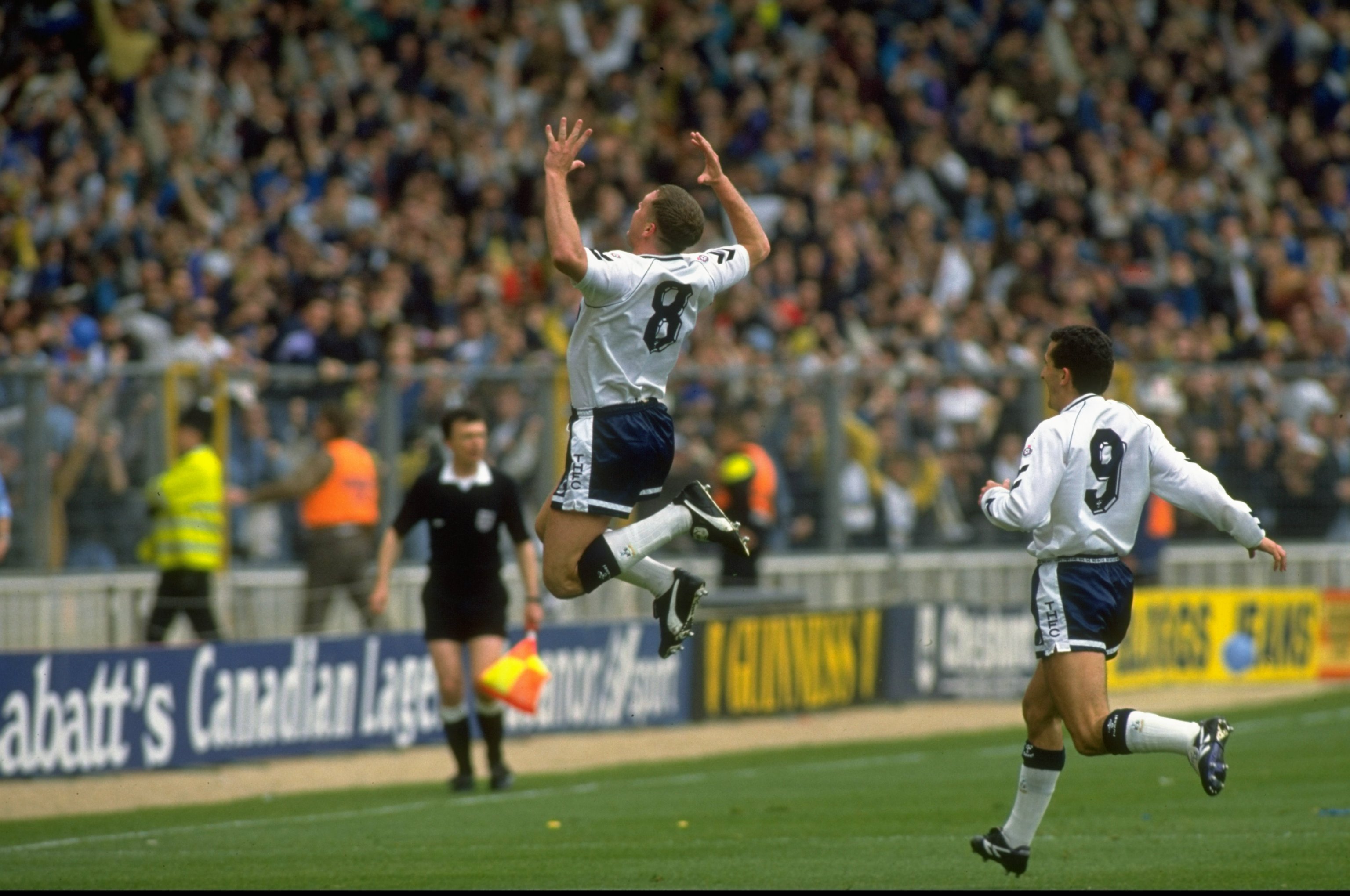 Gascoigne’s talent amazed even the harshest judges of all, his fellow professionals. During his first training game at Spurs, he picked up the ball, beat 8 players and smashed the ball into the roof of the net. Everyone stood and applauded. His manager said that to see him play like that made the hairs on the back of your neck stand up.
In the years that followed, he would come to inspire his team-mates to greater heights, but the effects took time to emerge. His much anticipated debut was delayed for a week as over-running building works at White Hart Lane caused the opening game against Coventry to be postponed, so his opener was away to Newcastle, a 2-2 draw. The home fans were less than enthusiastic about his return. He dodged flying Mars Bars whenever he approached the touchlines, a better day for local sweetshops than Gazza, perhaps.
Gascoigne received a much warmer welcome in his first home game against arch rivals Arsenal, without delay endearing himself to the crowd with a cheeky goal. Controlling a through ball from Waddle, he lost his boot as he entered the penalty area but still managed to round the keeper and score with his stockinged right foot. However, that match was lost 3-2 and Spurs struggled to find momentum. With two points deducted because of the Coventry postponement and only a single league victory, they were bottom in the first week of November. Gazza’s career was faring better, however. His individual performances were garnering rave reviews and he made his England debut in September, coming on as a substitute against Denmark.
His next goal, a curling free kick against QPR at the end of November, inspired a comeback, Spurs drawing 2-2 after being two down at half-time. This humble point signalled a gradual upswing in fortune. One defeat in December plus the two points restored saw Spurs end the month in the safety of 9th position. Gascoigne’s free kicks were fast becoming his trademark; another swirled into the top corner against Millwall. Any significant momentum dissipated early in the New Year on a muddy Bradford pitch as Spurs went out of the cup in the 3rd round. Another trademark, the roll of midriff fat, had by now disappeared and the young man’s eye-catching individual brilliance brightened months of mid-table mediocrity. Against Norwich in February he rounded the keeper to score the first in a 2-1 victory. March saw another free-kick fly over the wall to net another three points, followed by a solo effort away to Luton. Five wins in the last seven games propelled Spurs to a final position of 6th.
Paul Gascoigne began the 1989/90 season in fine form, matched by his goalscoring. His first came in late August away to Manchester City, followed by further 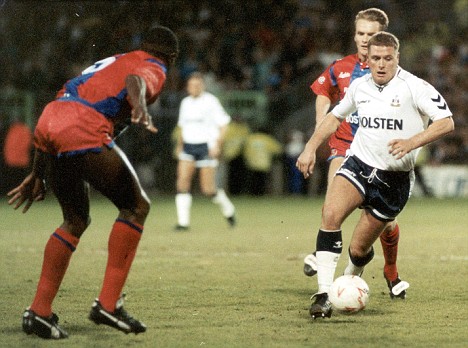 goals at home to Chelsea and a rebound off the post away to Norwich. The admiration earned by his growing contribution to Tottenham’s flowing football was not, however, matched by results. The defence was leaking too many goals and Spurs were one off the bottom after 6 matches, with just the opening day 2-1 success against Luton Town to show in the win column. In October Gascoigne scored in a strong 3-1 win at Charlton (his fourth goal in six league games), a characteristically direct, surging run carrying the ball from midfield, into the box, throw in two or three short strides for balance then stroked past the keeper. In similar fashion three weeks later he powered through the Southampton defence, this time finishing by taking the ball around goalkeeper Tim Flowers.
His League Cup goal against Tranmere at the end of the month proved to be his last until late April, but as the goals dried up his influence soared, for in the shape of Gary Lineker, signed in the close season from Barcelona, he now had a foil perfectly suited to exploiting his talents to the full. Not only was this supreme goal-poacher the grateful beneficiary of the full range of Gascoigne’s passing, Lineker’s movement created space for himself and for his team-mates. If he drifted wide, Paul could drive into the space. As defenders clustered around, Lineker then inserted himself into the resulting gaps. Often totally by-passing their colleagues, the understanding that lead to 26 league and cup goals for Lineker appeared remarkably prescient but the reality was more prosaic, based as it was on a system of signals. Lineker’s nod and short run towards the opponents’ goal was in fact a dummy and Gascoigne would knock the ball short, while a spinning finger gesture mimicked the striker’s spin away from his marker in pursuit of a longer ball into space behind the defence. No matter: 8 wins in the last 10 games, crowned by a memorable first half display against Manchester United when Gascoigne scored and made the other for Lineker, achieved a final league position of 3rd.
Given his head in Italia ’90, Gazza returned as the nation’s favourite son and he began the season in high spirits with a series of ebullient performances and goals to match. He scored in the opening day victory against Manchester City and against Derby he single-handedly won the game with a hat-trick, two of which were classic free kicks, from a virtually identical spot thirty yards out, differing only in that one went to Shilton’s left, the other to his right. Both were simply unstoppable, as, apparently, was Gascoigne himself, irrepressible and mesmerising in a series of dynamic displays. Hartlepool at home in the League Cup was hardly on a par with Germany, but he destroyed the visitors, scoring four in a 5-0 victory. In later rounds he notched the winner against Bradford and another versus Sheffield Utd as Spurs reached the 5th round of that competition.
After a barren spell he scored twice in December in two away defeats to Chelsea and Manchester City, his last in the League. As his powers waned, so did Tottenham’s fortunes. They fell away after a steady start, winning only two League matches in 1991 and limping home a disappointing 11th.
But his greatest impact, not merely in this season but in his Tottenham career, came in the FA Cup. After a solid away win at Blackpool in the third round, Gascoigne delivered two scintillating performances, scoring twice against Oxford, including a stunning individual effort, and again at Portsmouth in the next round, the winner coming from a long ball, a shimmy then an unstoppable left footer from the edge of the area. In round 5, at home to Notts County, he atoned for an early error with a memorable display that lifted the lifted the team, culminating in a late winner after it seemed that intense Spurs’ pressure would come to nothing.
This was Gascoigne at his finest, inspired to hitherto unknown heights by the magic of the Cup, but it is the unselfconscious energy, bravado and joy of his game that lingers in the memory. One reason perhaps why the fans loved him, because he would respond to their sense of occasion, not with trepidation but as the key to unlock his true, almost limitless potential.
Yet unbeknown to his adoring public, all the while he had been carrying a hernia injury. Injections could no longer postpone the inevitable operation. Tension mounted as Spurs approached the semi-final, no ordinary game even in their illustrious history, for this was the first such match against bitter rivals Arsenal and the first ever semi-final to take place at Wembley. Gascoigne struggled back, his only preparation was half a game in a league defeat away to Norwich; he was substituted. His fitness was confirmed only hours before kick-off but Paul, roused not deterred by such drama, did not hold back. An early free kick, thirty yards out, struck with sweet certainty into the top corner, improbable, miraculous, glorious, the fan behind this author still bitterly castigating Gascoigne for his ridiculous nerve to shoot from that distance even as the ball furled the net.
Gazza leapt in the air with unconfined joy. He set up Lineker for the second and played a full role in a 3-1 victory that many Spurs fans still prize as the most memorable performance of the modern era.
By the day of the Final against Nottingham Forest, the drama had been cranked to fever pitch. As ever at Tottenham, turbulence off the pitch proved the catalyst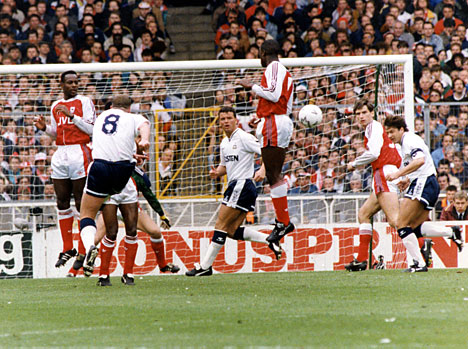 for the theatre that was to follow on it. Rescue from crippling debt was possible only by selling its prize asset. Gascoigne went into the game knowing that it was to be his last for the club, an £8.5m fee having been agreed with Lazio. He started frantically, but this time the burden of expectation proved too great. An utterly reckless early challenge on Garry Parker went unpunished but signalled danger ahead. Later the referee reflected that had he been booked then, he may have calmed down. As it was, a few minutes later another dangerous high lunge at the edge of the box left Gazza and full-back Gary Charles in a heap. After treatment, Paul rose gingerly to his feet, only to see Stuart Pearce score from the resulting free kick.
Lucky not to be sent off, Gascoigne departed instead on a stretcher, an ignominious end to his Tottenham career, although Spurs went on to a 2-1 triumph after extra time. His victorious team-mates joined him at his hospital bed for the celebrations. The resulting injury meant a year out of the game, with the transfer to Lazio eventually going ahead, for a reduced fee of £5.5m. Although he was relatively successful in Italy, where he remains extremely popular with the Lazio fans, he never quite regained the excellence of his best Tottenham performances. For Spurs fans of a certain generation, Paul is but one thing, a true great who graced their colours with moments of genius. It was an honour and a privilege to watch him play.
Add to: Facebook | Digg | Del.icio.us | Stumbleupon | Reddit | Blinklist | Twitter | Technorati | Furl | Newsvine

 TOTTENHAM ON MY MIND