Even my wife noticed. “See your lot are doing what the manager wanted then.” I watched Thursday’s Europa League victory against Sheriff from the comfort of my sofa but the sound of the crowd came through loud and clear. The noise was generated primarily by supporters sitting behind the Park Lane goal, the traditional Spurs ‘end’, who had bought tickets in a section allocated by the club for the 1882 movement, a loose grouping of mainly younger fans who want to bring back the atmosphere to White Hart Lane.
This time last week I wrote about the unease with which an increasing number of Spurs fans express their support for the club. The loyalty remains but the ground can be deadly quiet at times, there’s anxiety in the air and despite our league position and highly promising squad, there is a puzzling but tangible undercurrent of dissatisfaction about the direction the team is taking under Villas-Boas.
I suggested that while there’s no single reason for this (high prices, changing demographics, Sky TV and unrealistic, barely achievable expectations caused by the dominance of the Premier League and Champions League are all factors), many supporters have developed a growing sense of alienation in terms of their relationship with the club. They feel distant, cut off and undervalued. The feeling is by no means unique to Tottenham, indeed it is a worrying trend that is spreading throughout the Premier League. It’s not something that you can grasp easily or put a name to, but it’s around and therefore all too real.
This feeling hasn’t stopped life-long Spurs fan, season-ticket holder and author Martin Cloake from regularly attending games. He was curious about what he calls the “new ultras”, groups of fans at clubs in Britain, Europe and the States who encouraged fellow supporters to gather and sing. Unlike traditional supporters’ organisations they prefer to remain anonymous and keep officialdom at arms’ length.
These groups manifest their allegiance in different ways. For many european Ultras, violence and protest is never far from their vocal support, others like St Pauli have political elements while others focus on the team. The Spurs response is the 1882 initiative. My son and I were present at a tiny bit of Tottenham history, the first gathering at a Youth Cup match at Charlton. I was probably the oldest one there. It was organised by Spooky from Dear Mr Levy and, well, I wasn’t sure at the time. Find Flav Bateman and co-conspirators at Love The Shirt but at the time, I heard the call because it was just a great idea. Come and sing for the shirt. No other reason, get behind the team and where better than at a youth game where we don’t know the players but they are Tottenham so they are ours.
Martin makes 1882 his starting point for a riveting history of Spurs’ fan culture in the last thirty years. I’ve called 1882 a movement but it’s not really. It has organisers but no leaders. It has no manifesto or political ambition, other than to increase support for the team and enable fans to enjoy themselves in the process. It’s inclusive – you don’t have to be a member of anything, you just turn up. It isn’t po-faced – I didn’t take my shoes off to support the lads and I didn’t sit down if I loved Tottenham because it would play havoc with my knees, but that doesn’t matter. Sing your heart out for your lads.
Love the Shirt is clear about one thing: their starting point is the long and proud heritage of fan culture at Spurs. They see themselves as carrying on that tradition, spontaneous and anarchic in the past, it’s just that now because of the alienation, it needs a bit of work. One particular aspect of fan culture that is unique to Spurs is how this heritage has persisted despite fundamental attacks by the club. Sound of the Crowd takes you through the scurrilous, sordid tale of how Spurs tried to emasculate loyal and loud support.
When I began supporting Spurs in the mid-sixities, the vocal and mostly younger fans gathered behind the Park Lane goal with away fans at the Paxton and other home support in the Shelf. Spurs must be the only ground where home fans share an end with away support. That’s bad enough but imagine turning up one season to find you’ve been turfed out of your end, your place without any warning. Yet this has happened not once but twice at Spurs. First, away fans were moved exclusively into the Park Lane, then in the mid eighties, the ultimate indignity or in my view betrayal when one close season executive boxes replaced the Shelf, the home of the most loyal and most vocal.
In Martin’s hands, this sorry saga becomes the tautest of thrillers, heroic resistance in the face of mendacity, intrigue and conspiracy. It’s essential reading for anyone interested in our history and the relationship between the business of football and supporters. The revurberations of that period rumble on. The atmosphere has never been the same but more than that, it opened wide that distance between club and fans that has never been closed. Football is about a sense of belonging and place: our fans have nowhere to go.
The supporters are happy, there’s an atmosphere at the Lane and the manager has a response to something he identified as a major impediment to the team’s continued success. Spurs reach the League Cup quarter finals and the knock-out stages of the Europa League. You would think there’s a message there somewhere.
So this is what the club do next. The West Ham game is category C and there’s no 1882 block. Big game, intense rivalry, the manager wants the fans to get behind the team, yet no discounts, no singing section, both dropped because THFC can make a sweet profit from a full house derby.
Stoke was due to take place on the Saturday after Christmas, 3 pm kick-off. Yesterday the club announced that it had been moved to Sunday, 4pm. No reason has been given and it’s not on Sky. Many fans make their Christmas arrangements around the fixtures. Even I for once, a bah-humbug bloody Christmas man if ever there was one, have organised things in advance. If I am to attend this match, and for the first time in a long time it has become an ‘if’, 12 people close to me will have to shift their diaries around too.
A twitter pal of mine, big Spurs fan, used to blog, goes mostly to aways as he lives in the West Country, young family so short of cash, planned a real treat for himself to be at this game. Now he can’t make it. He can get a refund on his match ticket but not his advance rail fare. He can’t be the only one. He’s disgusted and so am I.
Clubs should make a profit. These days with vast television and commercial revenue they can do so without it being at the expense of the supporters. If you’re puzzled as to what alienation is, it’s probably the feeling you get when you read the three paragraphs above. Things must change, not for my sake – I’ll be there til I die then scatter my ashes under the feet of the crowd after the match – but for future generations.
It’s not all bad. There is a once in a lifetime opportunity with the new ground to create an end and keep some prices reasonable. 1882 and the Trust are doing some fine work. The club must welcome not reject them. 1882 isn’t a separate movement, it’s us, you and me. It is inspired by our past and we are the future.
Sound of the Crowd by Martin Cloake is available on kindle from Amazon and on other formats from Martin’s website. Only £3.08 probably the biggest bargain on the net
 Martin Cloake wryly describes as the best thing he ever did for the club. It keeps two key elements of the style too, the liberal use of photos and incorporating quotes and headlines from the following morning’s backpages, which gives a sense of time and place. As Martin says, until comparatively recently fans relied on the papers for an account of the match because there was no other way of finding out what happened. Even the radio was confined to the bigger ties.
 writing is easy on the eye and draws you in. This is no dull history textbook. Rather, Julie is a storyteller, engaging and curious. She communicates her passion without allowing her voice to intrude or detract from the telling of the tale. It’s a measure of her skill and dexterity that she makes the journey from Tottenham Hale through the industrial landscape that covers the old marshes to our first pitch sound enthralling. And she’s not averse to the occasional gratuitous dig at our rivals: after all, she is a lifelong fan.
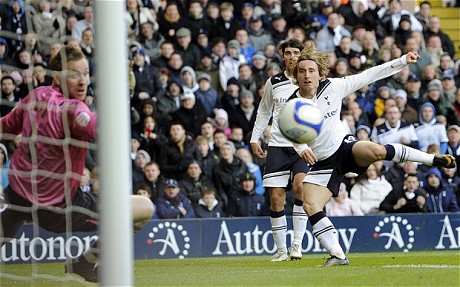 away. Pass and move. The Tottenham way. This was his home. Many looked his way, we made eye contact and began a 4 year love affair that sadly ended as all affairs do but the ecstatic pleasure will last until I’m old and grey.
 TOTTENHAM ON MY MIND