If Spurs Were United, We’d Never Be Defeated

Tribalism is the essence of being a football fan. United in support of our obscure object of desire, Tottenham Hotspur Football Club, we pledge everlasting love and set aside other relationships in preference to the one that truly matters. We have our colours, our temple of worship, our rituals. At games or out and about, I strike up conversations with perfect strangers because  they are navy blue and white. The Lane, just before kick-off, I shake hands with people I see more frequently than I do most of my friends and relatives, people with whom I feel a deep common bond in a place where I am more at home than anywhere else on earth. I don’t know their surnames, where they live, what they do or think, anything of any significance, yet none of this matters, because we are Spurs.

Scratch the surface, however, and deep fissures shatter this fragile unity. At least, that’s the conclusion I’ve reached after reflecting on how this blog has dealt with some of the major issues that face the club. Two topics have produced more comments than any other articles that I’ve written over the past couple of years, namely Stratford and the Madrid tickets.  Not necessarily more views than other pieces, in fact ironically my most read article is an innocuous match report on this season’s away game at Everton that was picked up by Everton sites and messageboards, Surprised and pleased at my even-handed approach, they extended fraternal greetings as fellow football supporters and wished us good luck in Europe.  It’s the reaction that has been markedly different, revealing deep divisions not just on the topic itself but, significantly, on the very nature of being a Spurs fan.

There are several pieces on Stratford; the comments sections on a couple are not for the fainthearted. The single biggest issue to face Spurs since the club was in deep financial distress under Scholar was bound to provoke a meaty debate. Last week I offered some constructive criticism of the ticket office’s appalling treatment of fans trying to buy Madrid tickets but the fascinating comments section, which as a regular correspondent noted somewhat disconcertingly for an author was as good as the article, revealed distinct differences of opinion about the solutions.

To be very clear – keep the comments coming. I read them all, often respond and don’t censor or delete them. If you take the time and trouble to not only read the blog but also comment, I’m genuinely grateful. Interaction is what blogging and the internet is all about.  This piece is not about who is right and wrong. Perhaps I was being naive but the ferocity with which some people got stuck into to fellow Spurs fans did take me by surprise.  With the OS, for example, I’m anti-Stratford but understood the concerns of people who see it as the way forward. The fairest way of distributing tickets for big games is via the loyalty points system, not perfect but the least worst. However, several people rightly pointed out that if they have a membership, they are just as entitled to go for the tickets as anyone else. In fact, a wider distribution encourages a broader based support.

In the end, we’re all Spurs, right? Wrong apparently. As the debates raged, the nature of a being a fan came into dispute. Are people who have been attending games for many years more a fan than others who come once or twice a season? Younger fans in this equation will always be at a disadvantage because of their date of birth. Family circumstances and money prevent an increasing number of supporters from coming to see the club they love. When I was in this position for a few years, I remember listening on the radio to a home game when we were near the bottom of the table and physically being in contortions of agony until victory. Would I have been more of a fan if I had been at the ground? Yet who can deny the phenomenal dedication of  those who give up their time and money to follow them around the country. Some tried to find the coefficient between the two. With Stratford, both sides saw themselves as defending the club’s future, both with very different views as to how this might be achieved.

To repeat myself, I’m not talking here about who is right or wrong about Stratford or ticket distribution: I’ve written about that elsewhere, feel free to comment. Rather, I’m taking this as evidence of divisions within Spurs fans that are exposed whenever problems arise. I’d say that the one thing we agree about is that we get behind the team, but the fact is, there’s disagreement there too, the two extremes being those who cheer on regardless and those who feel justified in complaining openly by booing or abusing our own team and/or players. Most of the time it’s a comforting and humbling experience to be part of the worldwide Spurs community. Sometimes, that comfort is an illusion.

Ironic that I’d been mulling this over in a week when a 4% rise in season tickets has been announced. I’ll pay of course, and Daniel Levy knows I will. More importantly, he knows that if I don’t then someone else will. For the record, my ticket has gone up by over 6%. Increased operating costs are the reason, apparently. I work for a charity. We have cut our costs as much as we dare because of the current climate, but Spurs are seemingly immune from the pressures we all face because the law of supply and demand has come down heavily in their favour. Increased revenue from Europe and TV ( did I see an increase of over 40% mentioned?) has not been reflected in concessions to the fans. There’s no moral imperative to consider the loyal fans – but again, I’m being naive. Levy knows we are divided. I’m reminded of the industrial disputes of the 70s and 80s. Two factors overruled everything else – the unity of the workforce and how real was the possibility of a strike. Levy knows our weaknesses and will exploit them.

League Leaders Spurs in Ticket Office Farce

Ten days ago the Football Supporters Federation, the country’s largest representative organisation for football fans, published the results of a nationwide survey of club charters, documents that set out standards of customer service. Clubs were graded according to a number of criteria, including accessibility, timeliness, quality, complaints procedure and contact details. Sitting proudly on top of the table are the mighty Tottenham Hotspur, scoring an impressive 31 points out of a possible 35 and fully 8 points clear of our nearest rivals, Arsenal. Where’s your St Totteringham’s Day now, huh?

Try telling that to anyone who went for Real Madrid tickets yesterday morning. The charter is on the web, if you have the time and inclination to work out where anything is on that messy and counter-intuitive  official site. It’s glossy, carefully constructed in well-modulated, easy to read language and about as useful as Aaron Lennon in the air, because in reality Spurs treat fans with withering contempt.

Madrid was always going to be busy and frustrating because demand massively outweighs supply. The boards and sites were bulging with tales of joy and despair as the infamous online site maroon bar tantalisingly stuttered from left to right along the screen. As ever the abundant ingenuity of fans reached new heights of creativity. Entire offices mobilised online and on the phone in pursuit of a single ticket. Different, non-premium rate telephone numbers. One person I know queued for 12 hours at the ticket to be successful.

We all understand this. Until we have a bigger stadium, sadly many fans will be disappointed for the big games. However, what truly infuriates is the manner in which the club handles these moments. The disappointment is bearable, a sense of being kept in the dark and of the club not caring is not, especially when some problems are entirely avoidable.

Yesterday I logged on to the system at 12.10 on behalf of my son who wanted to register for a Chelsea away ticket – applications closed at 5pm and he wasn’t near a computer. On the home page of the official site there was no direct link to Madrid home tickets. Plenty of knockabout hilarious banter between JD and Bale over today’s international or the breaking news -hold tight to something solid – that Crouch was looking forward to that game. Nothing about the single most important thing that any fan wants to know about their club – match tickets.

I went onto the online ticket section to be greeted with the usual message about waiting a queue, don’t refresh you putz or you’ll lose your place. Nothing happened. About 20 minutes later a sliver of maroon appeared which steadfastly refused to budge for another half an hour. By 1.20 I was about an eighth of the way along, an hour later not much further.

This could only be due to one thing – people still believed they were in with a chance of Madrid tickets. Yet a messageboard post at 10.53 stated tickets had sold out. On the ‘forthcoming matches’ page Madrid was listed as sold out but you would not access this page if you clicked on ‘buy tickets’ and were taken straight into the system. Just after 2 I had another go on a different browser. This time, a message came up saying the tickets had gone but people who logged on hours earlier had no way of knowing this – “don’t refresh” and still nothing on the home page of the main site.

About 2.30 I suddenly shot across to 75%, then was unceremoniously booted off just gone 3. My son called the box office who confirmed my suspicions – so many supporters had by this time been left hanging in the wind for at least 4 hours since tickets had ceased to be available. The club said they were intending to clear the system and start again.

This doesn’t affect me personally as I’m fortunate enough to have a season ticket. My original standing season ticket lapsed in the late 80s when my children were young and family life was busy. As they grew older, we started going regularly to matches and bought season tickets in 1999 (no waiting list back then) because of the increasing problems of getting members tickets for important matches. Even if we couldn’t go to every game, it was still worth it. Yet yesterday makes my blood boil because better communication and a better system could have prevented the frustration and anguish of my fellow fans. It’s made all the more insulting because of the mealy mouthed empty platitudes of the Charter written by club mandarins who keep themselves as far away from the unwashed public as they possibly can. Here’s a bloody charter for you from this fan.

Tell people what’s going on. We are old enough and ugly enough to handle bad news. What we don’t like is being the mushrooms under the crap, kept in the dark. Have clear, updated ticket information on the club home page. If I could do that in 30 seconds on my pony blog, then that’s easy for you too. Use the £3.70 admin fee you charged for the costs of the electric pulse that uploaded my ticket purchase onto my season ticket card, there’s probably about £3.699999 left over.

If tickets have sold out, clear the system and replace it with an up to date message. If the start time for tickets is 9.30, don’t allow people on the system before then, thus avoiding the myths circulating about when you can and can’t log on in the mornings.

The loyalty points system is not perfect but it’s the best we have and by far the fairest way of selling tickets. Use it for games like this. Publicise a number in advance, you can’t apply for a ticket unless you have, say, 200 points. Once you meet that threshold, it’s first come first served. Not perfect as I say, but better that what happens now.

I know nothing about the logistics of ticketing but these measures are straightforward. Perish the thought that any of this might cost the club money…

In my experience the individuals at the club ticket office, including the manager, are very helpful. When Paul Barber was at the club, he used to reply to genuine concerns and enquiries personally, via his Blackberry sometimes. The current system is better than in the old days. My first game at Spurs was against Sheffield United in 1967. As it was the final home game before the Cup Final, ballot cards were distributed at the turnstiles, so I could have obtained a Final ticket on the basis of attending precisely a single game. However, the system could so easily be improved. As for the Charter, not worth the glossy paper it’s written on and the FSF, noble though they are, would be better off surveying the actual experiences of fans with clubs who depend to a large extend on taking our money. About time they put some effort into treating us better.


John White: The Ghost of White Hart Lane by Rob White and Julie Welch

On my daughter’s mantelpiece sits a photo of her son, then aged about 3, walking along the beach with his father. Taken from behind, they are unaware of the camera’s presence. Their stance and gait are identical. Size and stature come from shared genes, the rest, the bit that matters, just happens.

For Rob White, denied the chance to bond with a father he never knew, there’s a gaping hole where that bit that matters should be. The story of his dad, John White, the former Spurs and Scotland international who rose from working class poverty to become one of the most distinctive players of his generation before dying in a tragic accident, is dramatic and fascinating in itself. Yet this is no ordinary biography. His story is interwoven with Rob’s search not just for his father’s ghost but for his own identity.

Rob was born a few months before White was fatally struck by lightning, sheltering alone under a tree on a golfcourse during a thunderstorm. White was in his prime: 26

The Ghost of White Hart Lane

years old, a Double and Cup Winners Cup behind him, the man around whom the incomparable Bill Nicholson intended to rebuild the ageing Tottenham team.

The touchstone for Rob’s quest is a dusty box tucked away at the back of the loft. As a boy, he scrapes off the dirt and prepares himself for the wonders within, like an archaeologist about to enter a hitherto unknown Egyptian pyramid. Inside, he sifts through the cuttings and medals, tries on his father’s tiny boots, size six and a half. Tries to conjure up his father’s spirit.

The search continues into adulthood. There’s no shortage of material as White was well liked and respected by his fellow professionals. Much is made of the camaraderie and team spirit of the Double side and he is still deeply mourned by those who knew him in the game. His close friends Cliff Jones and Dave Mackay in particular remain bewildered by his absence.

Little wonder White was so popular. On the field, not only was he supremely talented, a superb passer of the ball with excellent control, he was also tireless and unstinting in his work on behalf of the team. From boyhood backstreet kickabouts to the great stadiums of Europe, you underestimated him at your peril. This small man had the heart of a lion and lungs to match, with a phenomenal workrate. He made himself constantly available for his teammates for Spurs and Scotland, ready to pick up a pass and move it on. To his opponents, they simply could not get near him. He appeared and was gone again in the blink of an eye, hence the nickname the ‘Ghost’.

Despite Welch’s meticulous research and consummate storytelling, there’s a sense of never quite defining the man. Contradictions appear. Diffident in company, he was also an inveterate joker and confident in his ability. This little boy lost in the Spurs dressing room when he came to London from Falkirk in 1959 could easily delight crowds of 65,000 at the Lane, 160,000 at Hampden Park, yet each winter, after Christmas, his mood and form dipped until the spring.

This may be because White, a loving father and husband and good friend to many, always held something back, a reserve shaped perhaps by self-protection at the loss of his own father at a young age and of a series of rejections in his formative years because people were unable to see beyond his small stature. However, his childhood in a caring extended family dominated by matriarchal figures instilled a powerful determination, epitomised by a ferocious desire for supreme fitness. He played football all the time, in the back yards and on the green, challenging his brothers, both of whom good good enough to play professionally, to races and keepie-uppys, delighting in the fact that he beat them every single time.


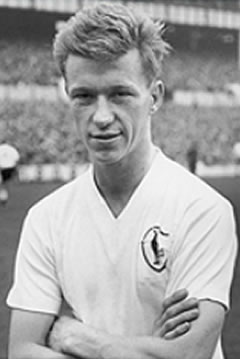
John White - Spurs and Scotland

Along the way there are solid gold nuggets of Spurs history. The Double, John’s rise to prominence and his growing influence is well chronicled and there’s a touching piece on Tommy Harmer, whose talent deserved more but who peaked in the mid 50s, between the great Tottenham teams of Push and Run and the Double. Blanchflower’s status and role in the club is perceptively defined, as is his decline, memorably instanced by the image of White steaming past him on a pre-season training run.

As with other biographies from this era, there are frequent reminders of how much the game has changed. White played for Spurs on a weekend pass from the army as he had to complete his National Service. The players lived up the road from ground. When sacked as manager to make way for Nicholson, Jimmy Adamson had been at the club for 51 unbroken years. White’s transfer was facilitated by a Scottish journalist, Jim Rodger, who took no fee – all he wanted was the scoop.

However, in other ways, at Tottenham nothing alters – Blanchflower, arguably the most influential midfielder in our post-war history, dropped for not fulfilling his defensive duties. The team criticised post-double because they were ‘only’ third or fourth.

Admirably the book leaves the reader in no doubt as to White’s ability. The only modern comparison is made, surprisingly perhaps, not with a midfielder but with Dimitar Berbatov, who like White has a picture of the game in his head and can anticipate several passes ahead. In my mind’s eye, the similarity with Luka Modric is inescapable, both small but tough, tireless with superb touch and almost prescient vision.

All this information and more unfolds for Rob as he grows up. The most poignant passages concern his search for connections with his father as a child. He watches the few snatches of film available of John in action, then convinces himself he runs in the same way as he studies his refection in shop windows. Mackay takes him under his wing. He’s allowed on the team coach, into the dressing room, not just to hear about White’s exploits but to experience the smells and sounds of the dressing room, the pre-match tension rising as kick-off approaches, the evocative clatter of studs on concrete as the players run out.

It’s comforting for a child to have so much information about a lost father. However, this is tempered with unease and frustration as the man eludes his grasp, walking beside him through his life yet when he reaches out to touch his presence, there’s nothing there, a ghost.

Rob is still searching into adulthood. He hears the stories, even sees a medium. His family are there for him, yet adulthood brings initiation into family secrets. Far from offering resolution, there is deeper mystery in the news of a half-brother from a fleeting teenage army relationship.

My first Tottenham game was in 1967 so I never had the privilege of seeing White play. Talk to fans from the Double era, they laud the greats, Mackay, Blanchflower, Smith up front, then invariably turn to the best footballer of them all, ‘John White, now there was a player’, and with a gentle shake of the head, tail off into wistful silence. The least known of this team, the book is a fitting tribute to his supreme talent and should bring him the recognition he deserves.

You find the man, however, in Rob White’s disarmingly open and honest search for his identity. His loss is laid bare as he works through familiar grieving patterns. Anger at what he can’t have. He can’t know his father, turn to him for advice or, as an adult, give a him a Christmas present. Seeking information, from people who knew his dad, family, press cuttings. Agonising over the might-have-beens and if-onlys. On the day of his death, if Jones or Jimmy Robertson had accepted his invitation in the dressing room after training to play golf, if Jones had run back with his trousers that he accidentally picked up, thus delaying him for precious moments…

This excellent book succeeds in being both a fascinating portrayal of a fine footballer and a profound, touching insight into how our origins shape our sense of self, of interest to all fans whether they support Spurs or not.

Rob’s a season ticket holder in the Park Lane now. I hope he enjoys the game and the club still. One wonders if, perhaps in the intensity of European games under lights in this venerable old ground, he catches a glimpse in the corner of his eye of the spirit of a true Tottenham great, his father. For me, there’s only one more thing to say about this book: having read it, I ache to see John White play.

The Ghost of White Hart Lane by Rob White and Julie Welch      Yellow Jersey Press

Hutton Causes The End of the Universe

Spurs deserved to win that one. Under pressure, fought back, superb goals, better team in the second half, almost held out.

Wolves deserved to win that one. Never let up, better team in the first half, probably overall, inconceivable how Hutton stayed on the pitch after the ref gave a penalty.

We should have taken it: hit the post, missed chances, Bale unstoppable when he came on.

Wolves got what they deserved, less maybe, kept making chances, no way Gomes was fouled for the disallowed goal, he threw it into his own net for chrissakes!

Oh I don’t know. You tell me. Reality is, that’s all true, every contradictory word. Wolves played exceptionally well but we had more than enough chances to bury the match, after two poor match-turning decisions went in our favour. But I’m starting again.

Two things are incontrovertible. One, it was an outstanding game, swinging this way and that throughout, drama, stunning goals and the outcome uncertain until the final whistle. Shame I couldn’t enjoy it then. This is because of the second point: our defending was abysmal. I have to admit, I like the idea of the football public characterising Spurs as the entertainers, the team to watch if you are a neutral. When we’re on Sky, I bet people make an effort to watch because one thing’s for sure, it won’t be dull. One reason for that is never mind the skill and verve of our attack, we’ve given up the art of defence in favour of some fifties throwback formation. Future matches will be covered in jerky-framed black and white, the players’ legs whizzing along and the fans throwing their flat caps into the air at every opportunity. Pass the rattle and thermos, mother, I’m off to the Spurs.

Pav Turns Away After Scoring. In My Head.

Wolves pulled them this way and that. Late in the game, chasing a precious win, first Gallas then Dawson were 70 yards from their own goal as willing opponents galloped into the wide open spaces behind them. The full backs were so far from the centrebacks, they were communicating by walkie talkie. Gomes made a couple of fine saves, one full-length tip round the post for a bouncing ball a potential match saver. Crosses were a different matter. He always looked shaky and under pressure chucked one into the goal, only for Halsey to be swayed by his pleading desperation. Whose heart does not melt at that innocent, pleading little-boy lost expression? Perhaps that’s what he works on in training, rather than catching the ball.

Harry’s renowned powers of man-management were on display again. Slaughter Hutton, let him know you don’t rate him and he’s off in the summer, then bring him back into the team and all is forgiven. Or maybe, just maybe, consider the possibility that shorn of all confidence it might affect the way he plays…  Hutton duly produced a performance of uniform awfulness that by the end was remarkable in its consistency. It’s not easy to get so much wrong for 90 minutes. Perhaps he was making up for the fact that he clearly should have been sent off for the foul that conceded the penalty. On that occasion, he was guilty of letting the man inside him. We’re all entitled to a mistake but not to repeat it, which he did for the entire game. Their runners come into the gaps in the back four. If the full back can see a man, he’s got to come across, surely. Hutton stood and gazed on, steadfastly marking space. To be fair to Harry, other players in Hutton’s situation have found the motivation when they have come back into the team through injury, whereas the Scot appeared disinterested. Unforgivable.

Amidst the joy of the Milan game, I soberly noted that the Corluka injury was highly significant. He’d come back into the team and we looked all the better for it, defending better and the Lennon/ Charlie link on the right was back in the groove. We’re really missing him. The same can be said for Kaboul, who not have given Wolves an easy ride.

Benny was better but still too far wide and in trying to retain possession gave it away too often with some poor decision-making. Gallas chose to have his worst performance for some time, uncertain and off the pace for the most part. However, it’s time to bore regular readers with my well-worn observations about defending as a team. in the first half, Sandro and Jenas didn’t pick up those loose balls at the edge of the area or do much to break up Wolves’ play in the midfield. The fact that they markedly improved in the second period only served to highlight our major weakness on the day. Wolves were more than willing to go wide because they had the freedom to bang in a series of crosses, which caused no end of trouble. They were beautifully judged and we were unable to handle them. Doyle unchallenged in the midst of our box for the first, the equaliser a classic far post header that I thought was down to good play on their part than poor defending. The player knocked it a yard to his right, out of Sandro’s tackling range, and delivered a perfect ball.

Our Defence Moments Before the Universe Implodes. I May Have Got That Wrong

Fact is, we did nothing throughout the game to stop that flow at source. Both our wide men have instincts that drive them inside. Pienaar was invisible, while Luka had a better second half. Neither prevented the flow of crosses that was our undoing. Later that evening, shattered, I dozed in front of the box. Brian Cox’s soft tones were taking me through the ultimate demise of the universe. As he spoke of the very atoms of the cosmos slowly becoming an eternal infinite nothingness, I dreamed he’d covered our defence on MOTD 2.

The amazing thing is, well though Wolves exploited our frailty, we could have easily won the match if we hadn’t determined to avoid all goals that were not possible Goal of the Month candidates. JD and Pav queued up for twenty yard thunderbolts, although that’s doing Defoe’s second an injustice, because that was a top class finish. Luka and others had been studying L’arse and were determined to have 25 touches in the box before even onsidering a shot. What a waste. All the talk of JD| breaking his duck and then the floodgates will open, the same can be said for Luka lately. He badly needs one to go in to encourage him to shoot more often.

Full credit to Defoe for a fine performance. He and Pav combined well – one went wide whilst  the other  stayed in the centre. Sometimes off-form strikers work too hard for the team in an effort to make up for the lack of goals. This is counterintuitive: they are selfish beasts at heart. Defoe is so much a confidence player – this should do him good. The same can be said for Pav – neither have technique to be relied upon and again his control let him down at important moments but he did better than in previous matches.

We looked so much more comfortable once Lennon and Bale were on, even though oddly they swapped wings. Bale was on to help out Hutton, a good call from Harry, and to introduce the element of surprise. We didn’t need reminding how much we’ve missed him, but what a threat he is. Sandro and Jenas could potentially offer so much, particularly mobility and drive in midfield. JJ overstretched himself at times in the pursuit of possession. He did well but neglected his defensive duties. I would like to have seen him nestling close to the back four. Sandro  had a decent second half, more willing to come back into

Rest In Peace Dean Richards

the box to take decisive action. Both should not have needed the presumably harsh reminders from Harry to get going. From the first whistle next time. We had similar problems at Blackpool, though with different personeall. We looked a very different prospect there  after half time – I fear this is becoming a problem.


In an era when football and footballers are heavily criticised, the assured dignity with which Dean Richards’ memory was celebrated will live longer than the match itself. Thanks go to Wolves for organising this with such care and respect, and to fans of both sides who raised the rafters. My thoughts are with his family.